Meeting & Public Record Transcription

Public Meeting TranscriptionReady for the Next 
Records Request

Verbatim, searchable transcripts of council, board, and commission meetings. Built to your format, ready for your archive, your website, and the next records request.
You get more than a completed transcript. You get a team you can reach.
Sample transcript
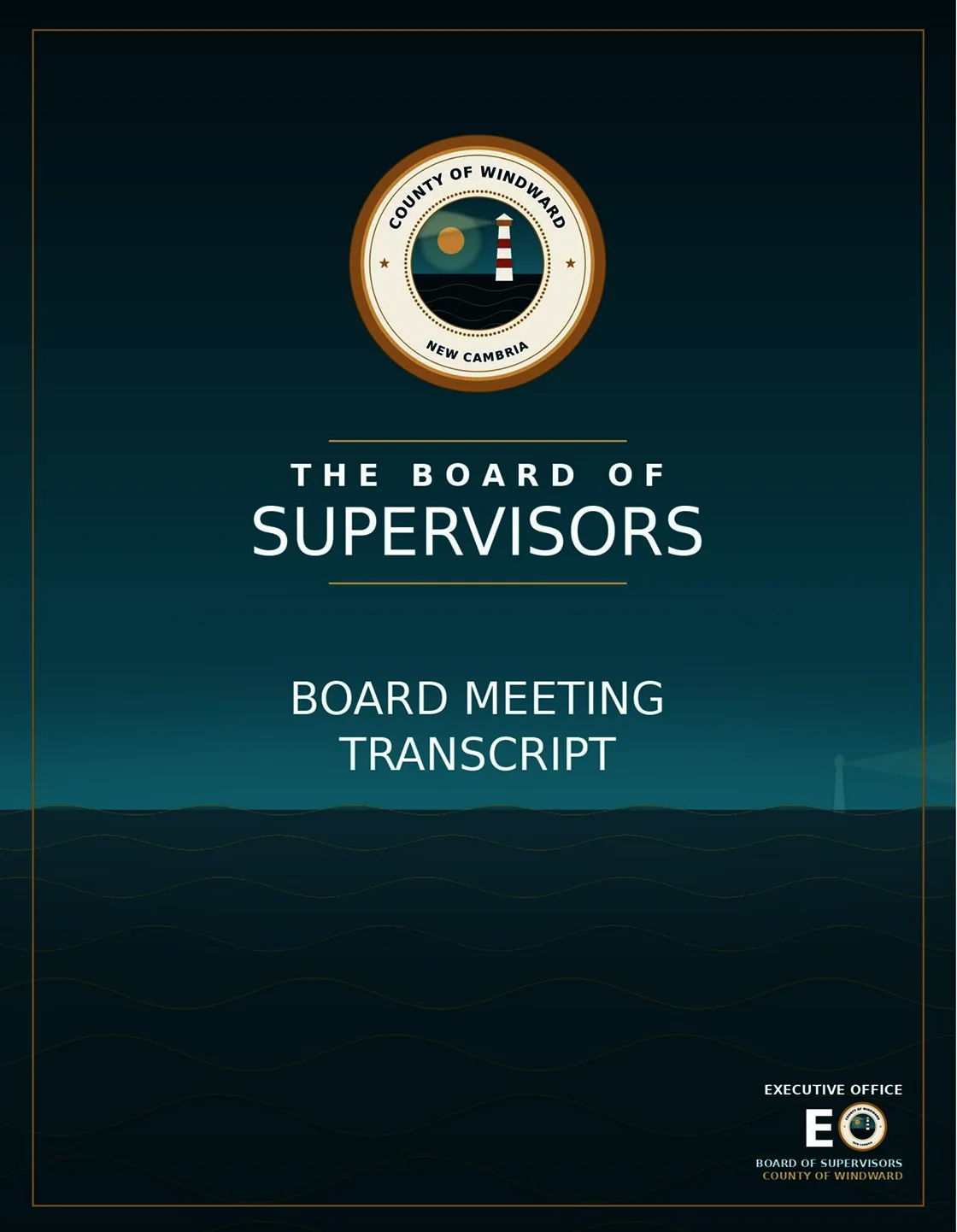
Sample transcript title page for a fictional county board of supervisors meeting, showing the county seal and the words Board Meeting Transcript.
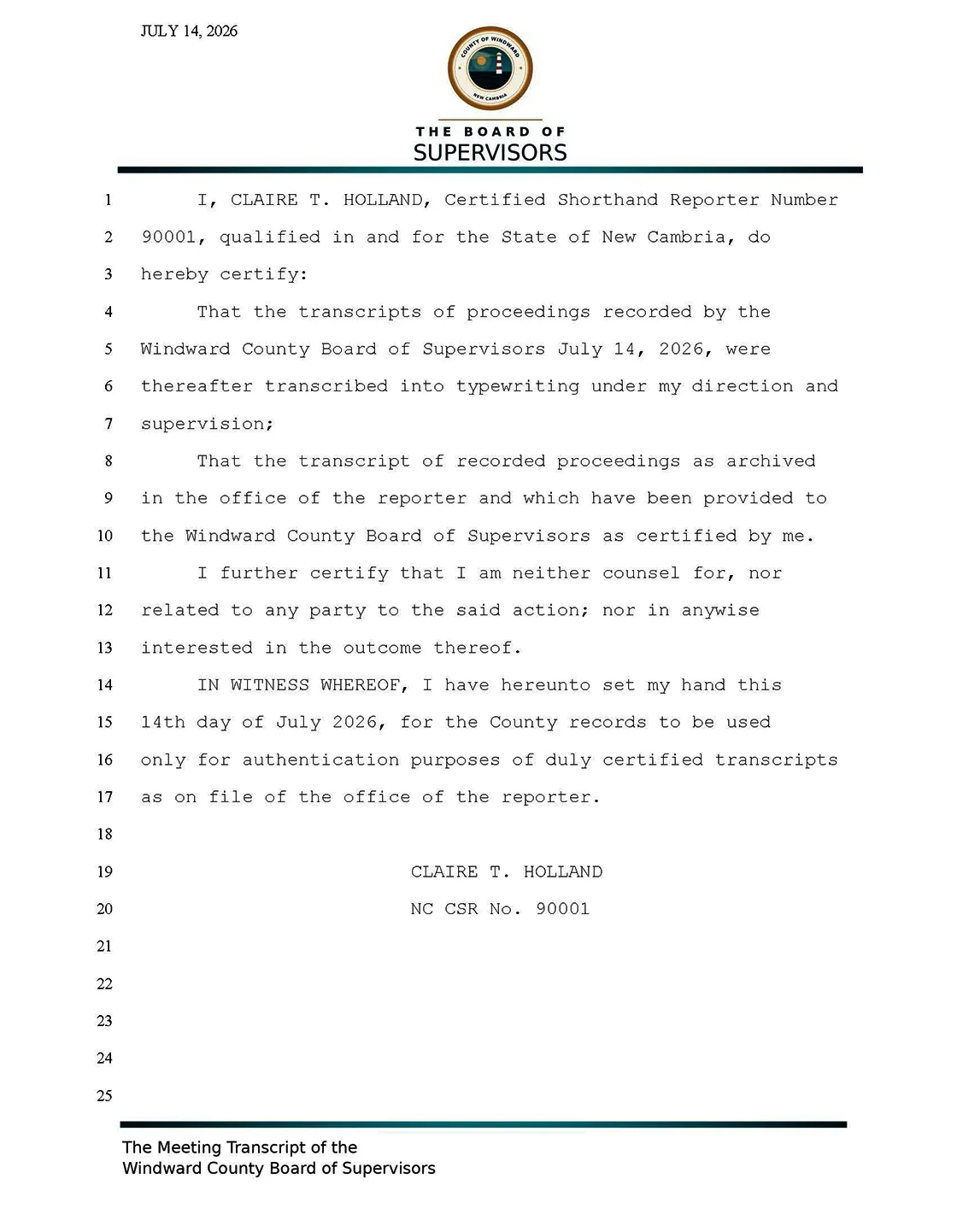
Sample transcript certification page signed by a Certified Shorthand Reporter, with 25 numbered lines, from a fictional county board of supervisors meeting.
Certification page attached
US-based transcribers and US data centers
100% verbatim
Built to your template
Expedited turnaround available
The full record

When the minutes aren’t enough

Minutes are a summary, and most of the time they are the right tool. They record the motion, the second, and the vote.

A transcript records everything else. What the fourth council member said before she changed her vote. What the eleven residents said during public comment. The exact wording of the condition that got added to the permit at 11:40 at night. When any of that comes back, and it often does, a summary won’t answer the question.
What a transcript adds
Minutes summarize what a body decided. A transcript records what everyone said.
Line numbered at 25 lines per page
Speakers identified
Lines numbered
Searchable across every meeting
Faster responses

When a records request lands on your desk

Without a transcript

Someone asks for everything said about a project at the March meeting. Without a transcript, that’s a staff member scrubbing through six hours of video with a notepad, and a response that takes days.

With a transcript

With a transcript, it's a search. Find the term, pull the pages, send the response. The same search works across every meeting you have ever had transcribed.

Speakers and languages

Public comment is the hardest part to get right

You've got twenty people at the podium with only some of them giving their names. Some say a name the clerk has never seen spelled out. Someone reads a street address into the record. Someone speaks in Spanish. Someone speaks over the chair. You get the picture. We do not guess.

Speakers are labeled by a consistent convention, or yours if you have one.
Names we cannot verify are flagged rather than invented.
Comment in another language can be transcribed in the original, translated, or both.
Anything genuinely inaudible is marked as inaudible, with a note telling your clerk exactly where.
You should be able to hand the transcript to the person who spoke and have them recognize what they said.
Past meetings

What about your archive?

Most agencies have years of video with no text to go with it. Without accompanying text, that archive can be difficult for staff and the public to search and use efficiently.

We work through backlogs as readily as we take new meetings. Send us the meetings you already have and we will work through them on a schedule and a budget that fits your fiscal year, so your archive becomes something staff and the public can search.
Where to start
A practical place to start is with the meetings that generate the most records requests and work outward from there.
who we serve

For councils, boards, commissions, and districts

Cities and city councils
Council meetings, study sessions, and special meetings on a standing schedule.
Counties and boards of supervisors
Full board days running hundreds of pages, delivered as one clean transcript.
Planning and zoning commissions
Hearings where the testimony matters as much as the vote, and where the record often gets appealed.
School boards and districts
Board meetings and public comment, transcribed for review, records requests, and the public archive.
Special districts and joint powers authorities
Water, transit, air quality, and other boards with a public record obligation and a small staff.
PEG and government channels
Stations already broadcasting the meeting, adding a searchable text record to the archive.
YOUR TIMELINE

A record that keeps up with your meeting calendar

We scope turnaround to your meeting calendar, volume, and format, then give you a delivery date we can commit to.
Same-day
24-hour
Expedited
Standard schedule

Same-day meeting transcripts, 24-hour turnaround, expedited delivery ahead of a packet deadline, or a standing schedule you can plan the year around

Send us your meeting calendar and the format you need, and we'll come back with a delivery commitment in writing. Build it once and you stop thinking about it.
Tell us what your meetings need and we will confirm the schedule in writing.
The process

How it works

1

Send us the recording through our secure transfer site, along with the agenda and any prep material you have.

2

Our transcription technology creates the first draft, then trained transcribers correct and format it.

 
3

It is formatted to your standard, with time-coding if you need it.

4

Our team runs a final quality check.

5

You receive the final verbatim record, certified if you need it, and we delete the source files on a documented timeline.

Prep material makes a real difference. The agenda, a roster of members and staff with correct titles, speaker cards from public comment, and the spelling of project names, street names, and consultants all go straight into the first draft instead of being reconstructed from audio. If your video shows name plates or lower thirds, send the video rather than the audio.
Deliverables

Formats and delivery

One meeting, delivered the way each part of your organization needs it. Deliverables can include.

Word document, in your template and branding, line numbered
Text-searchable PDF for the archive and the public website
Time-coded plain text for your agenda or video management system, so viewers can jump to the moment an item was discussed
Plain text for a fast read
Certification page when requested, including certification by a Certified Shorthand Reporter (CSR) or Certified Electronic Transcriber (CET) where your policy calls for it
Additional certified copies
Recordings come to us through a secure transfer site, not email, and transcripts go back the same way.
Differentiators

Why Aberdeen

We already do this every month.
Recurring board and council meetings, captioned live and transcribed on a standing schedule, for agencies and the production partners who serve them.
Your format, not ours.
Your seal, your line numbering, your speaker convention, your page setup. Send us a transcript you already like and we will match it. Switching vendors should not mean your archive changes shape halfway through.
100% verbatim.
Word for word on every final transcript. If it was said on the record, it is in the transcript.
100% human when you need it.
If your policy or contract requires that no AI touches the file, we can run a fully human workflow from the start.
Your clerk will know us by name
Call during business hours and a human answers. Start a chat on our site and you will get an immediate acknowledgement, then a real answer written by a person. No phone tree, no ticket queue.

Need your meetings captioned too?

Live captioning of board and council meetings is where Aberdeen started, and it remains a natural companion to meeting transcription. Real-time captions through your encoder make the meeting accessible to residents watching at home while it is happening.

Captioning and transcription from one vendor means one point of contact, one invoice, and one team that already knows your members, your regulars at the podium, and how your project names are spelled.

Live Captioning for Public Meetings
TRUST & COMPLIANCE

Security, procurement, and accountability

What a vendor or procurement review usually asks for, answered up front.

US-based handling and storage.

Handled by US-based team members and stored in US data centers located in Virginia. Files come to us through a secure transfer site rather than email, access is limited to the people doing the work, and files are deleted on a documented schedule once the transcript is delivered and accepted. We will provide written certification of destruction if your records policy requires it, and we do not use your content to train AI. See our Trust Center for the full documentation.

No long-term contract required. 

We do not require a multi-year commitment to work with us. Send us a group of hearings or set up a standing schedule if that suits you better. If a solicitation or your procurement process requires a term contract we will of course sign one, but we will not ask you for a long-term commitment as a condition of working together.

Built for public-sector procurement.

Aberdeen Captioning, Inc., doing business as Aberdeen Broadcast Services, is a California-certified Small Business (certification #2001516). Where a solicitation carries a DVBE participation requirement, we can meet it through a California-certified Disabled Veteran Business Enterprise subcontractor. We carry general liability, automobile, workers' compensation, and errors and omissions coverage, and we can supply certificates with your bid package.

Questions we get

Frequently asked questions

What is the difference between meeting minutes and a meeting transcript?

Minutes summarize what a body decided. A transcript records what everyone said, word for word, with speakers identified and lines numbered. Minutes tell you the motion carried four to one. A transcript tells you what the fourth member said before she voted, and what the eleven residents said before that.

Do we need a transcript if we already keep minutes?

Not always, and we will tell you when you do not. Agencies come to us when the record needs to be searchable, when a decision is likely to be appealed, when records requests keep landing on the same meeting, or when the clerk's office is spending hours writing up what a transcript would have produced overnight. If none of that applies to you, minutes may be all you need.

How does a transcript help with a public records request?

It turns hours of scrubbing through video into a search. Staff can find every mention of a project, a parcel, or a person across every transcribed meeting, pull the relevant pages, and respond in a fraction of the time. It also means two people searching the same record get the same answer.

Can you transcribe meetings we already have in our archive?

Yes. Send us what you have and we will work through the backlog on a schedule and a budget that fits your fiscal year. A practical place to start is with the meetings that generate the most records requests and work outward from there.

Can you handle public comment in Spanish or other languages?

Yes. Public comment in a language other than English can be transcribed in the original, translated into English, or both, depending on what your record requires. If your meeting uses an interpreter, we can work from the interpreted audio, the original, or both. Tell us which languages come up at your meetings and we will scope it.

What about public comment speakers who do not give their names?

We label them by a consistent convention, typically SPEAKER or the name the chair announces, and we flag anything ambiguous rather than guessing. If your clerk has a preferred convention, we use yours. We would rather hand you something marked unclear than something confidently wrong.

Will the transcript match the format we already use?

Yes. We build to your template: your seal or logo in the header, your line numbering, your speaker label convention, your page setup. If you are switching from another vendor, send us a transcript you already like and we will match it so your archive stays consistent.

Can it load into our agenda management system?

Yes. We deliver time-coded plain text built to drop into agenda and video management platforms so viewers can jump to the moment an item was discussed. Tell us which system you use and we will format for it.

Can we have the transcript before the next meeting?

Usually, and often much sooner. Same-day, 24-hour, and expedited turnaround are all things clients ask us for and things we take on. What we can commit to depends on the length of the meeting, the number of speakers, and the format you need. Send us your meeting calendar and we will tell you what we can commit to, in writing, so you can plan your packets around it.

How do you handle a long meeting with a lot of speakers?

Routinely. We keep a meeting with a single writer wherever we can, since that is the cleanest way to keep speaker labels and formatting consistent. On a very long session that is not always practical, and if more than one person is involved you would not be able to tell from the transcript: you receive one document with consistent labels and continuous pagination, not a pile of files for your clerk to reconcile.

What if the audio is bad, or someone speaks with their microphone off?

We tell you where, and we do not invent words to fill the gap. Inaudible passages are marked, and we send a note identifying exactly which portions were affected so your clerk can decide how to handle them.

Can the transcript be certified?

Yes. If you need a certified transcript, it includes a signed certificate of accuracy from the transcriber. If you do not need certification, we can provide the final verbatim transcript without it.

When your policy, contract, or solicitation specifically requires certification by a Certified Shorthand Reporter or Certified Electronic Transcriber, we can provide CSR or CET certification as well. Tell us what your requirements call for and we will confirm in writing what we can provide before you commit.

Can we post the transcript on our website?

Yes. We can deliver a text-searchable PDF or Word document for your public website or archive.

If your agency has specific document-accessibility requirements, tell us what standard or format you need and we will confirm what we can provide before the project begins.

Are your transcripts done by humans or AI?

That is your call, not ours. Our standard workflow uses our transcription technology to create the first draft. Trained transcribers then correct and format it, with a final review before delivery.

If your policy or contract requires that no AI touches the file, we run a fully human workflow instead. Tell us at quote time and we will scope it that way from the start. We also disclose our use of AI in writing before any contract is signed.

What happens if we find a problem with a transcript?

You tell us and we fix it, at no charge. Call during business hours and a human picks up. Start a chat on our site and you will get an immediate acknowledgement, then a real answer written by a person.

Your clerk will have a named point of contact who knows your meetings, so if something turns up the day before a packet goes out, you are talking to someone who can fix it rather than filing a ticket and waiting.

Do you also caption our meetings?

We do. Live captioning of board and council meetings through a caption encoder is one of Aberdeen's core services, and it pairs naturally with meeting transcription.

How is it priced?

Meeting transcripts are priced by the recorded minute or by the page, depending on which fits your program better, with turnaround and formatting factored in. Recurring meeting schedules get a standing rate, and archive backlogs are quoted as a project.

Send us a sample of what you need plus your meeting calendar and we will send you a price quote you can take into a budget cycle.

Send us a meeting. We will show you the record.

Give us a recording and the transcript format you use today. We will transcribe it, match your template, and price out your meeting calendar for the year.