At the four-day International Christian Media Convention in Grapevine, Texas, Aberdeen Broadcast Services revolutionized accessibility by delivering real-time Automated Speech Recognition (ASR) and Automated Machine Translation (AMT) solutions. Through AI-powered captions, subtitles, and voice dubs, we ensured that all sessions, workshops, and events were accessible to a diverse audience, including Deaf and Hard of Hearing (D/HH) attendees, international guests, and non-English speakers.
This case study highlights the technical execution, engagement analytics, and impact of our AI-driven accessibility services, demonstrating how these innovations enhance inclusivity while setting new standards for multilingual communication in the religious broadcasting industry.
Client Overview: NRB (National Religious Broadcasters)
NRB unites content creators, broadcasters, and media professionals in faith-based media. The annual convention serves as a key platform for industry innovation and networking, drawing thousands of attendees from across the globe.
Aberdeen Broadcast Services has been a proud NRB member since 2001, and we’ve exhibited annually in the convention’s Exhibit Hall—supporting Christian media leaders with broadcast-quality captioning, translation, and broadcast transcoding and station delivery solutions year after year.
For more detailed information about NRB's mission, history, and upcoming events, you can visit their official website at https://nrb.org/.
Background & Project Objectives
Aberdeen Broadcast Services collaborated with the NRB (National Religious Broadcasters) team to deploy automated captions and multilingual translations across all event venues.
The initiative aimed to:
Enhance Accessibility – Ensure deaf & hard of hearing (D/HH) and multilingual attendees can fully engage with live content through captions and translated voice dubs.
Expand Reach – Enable non-English speakers and international attendees to participate via real-time, high-accuracy ASR and AMT services.
Seamless Integration – Deploy AI-powered solutions that integrate smoothly with the event’s media and AV infrastructure.
Showcase Innovation – Demonstrate how AI-driven translation transforms live event accessibility.
Implementation Strategy
Aberdeen worked closely with NRB’s event tech and media teams to implement AI-powered captions and voice translations across conference rooms, exhibit halls, and keynote sessions.
Pre-Event Planning
To ensure a smooth deployment, Aberdeen conducted detailed pre-event coordination with NRB’s technical teams. These planning sessions covered AV compatibility, network readiness, and session logistics, laying the groundwork for a seamless on-site setup.
In parallel, Aberdeen’s AI models were fine-tuned specifically for NRB’s audience—incorporating religious broadcasting terminology, varied speaker accents, and unique session formats. This customization helped boost initial accuracy and reduced the need for on-the-fly corrections once the event was live.
On-Site Execution
Delivering real-time captions and multilingual voice dubs across dozens of live events requires more than great technology; it demands strategic integration, on-the-ground expertise, and proactive user engagement. At NRB 2025, Aberdeen’s team worked room by room to implement a reliable, low-latency system that ensured seamless delivery throughout the four-day event.
From technical setup to attendee onboarding, every detail was planned and executed to provide a smooth, accessible experience for all.
Here's how it came together on-site:
Technical Setup & System Integration
Aberdeen deployed a robust, multi-room workflow to ensure the reliable delivery of real-time captions and multilingual voice dubs throughout NRB 2025. Designed for low-latency audio capture and seamless cloud-based processing, the system was supported by a team of on-site technicians assigned to each room.
Technicians monitored session quality, managed live connections, and handled any real-time troubleshooting, ensuring maximum system uptime and translation accuracy across the event.
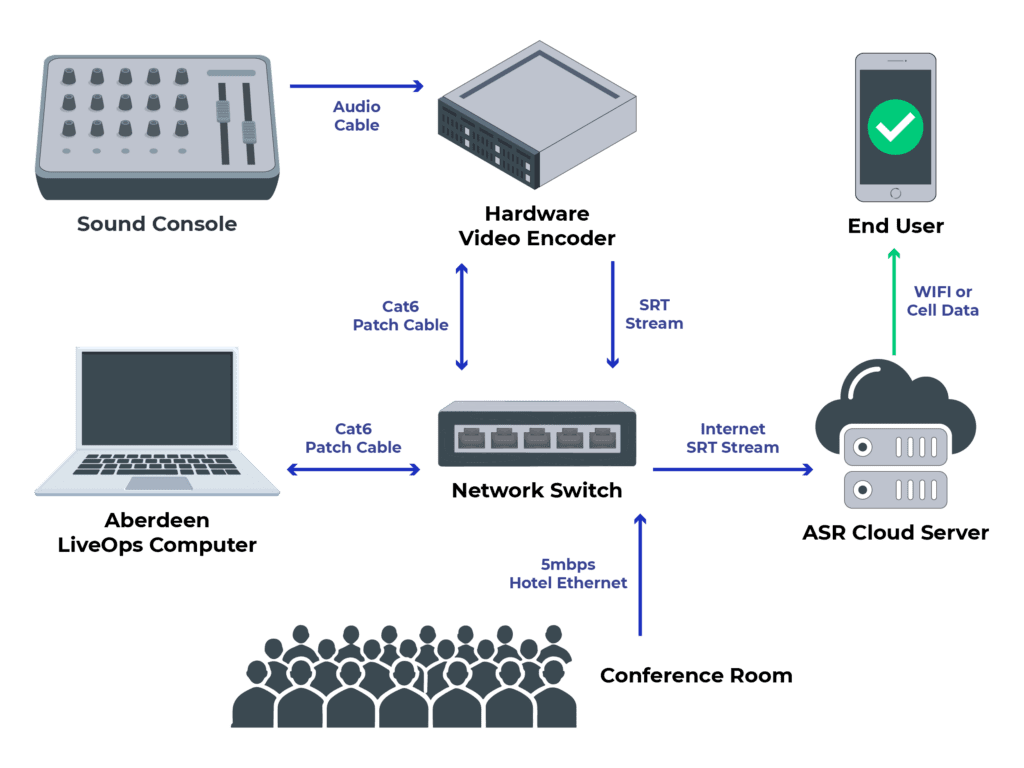
Audio feeds from each venue’s sound console were routed into video encoders and transmitted via dedicated Ethernet connections to Aberdeen’s ASR cloud servers. Simultaneously, technicians used laptops at each event to monitor session loads and dynamically add languages on the fly based on audience needs.
AV & Network Inputs from Each Room
Sound Console (with audio out to connect to Aberdeen’s encoder)
5 Mbps+ Ethernet Connection (dedicated per room)
Aberdeen’s On-Site Equipment
Network Switch
Cat6 Patch Cables (x2): One to connect the encoder to the network and one to connect the technician’s controller laptop
Video Encoder – Captured and streamed audio to ASR servers
Aberdeen Laptop (Controller) – Carried by the technician for on-the-fly control and session monitoring
Backup Audio Cable – Ensured compatibility with varying soundboard configurations
Here's a visual look at the setup:
Event Awareness & User Guidance
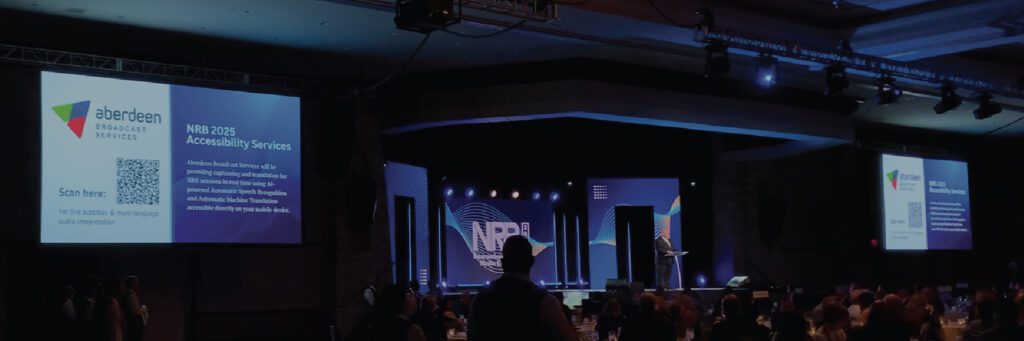
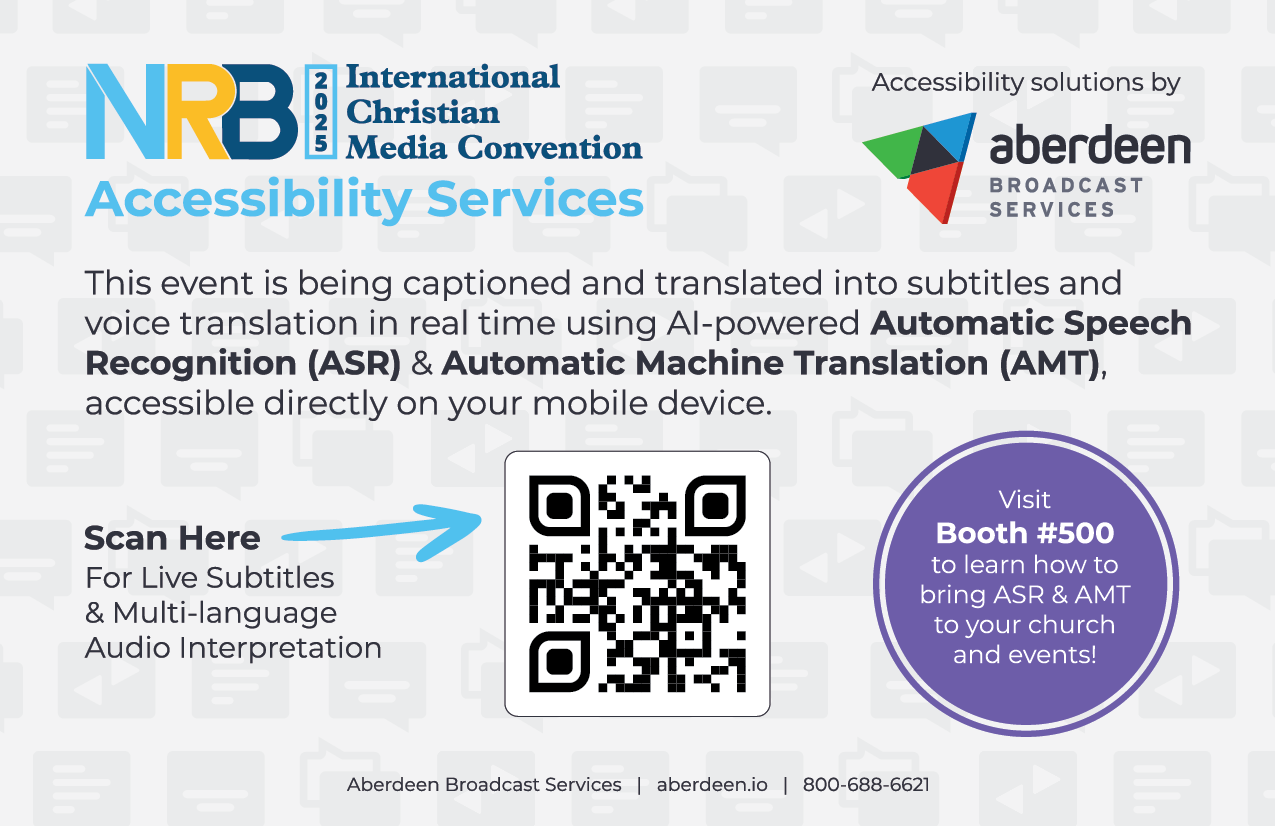
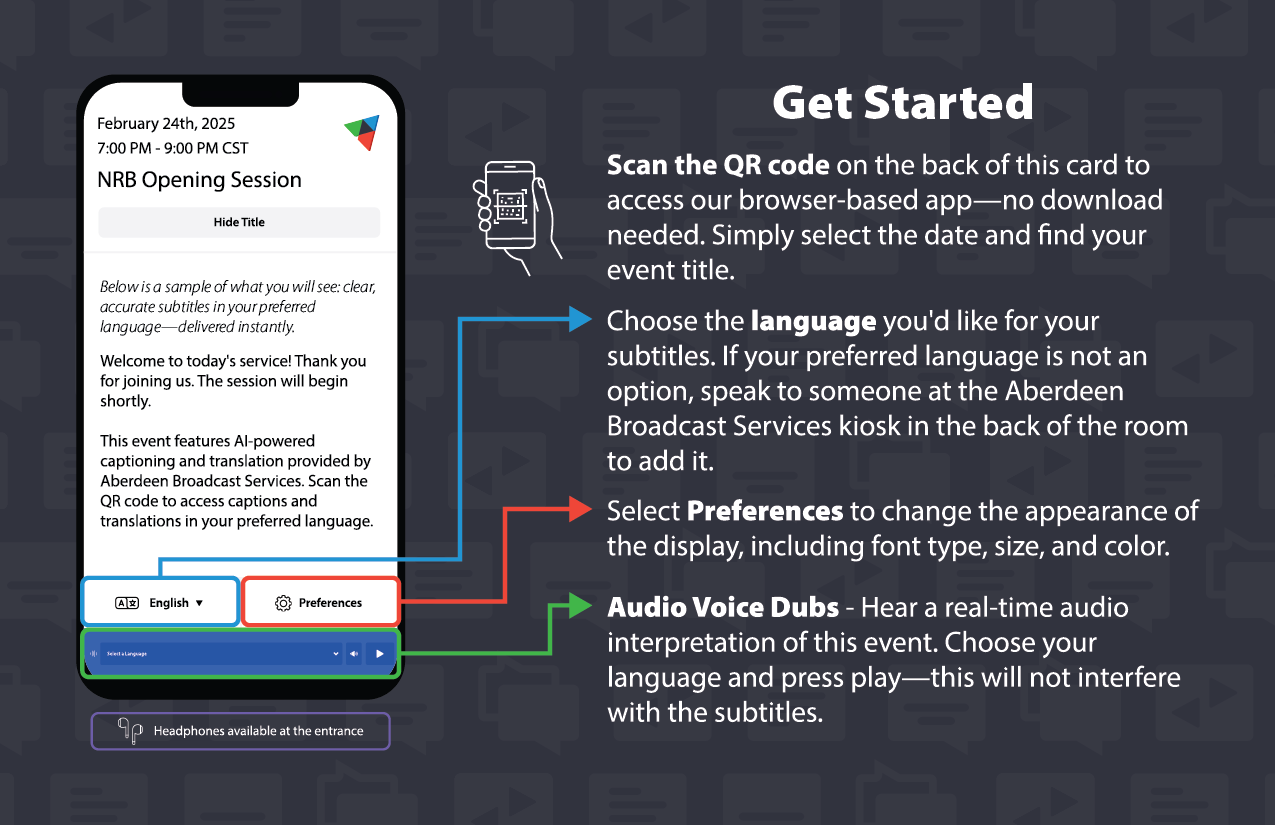
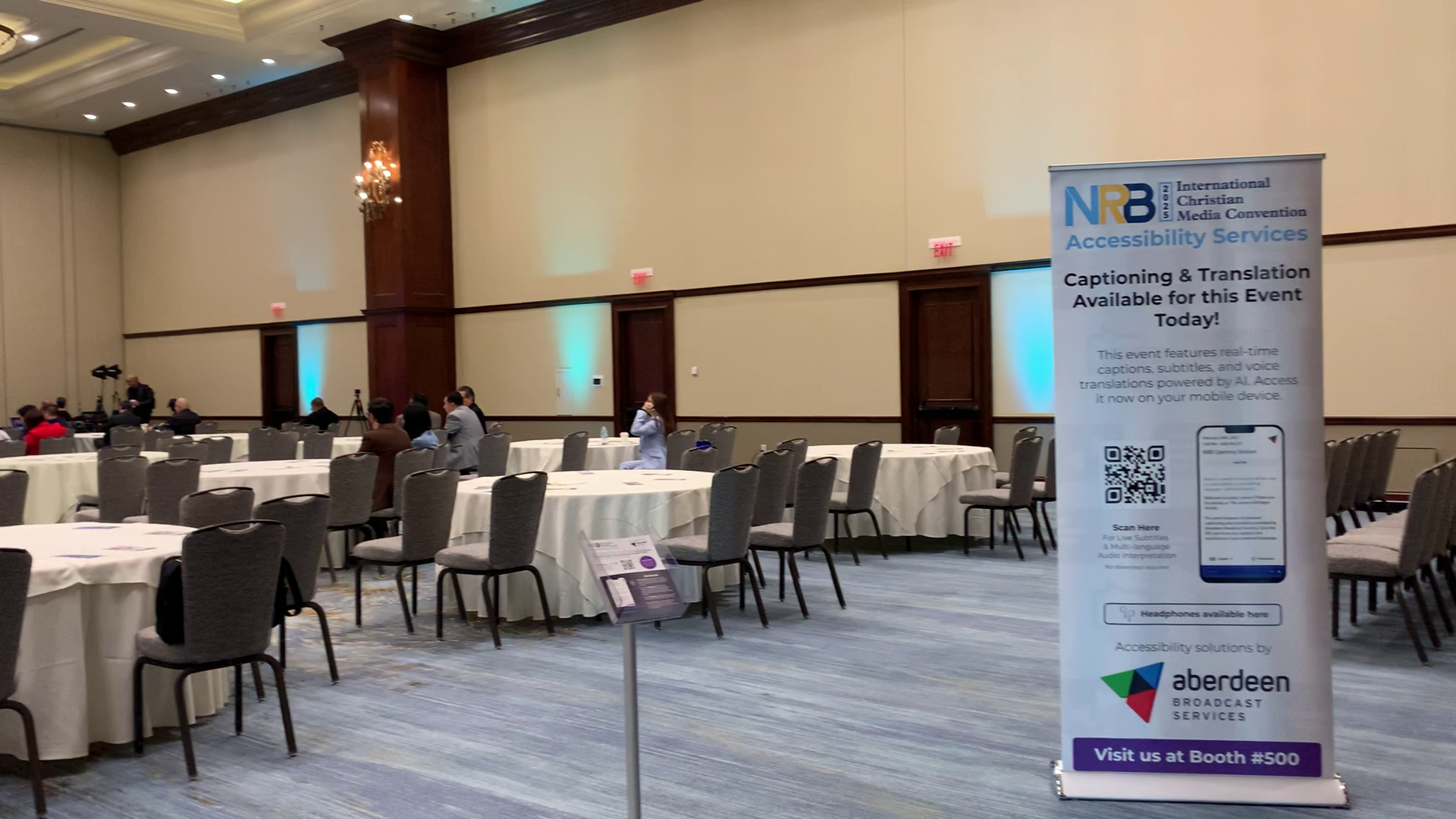
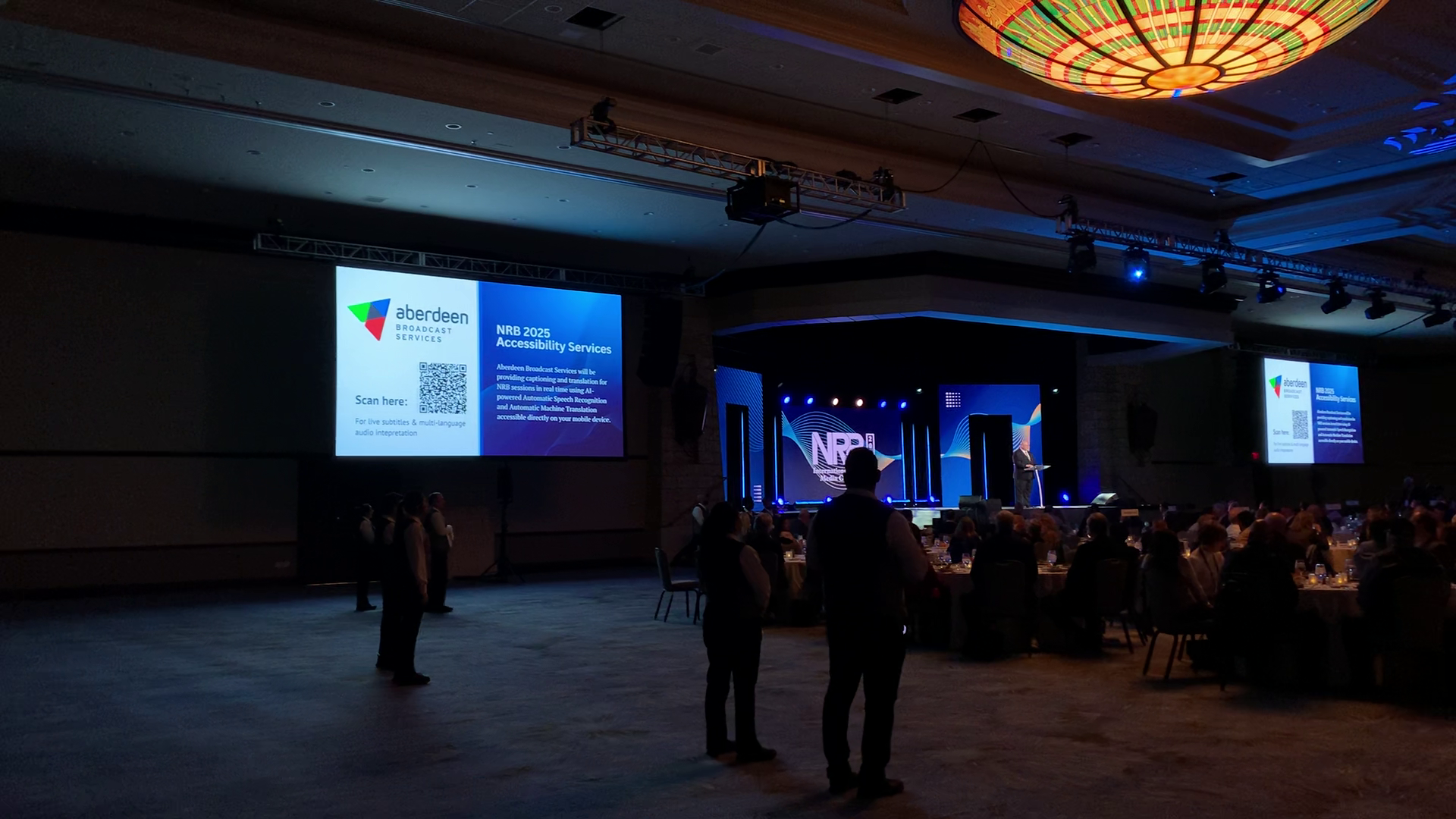
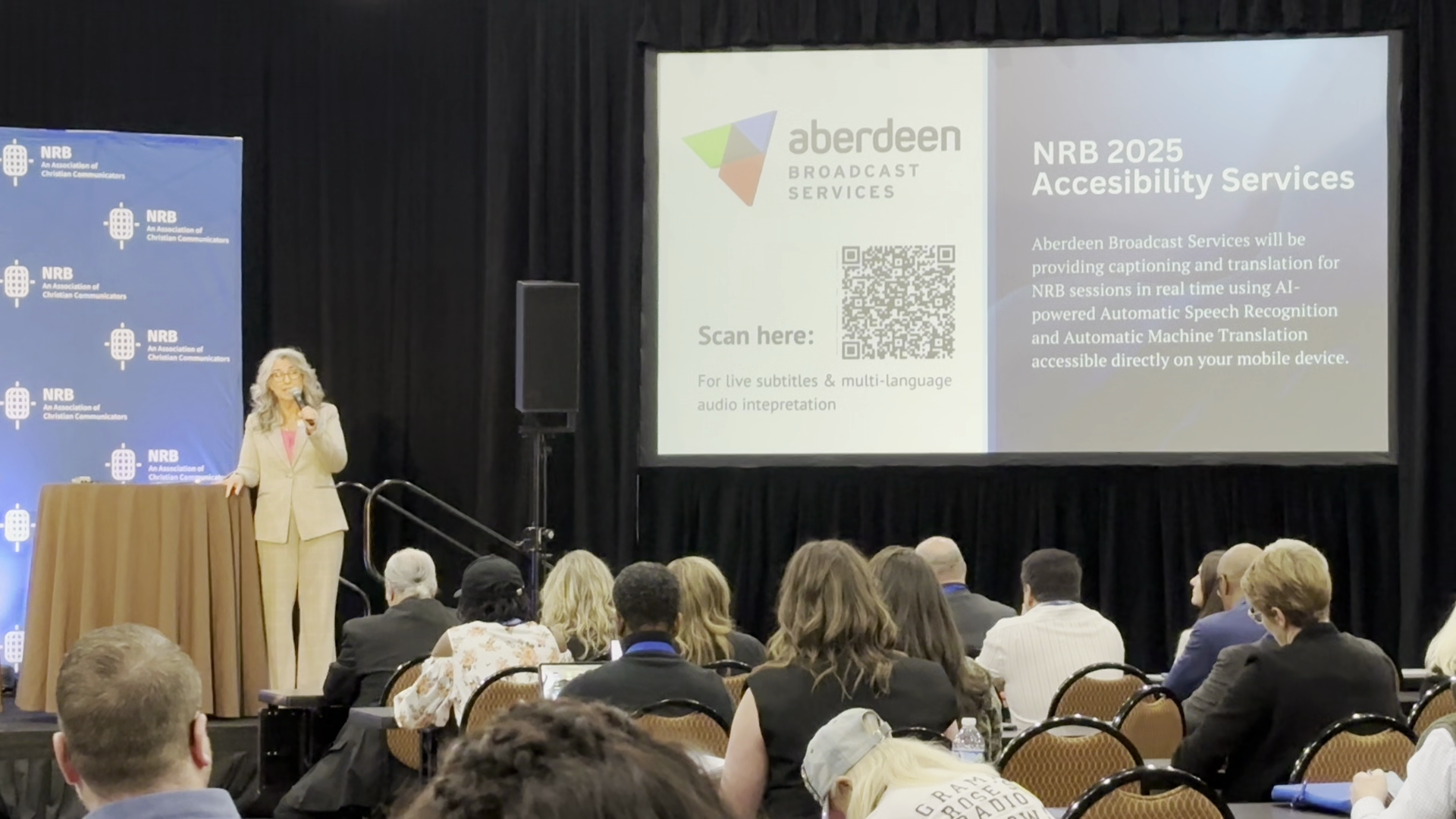
Printed Cards with QR Codes: Distributed to attendees, containing a QR code and simple instructions on how to access the AI-powered captions and voice dubs.Tall Banners at Session Entrances: These are placed at the entrances of all sessions and events, clearly displaying how to use the accessibility services.Pre-Session TV Slides: Before each session, conference TVs displayed an instructional slide with a QR code, ensuring every audience member knew how to access the service before the session started.
Complimentary Earbuds – Upon request, we provided headphones for attendees who wished to listen to the voice dubs.
Engagement Performance (Totals)
The NRB (National Religious Broadcasters) Convention welcomed more than 5,800 Christian media professionals—including 345 international attendees representing 52 countries outside the United States.
The following statistics reflect actual show usage, based on attendees who actively engaged with Aberdeen’s accessibility tools during sessions and events.
It’s important to note that every unique view was automatically recorded as a view of the English captions since English was the default language. Users then had the option to select a translated subtitle or voice dub, meaning the counts for translated languages reflect intentional user selection beyond the initial caption display.
NOTE: The following head counts reflect individual event attendance, not unique people. Many attendees participated in multiple sessions and events, so individuals may be counted more than once.
Metric
Total
% of Attendance
Head Count (Session Attendance)
Total
6,215
% of Attendance
Not applicable
Unique Users Engaged
Total
663
% of Attendance
10.67%
Voice Dub Usage
Total
276
% of Attendance
4.5%
41.63% of engaged users
Subtitle Usage (Non-English)
Total
61
% of Attendance
0.98%
9.2% of engaged users
Over 6,000 seats were filled across four days of sessions, panels, workshops, and keynotes—showcasing the scale and momentum of NRB 2025.
663 attendees actively used Aberdeen’s accessibility tools, representing slightly over 1 in 10 participants who engaged with real-time captions, translated subtitles, or AI-generated voice dubs.
Of those who engaged with the service, nearly 42% chose to listen to translated voice dubs, while just under 10% accessed content through on-screen subtitles—highlighting a clear preference for audio over text-based translation.
Day-By-Day Trends
Day
Head Count
Unique Views
Dubs
Subtitles
Monday
Head Count
1,002
Unique Views
37
Dubs
20
Subtitles
0
Tuesday
Head Count
1,734
Unique Views
272
Dubs
112
Subtitles
2
Wednesday
Head Count
2,220
Unique Views
240
Dubs
90
Subtitles
37
Thursday
Head Count
1,259
Unique Views
114
Dubs
54
Subtitles
22
Room-By-Room Performance
Room
Head Count
Unique Views
Dubs
Subtitles
% Views
Texas Ballroom AB
Head Count
2,067
Unique Views
78
Dubs
31
Subtitles
0
% Views
6.19%
Texas Ballroom C
Head Count
2,535
Unique Views
296
Dubs
104
Subtitles
8
% Views
11.68%
Longhorn Workshop Stage
Head Count
1,431
Unique Views
232
Dubs
115
Subtitles
7
% Views
16.21%
Grapevine Ballroom C
Head Count
182
Unique Views
57
Dubs
26
Subtitles
46
% Views
31.32%
Notable Event Highlights
Tuesday marked the highest engagement day for both attendance and unique views.
Subtitle usage rose significantly midweek, peaking on Wednesday and Thursday.
Longhorn Workshop Stage had the most consistent adoption, with over 16% of attendees engaging daily.
Grapevine Ballroom C hosted the two-day Latino Media Summit, which drew 182 attendees and recorded the highest subtitle usage of the week, with 31.32% engaging with the accessibility service.
Podcasting & Video Workshops (Longhorn Workshop Stage): 1,431 combined headcounts, 232 unique views, and highest per-capita voice dub usage of the week.
Challenges & Mitigation
Challenge
Solution
Hotel Network Configuration
Solution
The hotel’s IT infrastructure blocked standard static IPs and subnet masks. Aberdeen quickly adapted by configuring all encoders to use DHCP, scanning the network to identify active IPs, and manually accessing each WebUI to reconfigure the streaming setup.
User Awareness & Onboarding
Solution
Coming into the event, most attendees didn’t know the service was available or how to access it, so Aberdeen deployed printed QR cards, tall instructional banners, and pre-session screen slides to guide users before each session.
Scaling Across Diverse Room Setups
Solution
Different rooms had varying AV capabilities and audio console types. A technical kit was standardized and included flexible backup equipment, such as extra audio cables and patch cables, to adapt quickly from room to room.
Terminology Accuracy
Solution
Our team built custom dictionaries for each event, including names, acronyms, and phonetic pronunciations tailored to individual sessions, greatly improving real-time accuracy.
Conclusion & Future Strategies
Aberdeen’s AI-powered ASR & AMT deployment at NRB 2025 demonstrated strong engagement and adoption, especially in high-traffic venues. While initial awareness posed a challenge, the usage numbers and feedback show clear potential for continued growth.
Future Improvements
Enhanced Pre-Event Marketing – Increase awareness and user adoption through targeted event promotions.
Survey Language Preferences During Registration – Gather attendee language preferences ahead of time to personalize content delivery and better anticipate demand for specific translations.
Expanded Language Support – Introduce additional languages to serve a broader audience.
This project set a new benchmark for AI-driven accessibility in religious broadcasting and live events. Aberdeen looks forward to refining these solutions and expanding their impact at future industry gatherings.
Ready to Make Your Next Event Accessible to All?
Whether you're planning a conference, live broadcast, or global webcast, Aberdeen’s AI-powered captioning and translation solutions can help you engage a broader, more inclusive audience.
Let’s talk about how we can support your next event.Contact us to learn more.
Frequently Asked Questions
What accessibility services did Aberdeen Broadcast Services provide at the NRB 2025 convention?
Aberdeen delivered real-time Automated Speech Recognition (ASR) captions and Automated Machine Translation (AMT) voice dubs and subtitles across all sessions, workshops, and events at the four-day NRB convention in Grapevine, Texas. The goal was to make live content accessible to Deaf and Hard of Hearing attendees, international guests, and non-English speakers.
How many people used Aberdeen's accessibility tools at NRB 2025?
663 unique attendees actively engaged with the accessibility tools, representing 10.67% of the 6,215 total session head count across the four-day event. This was out of more than 5,800 total convention attendees, including 345 international guests from 52 countries.
Did attendees prefer voice dubs or subtitles for translation at NRB 2025?
Attendees showed a clear preference for audio over text. Of those who used the accessibility service, nearly 42% (276 uses, 4.5% of total attendance) chose translated voice dubs, while just under 10% (61 uses, 0.98% of total attendance) used non-English subtitles.
Which session or room had the highest engagement with translated content at NRB 2025?
Grapevine Ballroom C, which hosted the two-day Latino Media Summit with 182 attendees, recorded the highest subtitle usage of the week at 31.32% of views. The Longhorn Workshop Stage also stood out, with over 16% of attendees engaging with the accessibility service daily, the most consistent adoption of any room.
What technical challenges did Aberdeen face during setup at NRB 2025, and how were they resolved?
The hotel's IT infrastructure blocked standard static IPs and subnet masks, so Aberdeen configured all encoders to use DHCP, scanned the network to find active IPs, and manually accessed each device's WebUI to reconfigure streaming. The team also standardized a technical kit with backup audio and patch cables to adapt to varying AV setups room by room.
How did Aberdeen prepare its ASR and translation technology before the NRB event?
Before the event, Aberdeen fine-tuned its AI models specifically for NRB's audience, incorporating religious broadcasting terminology, varied speaker accents, and unique session formats. The team also built custom dictionaries for each event covering names, acronyms, and phonetic pronunciations, which improved real-time accuracy and reduced the need for on-the-fly corrections.
How did attendees find out how to access captions and voice dubs at NRB 2025?
Aberdeen used printed cards with QR codes distributed to attendees, tall instructional banners placed at session entrances, and pre-session TV slides showing a QR code before each session started. Complimentary earbuds were also provided to attendees who wanted to listen to the voice dubs.
What did Aberdeen learn was the biggest challenge to adoption at NRB 2025?
The main challenge was user awareness: most attendees didn't initially know the accessibility service was available or how to access it. Aberdeen addressed this on-site with QR cards, banners, and screen slides, and plans to expand pre-event marketing and survey attendee language preferences during registration for future events.