Matt Cook joins Kenny Jahng on the Church Tech Today Podcast
We’re excited to share that our President, Matt Cook, was recently featured on the Church Tech Today Podcast hosted by Kenny Jahng — one of the leading voices in digital ministry and AI innovation for churches. The conversation dove into how Aberdeen’s real-time AI captioning and translation tools are making worship services more accessible, inclusive, and effective for everyone in the pews.
The conversation wasn’t just about cool tech — it was about mission. AI is opening the door for churches to reach people who’ve been sitting quietly in their pews, unable to fully engage — whether due to hearing loss, language barriers, or generational differences in media consumption.
As Kenny noted, "Most churches are barely scratching the surface of what's possible." But with the right tools, accessibility can be seamless, affordable, and incredibly impactful.
Key Takeaways from the Interview
1. AI Makes Accessibility Affordable for Every Church
Matt shared how Aberdeen has taken technology once reserved for large, media-savvy churches — and made it accessible for congregations of all sizes. Even 100-member churches are now using AI captioning and translation to serve ESL communities and individuals with hearing loss.
“We’ve had churches start this just to help one deaf member, and suddenly realize there are more people quietly struggling to engage — and they begin reaching new audiences they never expected.” — Matt Cook, Aberdeen
2. Captions Aren’t Just for the Hearing Impaired
More than 70% of Gen Z and over 50% of Millennials now watch content with captions on. It’s not an accessibility issue — it’s an engagement issue.
Captions help with focus, retention, and accessibility for everyone — not just those with hearing impairments.
“Captions help us absorb more. They’ve become part of how the next generation engages with content, including sermons.” — Kenny Jahng
3. Live, In-Person Captions Are Easier Than Ever
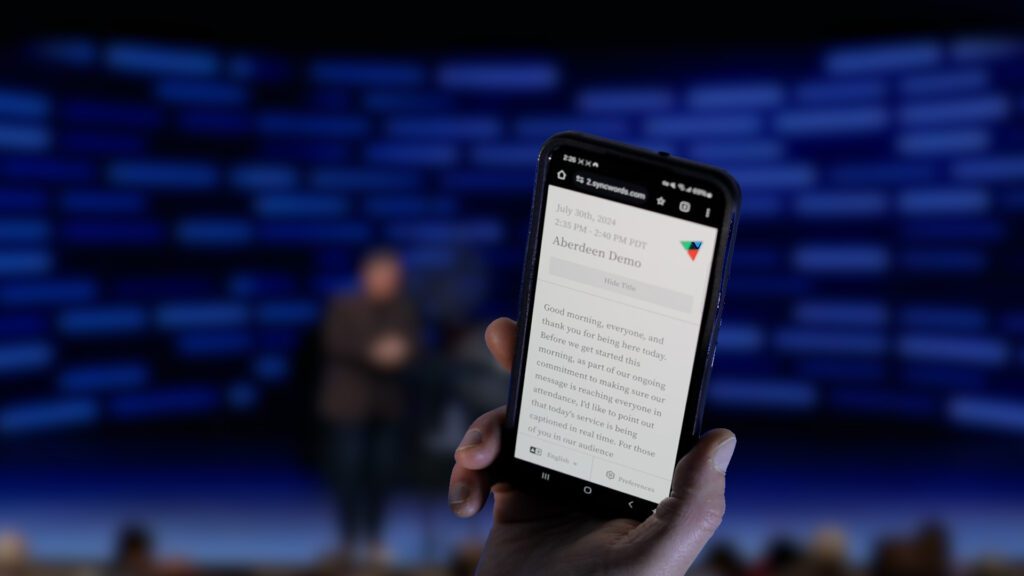
Churches don’t need expensive gear or complex workflows. Aberdeen’s AI captioning and translation system works right from the audio feed churches already have. Viewers can scan a QR code and get real-time captions or listen to a voice dub in their preferred language — right on their phone.
“Setup takes just minutes. Most churches already have everything they need.” — Matt Cook
4. Voice Dubbing in 60+ Languages
Beyond just captions, Aberdeen offers AI voice dubbing — allowing attendees to hear the sermon in real time in their own language, with natural inflection and clarity. This opens the door to multi-generational families, immigrant communities, and global reach without needing separate services.
A Tool for Growth, Not Just Accommodation
Kenny brought up an important shift in thinking: Captioning and translation aren't just for “accommodation” — they’re tools for growth and connection.
Whether it’s helping Gen Z absorb more of the message, allowing a Spanish-speaking grandmother to understand her grandson’s baptism, or making someone with hearing loss feel seen and included — accessibility is kingdom work.
Try It with Your Own Content
As Matt shared on the podcast, Aberdeen offers churches a free trial month and will even demonstrate the technology using the church’s own sermon video.
Real-time captions
Mobile access via QR code
Translation and voice dubs in 60+ languages
Seamless setup using your existing equipment
Ready to See It in Action?
Curious how it would work for your services? We’re now offering personalized live demos using your actual content so you can see how real-time captions and multilingual translations would look during your own worship services.
Get guidance tailored to your tech setup
Experience the interface with familiar voices and formats
Evaluate translation quality in real-time
Schedule your one-on-one demo now using our calendar link below.
In a recent StreamingChurch.tv webinar, Aberdeen Broadcast Services President Matt Cook joined Phil Thompson to discuss the powerful role artificial intelligence is playing in making church services more accessible—both in-person and online.
As churches strive to reach broader and more diverse communities, the need for multilingual captioning and translation has never been greater. During the conversation, Matt shared how Aberdeen has spent years refining AI tools behind the scenes before confidently bringing them forward for real-time use.
“We’ve been using AI in post-production captioning for years—combining it with human editors to ensure top-tier quality,” Matt explained. “But we didn’t want to offer it live until we were confident it would meet the high standards our clients expect.”
A New Era of Real-Time Accessibility
What once required dedicated human captioners or translators can now be achieved instantly through AI—with support for over 60 languages in both subtitles and audio dubbing.
Whether you’re broadcasting to viewers across the globe or welcoming a multilingual congregation in your sanctuary, Aberdeen’s real-time solution is built to scale with you. During the live demo, attendees saw firsthand how captions and translations could be instantly toggled across multiple devices—no app, log-in, or special equipment required.
Designed for Churches—Not Just Tech Experts
One of the biggest takeaways from the webinar was that you don’t have to be a tech expert to bring this level of accessibility to your church. Aberdeen’s cloud-based tools work with any encoder and can be used in both live streams and in-person worship services.
“It’s as simple as scanning a QR code or clicking a link. Your viewers can then choose their preferred language and follow along in real-time,” said Matt.
Watch the Full Webinar Replay
If you missed the live event or want to revisit what was shared, you can now watch the full replay on demand here:
You’ll see:
A live demo of the tech in action
How churches are using it for both local and international outreach
A walkthrough of Aberdeen’s 60+ language support
The inspiration behind Aberdeen’s long-term commitment to accessibility
See It in Action—With Your Own Content
Curious how it would work for your services? We’re now offering personalized live demos using your actual content so you can see how real-time captions and multilingual translations would look during your own worship services.
Experience the interface with familiar voices and formats
Evaluate translation quality in real-time
Get guidance tailored to your tech setup
Spots are limited and filling up quickly. Schedule your one-on-one demo now using our calendar link below.
Churches today have an unprecedented opportunity to reach global audiences, welcome newcomers, and serve members of all abilities and backgrounds. With trusted AI-powered tools from Aberdeen, you can break language barriers and make sure no one misses the message.
Learn more about ASR-powered accessibility tools for churches here.
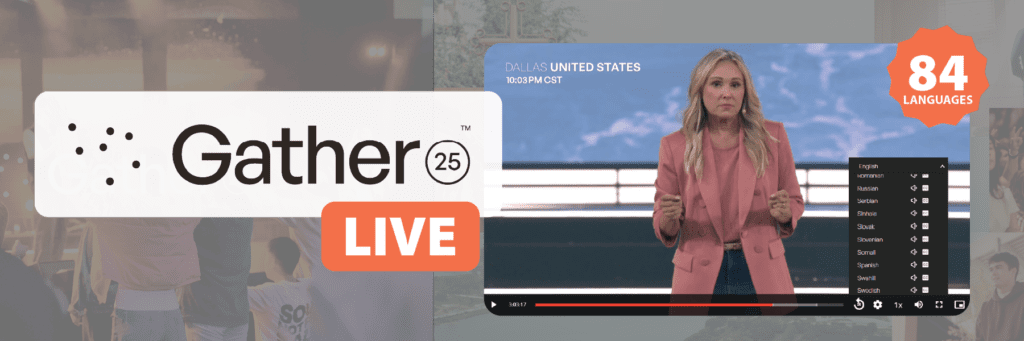
Gather25, hosted by IF:Gathering, was a groundbreaking 25-hour global broadcast connecting audiences across every continent. With over 1.25 million online viewers and participation from more than 21,000 Gather Groups worldwide, the event aimed to inspire and unite the global church community.
Aberdeen Broadcast Services has partnered with IF:Gathering since 2020, providing both live captioning for streaming events and post-produced captioning for archived content. Gather25 marked an ambitious new chapter in that partnership—the first time Aberdeen was brought on to help scale the event’s global reach through real-time translation.
As far as we know, this was a first-of-its-kind undertaking: a multilingual livestream of this magnitude, requiring impeccable coordination across dozens of languages and platforms. Aberdeen was one of several trusted vendors, working alongside the technology and broadcast partners hired for the event to make it all possible.
The Challenge: Delivering 25 Hours of Multilingual, Real-Time Access
Supporting a continuous, multilingual broadcast of this scale introduced several technical challenges:
Maintain uninterrupted captioning across a 25-hour live stream spanning 7 global broadcast hubs.
Generate real-time captions and translations for 84 language streams with high accuracy and minimal latency.
Implement a dynamic captioning system that allows viewers to pause, rewind, and review up to four hours of content during the live event ("rolling DVR" functionality).
Collaborate across multiple teams — Element Media Group (master control), Sardius (video player delivery), SyncWords (captioning/subtitle platform), and Interprefy (live interpreters) — to ensure flawless live execution.
Deliver caption files in a continuous VTT format, dynamically updating during the broadcast to support both live viewing and post-event on-demand access.
The Solution: Continuous Live Captioning and Translation Across 84 Languages
Before the event went live, a workflow that could support uninterrupted, real-time captioning and translation across dozens of simultaneous streams needed to be built. This required deep coordination with multiple teams to align audio sources, language feeds, and delivery endpoints. Our goal was to ensure every segment of the broadcast could be accurately captioned and translated with minimal manual intervention once the event began.
A key technology partner behind this workflow was SyncWords, whose platform Aberdeen leverages to manage real-time captioning and translation delivery. SyncWords played a vital behind-the-scenes role in not only powering the infrastructure we used to deploy captions across dozens of streams but also collaborating directly with engineers at Sardius and Elemental Media to implement specialized audio-isolation coding for the event. This coordination ensured that every audio feed we received was optimized for clean, accurate transcription and translation at scale.
Pre-Event Testing
To guarantee performance, Aberdeen conducted over 50 hours of pre-event testing, stress-testing multi-language streams, and simulating 25-hour sessions to ensure system endurance. A key priority was ensuring that VTT caption files would function as continuously updated feeds, rather than static uploads. This real-time updating was essential for Sardius’ platform to support both live captions and rolling DVR features, while also allowing seamless access to captions during on-demand playback after the event.
Streaming Caption Workflow
In a typical video workflow, captions are created after recording, uploaded separately, and synced to on-demand content. For Gather25’s livestream, captions had to be generated and delivered in real time, alongside the video stream.
The system worked like this:
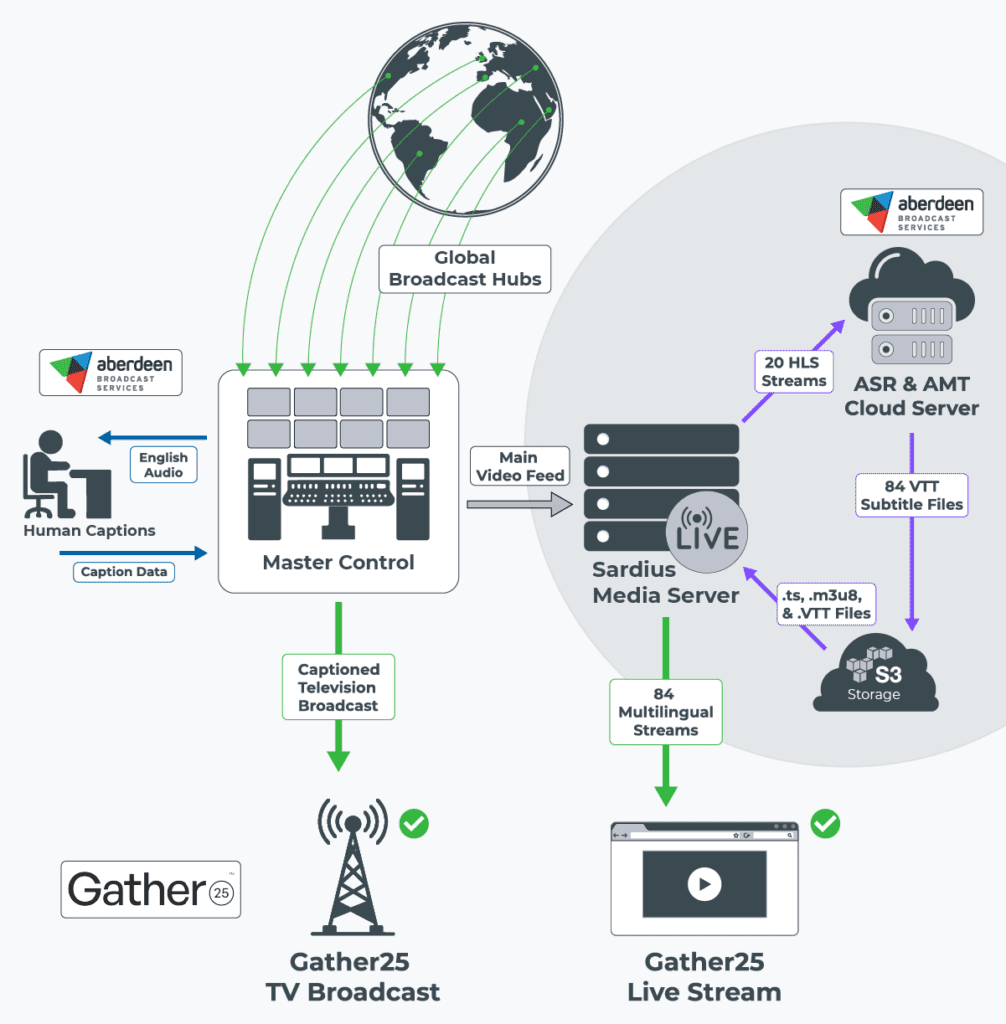
Live video was broken into segments (HLS .ts files) and stored in an S3 bucket, alongside a .m3u8 manifest file managing playback.
Simultaneously, a VTT subtitle file was created and appended in real time—each new caption line was added to the file without restarting it.
This continuous file structure allowed Sardius’ player to provide viewers with immediate access to live captions while also enabling DVR controls—viewers could rewind up to four hours and then return to the live stream without losing their place.
Once the event ended, these same VTT files remained attached to the recorded content for full accessibility during on-demand viewing.
This architecture required precise timing, structured file delivery, and full alignment with Sardius’ streaming infrastructure.
What's an HLS Stream?
An HLS stream (HTTP Live Streaming) delivers video content over the internet in small, manageable chunks. The video is split into short segments (usually 2–10 seconds long) and saved as .ts (transport stream) files. A playlist file (called a .m3u8) tells the video player what order to play those chunks in. As a viewer watches, their device downloads and plays the segments one at a time, allowing smooth playback, even with slow or fluctuating internet.
Workflow Optimization
Aberdeen’s team engineered a sophisticated workflow to process 20 incoming HLS feeds. Working closely with Element Media Group, which managed master control and delivered stripped audio to Sardius, Aberdeen received feeds prepped for accessibility:
Speech-Only Audio Extraction: Each of the 20 HLS streams included up to 16 audio tracks; Aberdeen pulled content from Track 16, where music had been removed to isolate spoken word, ensuring clean inputs for accurate captioning and translation.
Language Processing:
Live English captioning was performed by Aberdeen’s professional human captioners via a broadcast encoder at Master Control, ensuring exceptional accuracy of the English captions for the television broadcast.
Translated English to Kinyarwanda, a language not supported by any of the major ASR engines, demonstrating a custom solution beyond standard automation.
Created native-language captions for 14 non-English spoken feeds, including Arabic, Mandarin, French, German, Portuguese, and more.
Translated stripped English audio into 68 other languages, selecting the best available machine translation engine per language (prioritizing: DeepL > OpenAI > Amazon > Google > Azure).
File Management: All caption files were delivered to Sardius using clearly labeled S3 bucket destinations (e.g., EN for English, ES for Spanish), with structured naming conventions to ensure accurate mapping during the live event and in the post-event archive.
Impact: Real-Time Engagement and Global Reach Through Accessibility
Gather25’s accessibility efforts produced measurable results:
Over 1 million minutes of English captions and translations were viewed during the live stream, equal to nearly 17,000 hours of real-time engagement.
Continuous, real-time VTT streaming ensured seamless live accessibility, enabled four-hour rolling DVR, and extended caption access post-event.
Aberdeen's workflow operated without any critical interruptions across the entire 25-hour window, validating the strength of its testing protocols and system reliability.
By combining AI-driven automation, human captioning expertise, and a deep integration with broadcast systems, Aberdeen Broadcast Services delivered scalable, high-quality accessibility at a truly global level.
Conclusion: Advancing Live Event Accessibility on a Global Scale
Gather25’s mission to unite believers around the world was made stronger through its commitment to accessibility. With real-time captioning and translation across 84 language streams, Aberdeen Broadcast Services helped make this global event inclusive, impactful, and available to all.
For organizations planning large-scale, multilingual broadcasts, Aberdeen’s tested and proven solutions offer the reliability and scalability needed to reach a worldwide audience.
Let’s talk about how we can support your next event.Contact us to learn more.
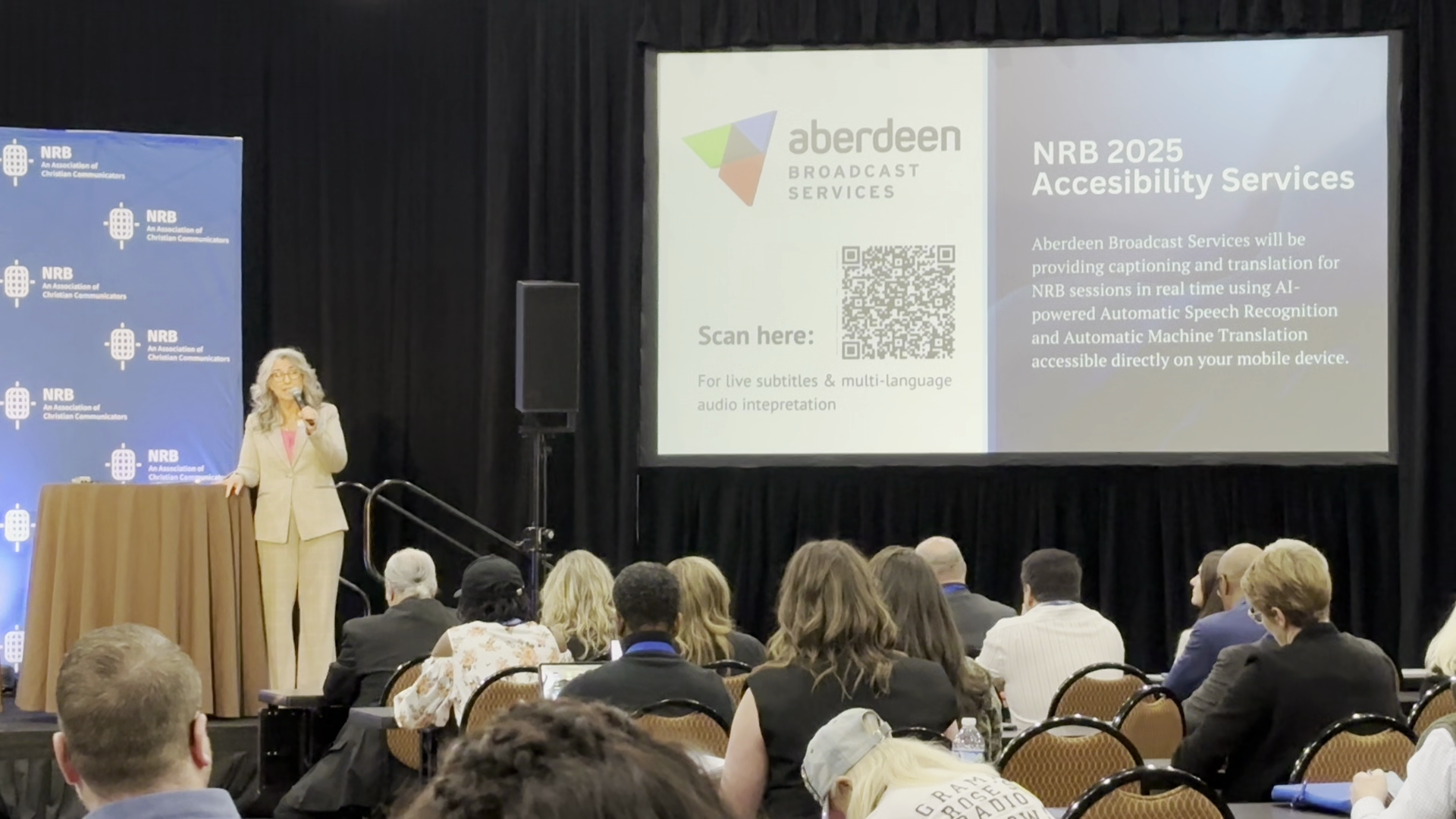
At the four-day International Christian Media Convention in Grapevine, Texas, Aberdeen Broadcast Services revolutionized accessibility by delivering real-time Automated Speech Recognition (ASR) and Automated Machine Translation (AMT) solutions. Through AI-powered captions, subtitles, and voice dubs, we ensured that all sessions, workshops, and events were accessible to a diverse audience, including Deaf and Hard of Hearing (D/HH) attendees, international guests, and non-English speakers.
This case study highlights the technical execution, engagement analytics, and impact of our AI-driven accessibility services, demonstrating how these innovations enhance inclusivity while setting new standards for multilingual communication in the religious broadcasting industry.
Client Overview: NRB (National Religious Broadcasters)
NRB unites content creators, broadcasters, and media professionals in faith-based media. The annual convention serves as a key platform for industry innovation and networking, drawing thousands of attendees from across the globe.
Aberdeen Broadcast Services has been a proud NRB member since 2001, and we’ve exhibited annually in the convention’s Exhibit Hall—supporting Christian media leaders with broadcast-quality captioning, translation, and broadcast transcoding and station delivery solutions year after year.
For more detailed information about NRB's mission, history, and upcoming events, you can visit their official website at https://nrb.org/.
Background & Project Objectives
Aberdeen Broadcast Services collaborated with the NRB (National Religious Broadcasters) team to deploy automated captions and multilingual translations across all event venues.
The initiative aimed to:
Enhance Accessibility – Ensure deaf & hard of hearing (D/HH) and multilingual attendees can fully engage with live content through captions and translated voice dubs.
Expand Reach – Enable non-English speakers and international attendees to participate via real-time, high-accuracy ASR and AMT services.
Seamless Integration – Deploy AI-powered solutions that integrate smoothly with the event’s media and AV infrastructure.
Showcase Innovation – Demonstrate how AI-driven translation transforms live event accessibility.
Implementation Strategy
Aberdeen worked closely with NRB’s event tech and media teams to implement AI-powered captions and voice translations across conference rooms, exhibit halls, and keynote sessions.
Pre-Event Planning
To ensure a smooth deployment, Aberdeen conducted detailed pre-event coordination with NRB’s technical teams. These planning sessions covered AV compatibility, network readiness, and session logistics, laying the groundwork for a seamless on-site setup.
In parallel, Aberdeen’s AI models were fine-tuned specifically for NRB’s audience—incorporating religious broadcasting terminology, varied speaker accents, and unique session formats. This customization helped boost initial accuracy and reduced the need for on-the-fly corrections once the event was live.
On-Site Execution
Delivering real-time captions and multilingual voice dubs across dozens of live events requires more than great technology; it demands strategic integration, on-the-ground expertise, and proactive user engagement. At NRB 2025, Aberdeen’s team worked room by room to implement a reliable, low-latency system that ensured seamless delivery throughout the four-day event.
From technical setup to attendee onboarding, every detail was planned and executed to provide a smooth, accessible experience for all.
Here's how it came together on-site:
Technical Setup & System Integration
Aberdeen deployed a robust, multi-room workflow to ensure the reliable delivery of real-time captions and multilingual voice dubs throughout NRB 2025. Designed for low-latency audio capture and seamless cloud-based processing, the system was supported by a team of on-site technicians assigned to each room.
Technicians monitored session quality, managed live connections, and handled any real-time troubleshooting, ensuring maximum system uptime and translation accuracy across the event.
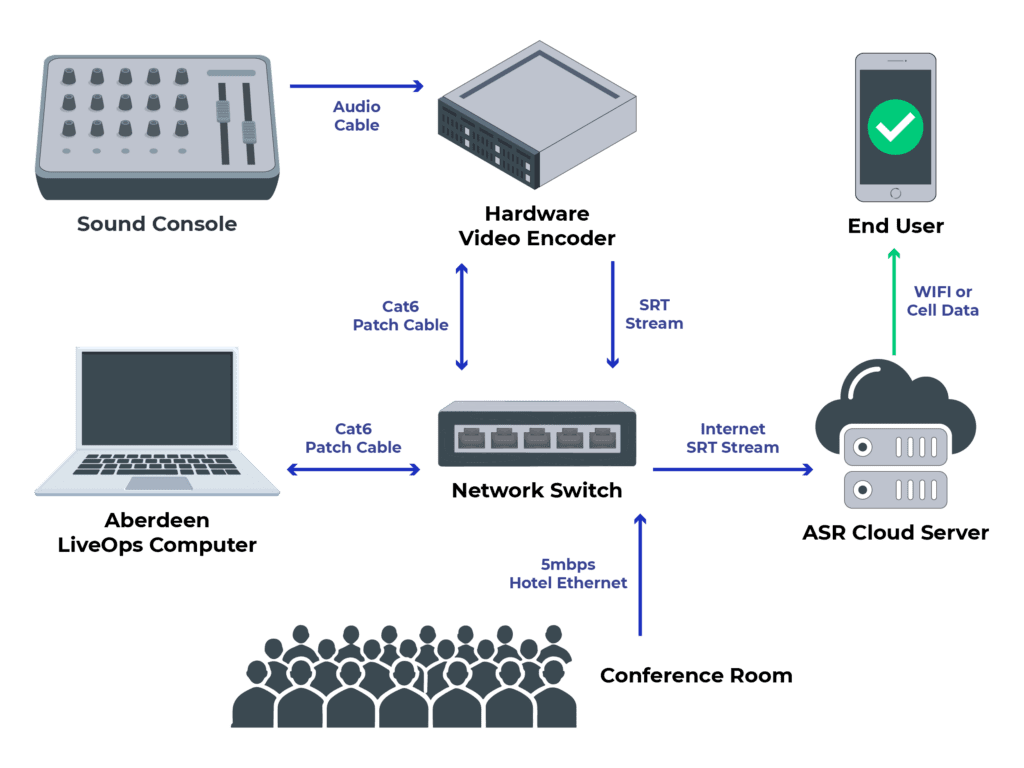
Audio feeds from each venue’s sound console were routed into video encoders and transmitted via dedicated Ethernet connections to Aberdeen’s ASR cloud servers. Simultaneously, technicians used laptops at each event to monitor session loads and dynamically add languages on the fly based on audience needs.
AV & Network Inputs from Each Room
Sound Console (with audio out to connect to Aberdeen’s encoder)
5 Mbps+ Ethernet Connection (dedicated per room)
Aberdeen’s On-Site Equipment
Network Switch
Cat6 Patch Cables (x2): One to connect the encoder to the network and one to connect the technician’s controller laptop
Video Encoder – Captured and streamed audio to ASR servers
Aberdeen Laptop (Controller) – Carried by the technician for on-the-fly control and session monitoring
Backup Audio Cable – Ensured compatibility with varying soundboard configurations
Here's a visual look at the setup:
Event Awareness & User Guidance
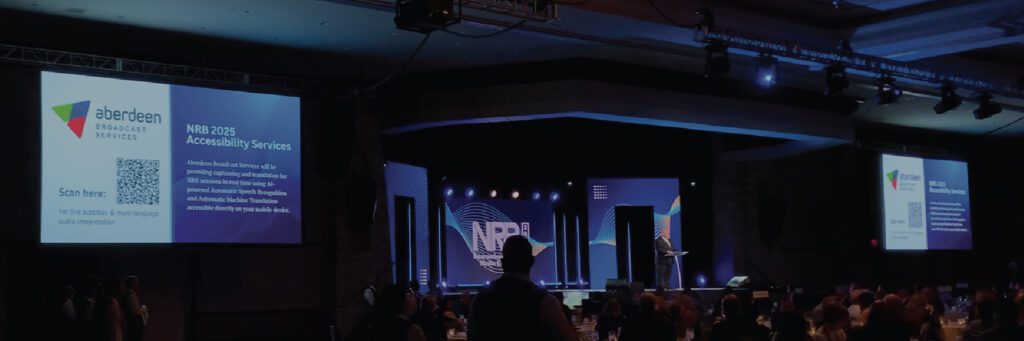
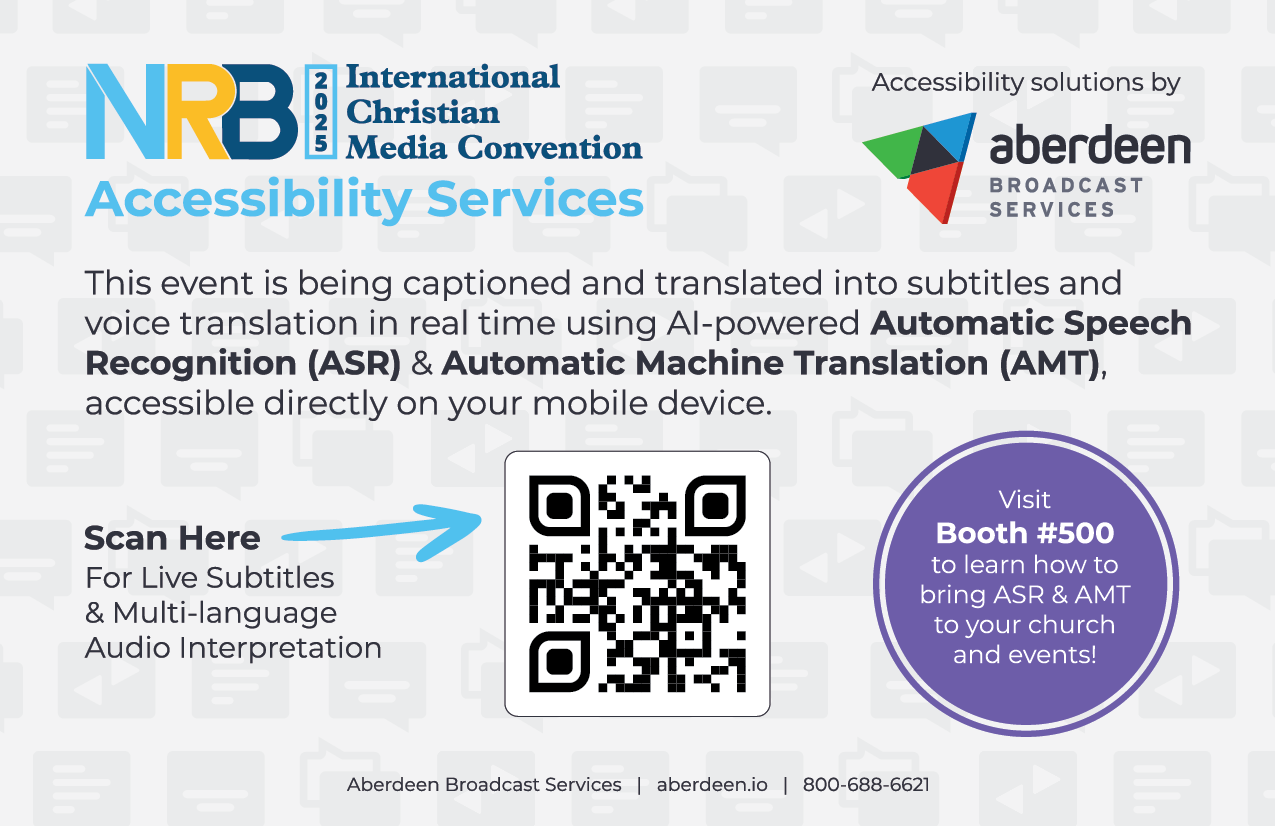
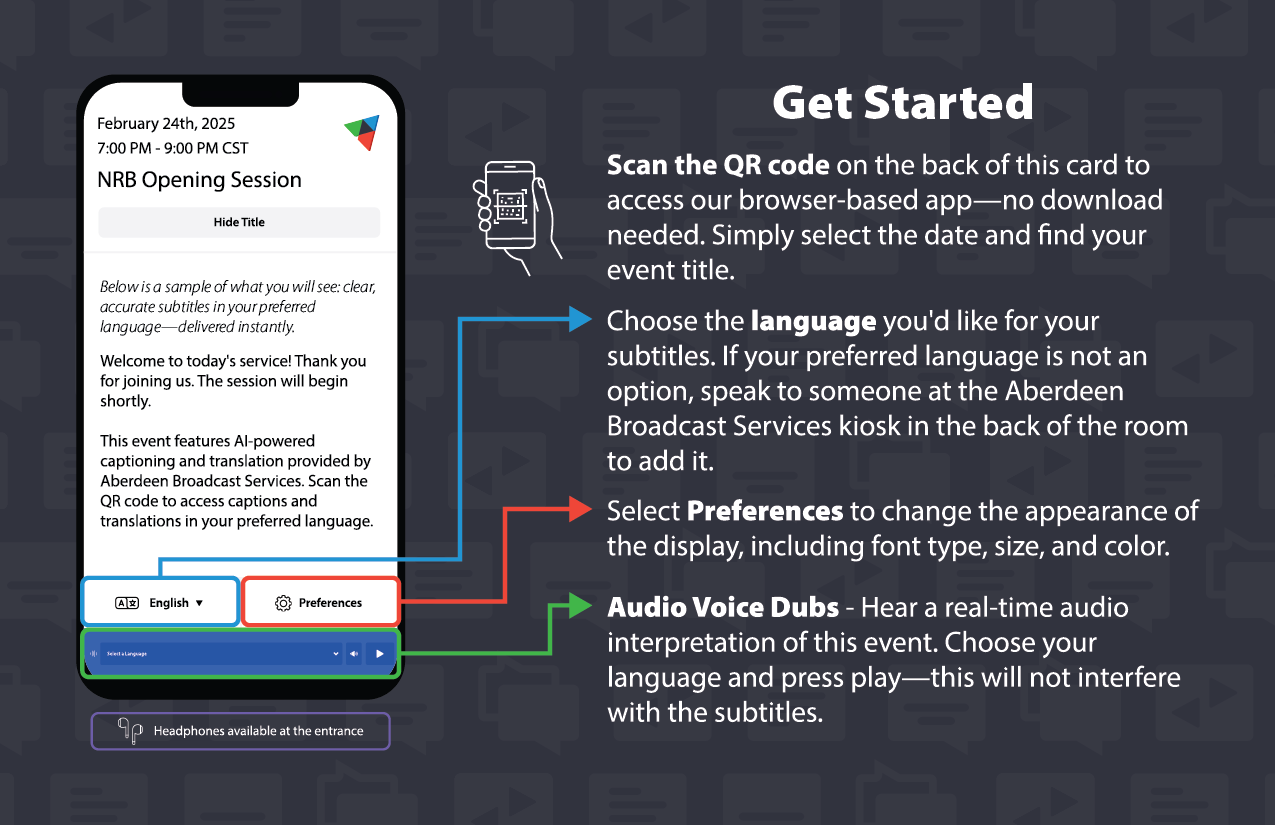
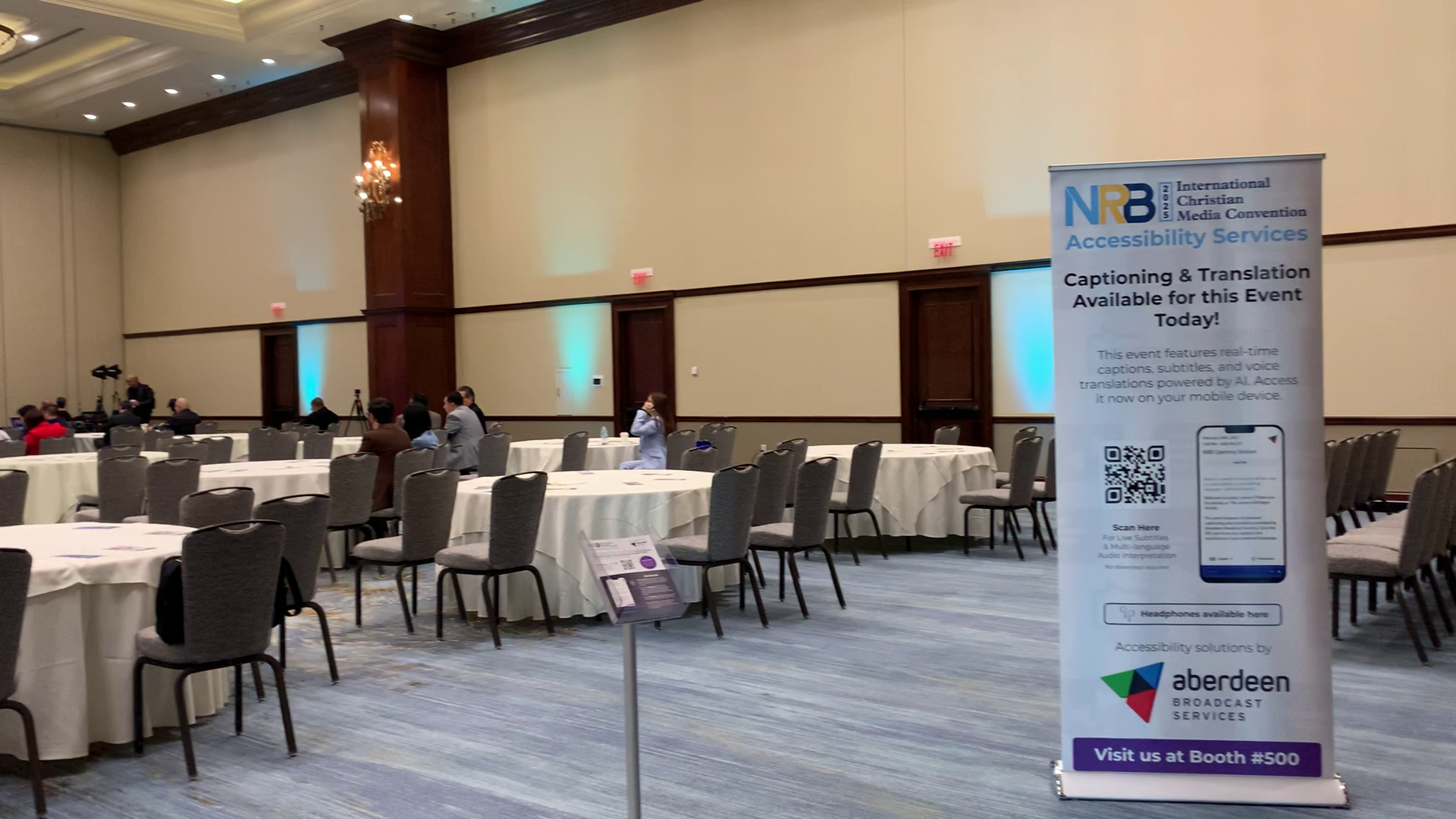
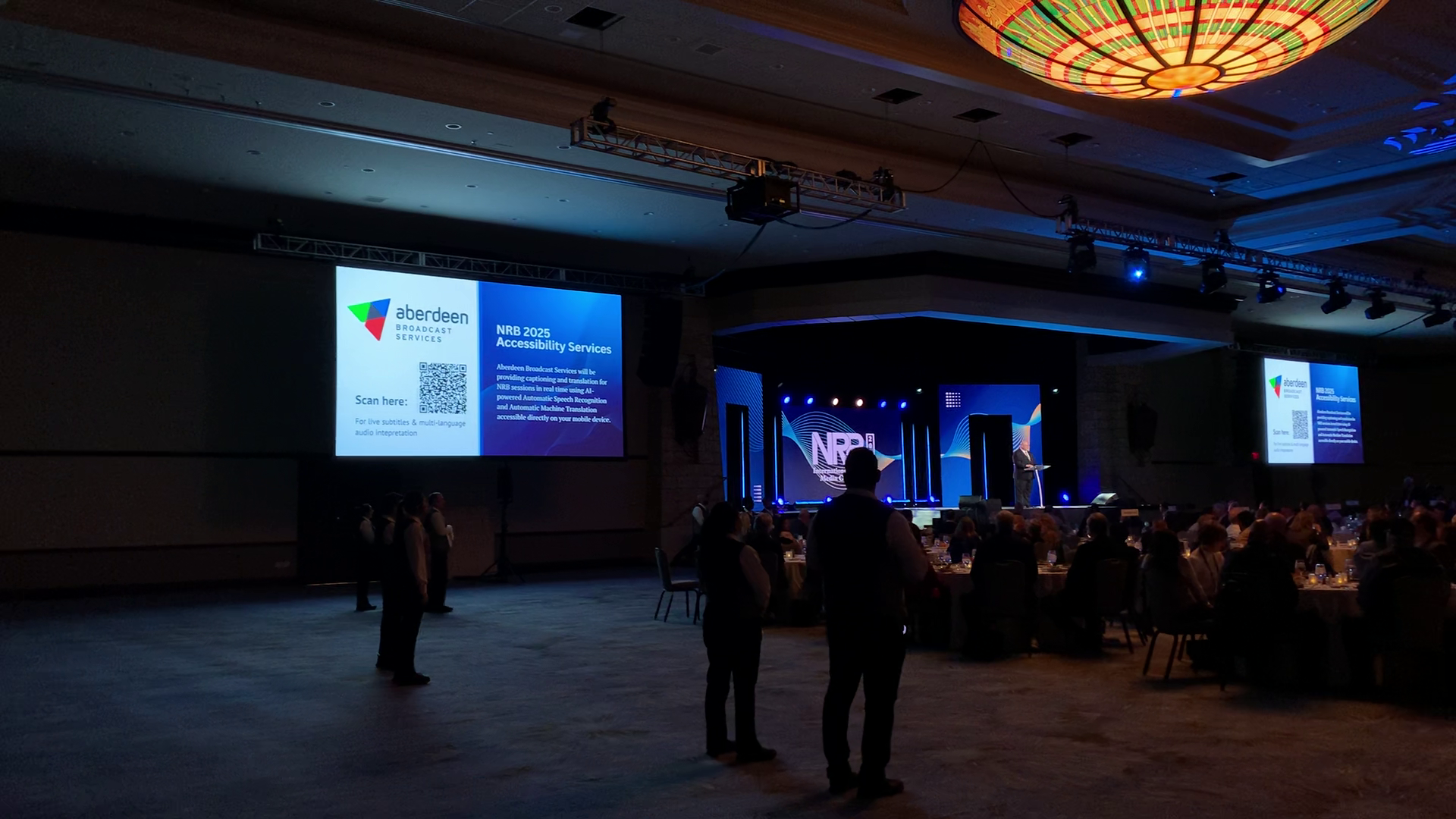
Printed Cards with QR Codes: Distributed to attendees, containing a QR code and simple instructions on how to access the AI-powered captions and voice dubs.Tall Banners at Session Entrances: These are placed at the entrances of all sessions and events, clearly displaying how to use the accessibility services.Pre-Session TV Slides: Before each session, conference TVs displayed an instructional slide with a QR code, ensuring every audience member knew how to access the service before the session started.
Complimentary Earbuds – Upon request, we provided headphones for attendees who wished to listen to the voice dubs.
Engagement Performance (Totals)
The NRB (National Religious Broadcasters) Convention welcomed more than 5,800 Christian media professionals—including 345 international attendees representing 52 countries outside the United States.
The following statistics reflect actual show usage, based on attendees who actively engaged with Aberdeen’s accessibility tools during sessions and events.
It’s important to note that every unique view was automatically recorded as a view of the English captions since English was the default language. Users then had the option to select a translated subtitle or voice dub, meaning the counts for translated languages reflect intentional user selection beyond the initial caption display.
NOTE: The following head counts reflect individual event attendance, not unique people. Many attendees participated in multiple sessions and events, so individuals may be counted more than once.
Metric
Total
% of Attendance
Head Count (Session Attendance)
Total
6,215
% of Attendance
Not applicable
Unique Users Engaged
Total
663
% of Attendance
10.67%
Voice Dub Usage
Total
276
% of Attendance
4.5%
41.63% of engaged users
Subtitle Usage (Non-English)
Total
61
% of Attendance
0.98%
9.2% of engaged users
Over 6,000 seats were filled across four days of sessions, panels, workshops, and keynotes—showcasing the scale and momentum of NRB 2025.
663 attendees actively used Aberdeen’s accessibility tools, representing slightly over 1 in 10 participants who engaged with real-time captions, translated subtitles, or AI-generated voice dubs.
Of those who engaged with the service, nearly 42% chose to listen to translated voice dubs, while just under 10% accessed content through on-screen subtitles—highlighting a clear preference for audio over text-based translation.
Day-By-Day Trends
Day
Head Count
Unique Views
Dubs
Subtitles
Monday
Head Count
1,002
Unique Views
37
Dubs
20
Subtitles
0
Tuesday
Head Count
1,734
Unique Views
272
Dubs
112
Subtitles
2
Wednesday
Head Count
2,220
Unique Views
240
Dubs
90
Subtitles
37
Thursday
Head Count
1,259
Unique Views
114
Dubs
54
Subtitles
22
Room-By-Room Performance
Room
Head Count
Unique Views
Dubs
Subtitles
% Views
Texas Ballroom AB
Head Count
2,067
Unique Views
78
Dubs
31
Subtitles
0
% Views
6.19%
Texas Ballroom C
Head Count
2,535
Unique Views
296
Dubs
104
Subtitles
8
% Views
11.68%
Longhorn Workshop Stage
Head Count
1,431
Unique Views
232
Dubs
115
Subtitles
7
% Views
16.21%
Grapevine Ballroom C
Head Count
182
Unique Views
57
Dubs
26
Subtitles
46
% Views
31.32%
Notable Event Highlights
Tuesday marked the highest engagement day for both attendance and unique views.
Subtitle usage rose significantly midweek, peaking on Wednesday and Thursday.
Longhorn Workshop Stage had the most consistent adoption, with over 16% of attendees engaging daily.
Grapevine Ballroom C hosted the two-day Latino Media Summit, which drew 182 attendees and recorded the highest subtitle usage of the week, with 31.32% engaging with the accessibility service.
Podcasting & Video Workshops (Longhorn Workshop Stage): 1,431 combined headcounts, 232 unique views, and highest per-capita voice dub usage of the week.
Challenges & Mitigation
Challenge
Solution
Hotel Network Configuration
Solution
The hotel’s IT infrastructure blocked standard static IPs and subnet masks. Aberdeen quickly adapted by configuring all encoders to use DHCP, scanning the network to identify active IPs, and manually accessing each WebUI to reconfigure the streaming setup.
User Awareness & Onboarding
Solution
Coming into the event, most attendees didn’t know the service was available or how to access it, so Aberdeen deployed printed QR cards, tall instructional banners, and pre-session screen slides to guide users before each session.
Scaling Across Diverse Room Setups
Solution
Different rooms had varying AV capabilities and audio console types. A technical kit was standardized and included flexible backup equipment, such as extra audio cables and patch cables, to adapt quickly from room to room.
Terminology Accuracy
Solution
Our team built custom dictionaries for each event, including names, acronyms, and phonetic pronunciations tailored to individual sessions, greatly improving real-time accuracy.
Conclusion & Future Strategies
Aberdeen’s AI-powered ASR & AMT deployment at NRB 2025 demonstrated strong engagement and adoption, especially in high-traffic venues. While initial awareness posed a challenge, the usage numbers and feedback show clear potential for continued growth.
Future Improvements
Enhanced Pre-Event Marketing – Increase awareness and user adoption through targeted event promotions.
Survey Language Preferences During Registration – Gather attendee language preferences ahead of time to personalize content delivery and better anticipate demand for specific translations.
Expanded Language Support – Introduce additional languages to serve a broader audience.
This project set a new benchmark for AI-driven accessibility in religious broadcasting and live events. Aberdeen looks forward to refining these solutions and expanding their impact at future industry gatherings.
Ready to Make Your Next Event Accessible to All?
Whether you're planning a conference, live broadcast, or global webcast, Aberdeen’s AI-powered captioning and translation solutions can help you engage a broader, more inclusive audience.
Let’s talk about how we can support your next event.Contact us to learn more.
In today's world defined by constant digital engagement, younger generations increasingly rely on captions and subtitles to enhance their viewing experience. This trend, largely popularized by Gen Z and Millennials, isn’t just limited to streaming shows or watching social media content; it’s spilling over into live events, with a strong case for captions as a way to boost engagement and attendance in venues that historically may have overlooked them, such as churches.
Here’s a look at the data supporting this movement and how churches can use captioning to foster a more engaging environment.
Younger Generations and the Subtitle Revolution
Preply, a language learning platform, conducted a survey titled, “Why America is Obsessed with Subtitles,” to explore the growing trend of subtitle usage among Americans. The study involved over 1,200 participants, aiming to understand how and why individuals use subtitles in their media consumption. The findings revealed that 50% of Americans watch content with subtitles most of the time, with younger generations, particularly Gen Z, showing a greater preference for subtitle use.
According to Preply's survey, 70% of Gen Z and 53% of Millennial viewers turn on subtitles most of the time when they watch content. This statistic highlights a major shift in media consumption patterns: it’s not just about watching but understanding and engaging with content that drives this trend.
74% of Gen Z also prefer subtitles when watching content in foreign languages. With the global reach of platforms like Netflix, young people are more accustomed than ever to encountering diverse media, where subtitles bridge language and comprehension gaps.
Another 57% of younger viewers report watching content in public places, using captions to stay engaged while maintaining privacy or avoiding sound disruptions. This trend underscores their reliance on captions to stay connected to content in any setting.
This data reveals a generation that sees captions not as an add-on but as an essential part of the viewing experience. For churches, this could signal an opportunity: integrating captions into services may not only help with accessibility but also align with the viewing habits of younger generations.
Captioning Live Events: A Path to Higher Engagement
The impact of captions on in-person attendance is significant. A study from Stagetext revealed that 31% of people would attend more live events if captions were readily available, with younger people leading this interest: 45% of 18-25-year-olds would be more likely to attend events if they were captioned, compared to 16% of those over 56.
This enthusiasm for live captions reflects a shift in how younger generations want to consume live content. Captions at events enhance accessibility for everyone, regardless of hearing ability, and address concerns with acoustics or unclear speech, which often deter audiences. In the church context, offering captions during sermons, worship songs, or events could break down barriers that may otherwise prevent younger individuals from fully engaging.
Engaging a New Generation: How Captioning Can Help Churches Reconnect with Young Adults
Christian churches across the United States are increasingly challenged to capture the interest and attendance of younger generations, who are showing declining levels of religious affiliation and engagement." The Pew Research Center's 2019 article, "In U.S., Decline of Christianity Continues at Rapid Pace," highlights a significant decline in Christian affiliation among younger Americans. The data indicates that only 49% of Millennials (born between 1981 and 1996) identify as Christians, compared to 84% of the Silent Generation (born between 1928 and 1945).
With reports indicating a decline in church attendance in the U.S., many churches are seeking strategies to re-engage their congregations, especially young adults. Captions could be a powerful, practical solution.
Offering live captions during services could address several issues:
Accessibility and Inclusivity: Young people who are accustomed to captions often view them as an essential tool for inclusion. By offering captions in church, congregations can signal a commitment to inclusivity, welcoming not only those with hearing impairments but also those who may benefit from captioning for other reasons, like understanding speakers with different accents or enhancing focus.
Boosting Engagement: With 55% of Americans saying it’s harder to hear dialogue in shows than it used to be, similar issues with acoustics or clarity in large church spaces might deter engagement. Captions can solve this problem, making services clearer and more engaging for all attendees.
Attracting a Tech-Savvy Generation: For a generation that turns to their phones for entertainment, information, and engagement, adding captions is a way of bridging familiar digital practices into the church environment. Just as captions boost engagement on platforms like Instagram and TikTok, they could play a similar role in church services.
Providing a Multilingual Option: In a diverse country, language can be a barrier for many congregants. With nearly 1 in 5 Preply survey respondents using subtitles to learn a new language, churches could consider offering caption translations in key languages relevant to their community, creating a multilingual service environment.
Moving Forward: A Call for Churches to Embrace Captioning
By understanding the viewing habits of younger generations, churches have the opportunity to create an environment that aligns with their engagement preferences. Embracing captioning technology for in-person services and online sermon streams not only makes services more accessible but can also foster deeper engagement, particularly among younger congregants who see captions as an essential part of their everyday experience.
As churches consider how best to adapt to changing times, incorporating live captions could be a powerful step toward renewing attendance and helping younger generations feel seen, heard, and included in the community. It’s a practical, meaningful solution that could not only enhance accessibility but help bridge generational gaps, allowing churches to resonate with the next generation and grow their community in an inclusive and modern way.
ASR CAPTIONING & TRANSCRIPTION SERVICES
In-person Captions & Translation
Transform your in-person church services with instant, real-time captioning & translation.
With our real-time captioning solution, you can ensure that everyone, regardless of hearing ability or language preference, can follow along with ease. Designed for seamless integration into your existing setup, our captions are easy to use and perfect for enhancing the inclusivity of your in-person worship experiences.
Automatic Speech Recognition (ASR) is now making a substantial impact on how local churches connect with their communities, breaking down barriers once caused by financial limitations. With ASR, churches can now offer inclusive services to the Deaf and Hard of Hearing (D/HH) community. But it doesn’t stop there—when combined with Automatic Machine Translation (AMT), this powerful duo overcomes language hurdles, translating sermons into dozens of languages. Even the smallest congregations can now reach a global audience, sharing their message far and wide.
We previously explored the ethical and theological concerns with AI in the Church in our last blog post: The Role of AI in Enhancing Church Accessibility and Inclusion.
While human-generated captions and translations always offer the highest quality, ASR and AMT provide a cost-effective solution that can be utilized by churches and ministries of any size or budget. Imagine your sermon reaching the Deaf and Hard of Hearing (D/HH) community, allowing for full participation, or sharing your message in various languages to a worldwide audience that might otherwise have been unreachable. AI-powered closed captioning and translations help make this a reality. ASR captions and translations are not only a technological advancement; they are tools for inclusivity and global outreach.
Churches aiming to make a significant impact can turn to AI-powered accessibility tools, once considered out of reach, for preaching and teaching. Practical uses of ASR include:
Live Streaming: AI-powered ASR can integrate with live streaming services to provide real-time captions, subtitles, or even real-time voice dubbing, making worship services accessible to a global audience. This allows viewers from different parts of the world to follow along with the sermon, regardless of their language or hearing ability, thereby expanding the church’s reach and inclusivity.
In-Person Services: ASR technology can make live sermons more accessible by providing real-time text or audio dubs on congregants’ mobile devices. By making the sermon text available on personal devices, churches can enhance comprehension and engagement for in-person attendees.
Notes/Summaries: After a sermon is transcribed, extend the message's reach with our AI-enhanced sermon extras. Whether you want to generate Bible studies or daily devotionals, curate key terms and highlight Bible verses, or create summaries and discussion questions, our enhanced transcript materials are designed to add value and extend the impact of your content. Create endless content from a single sermon.
Aberdeen’s new ASR solution, developed with ministry in mind, employs robust AI engines and large language models to provide a powerful advantage in delivering Christian content. Each solution is carefully crafted to fit your specific ministry needs, providing high-quality captions at a fraction of the cost.
ASR CAPTIONING & TRANSCRIPTION SERVICES
In-person Captions & Translation
Transform your in-person church services with instant, real-time captioning & translation.
With our real-time captioning solution, you can ensure that everyone, regardless of hearing ability or language preference, can follow along with ease. Designed for seamless integration into your existing setup, our captions are easy to use and perfect for enhancing the inclusivity of your in-person worship experiences.
Discover how Aberdeen’s ASR solution offers a cost-effective approach to closed captioning & translation. Learn more here: Aberdeen ASR Closed Captioning.
Does Artificial Intelligence (AI) have a place in the Church? Countless podcasts, articles, and sermons are popping up addressing the same question. Despite the widespread discussion, many overlook how deeply AI is already embedded in our daily lives. It influences everything from manufacturing processes and automotive technology to how our food is produced, impacting many products and services we use daily.
Understanding AI: What Is It?
To tackle the question, “Does AI have a place in the Church?” let’s first understand what AI is. At its core, AI simulates human intelligence, performing tasks that typically require human intervention. In the article Artificial Intelligence, IBM explains that “On its own or combined with other technologies (e.g., sensors, geolocation, robotics) AI can perform tasks that would otherwise require human intelligence or intervention”.
Think of AI as a modern tool designed to handle tedious, repetitive, and data-intensive tasks efficiently. For Christians, AI should be considered like any other tool, such as the internet. It’s a resource that, when used wisely, can enhance our practices and outreach without compromising our core values or mission.
Concerns and Fears about AI in Churches
The fear of AI has led some people to strongly believe that the world will be overtaken by it. This reaction is understandable, as AI has quickly evolved from a science fiction concept to a societal staple. Major news outlets continuously report on various issues related to AI. Hollywood produces big-budget movies and TV shows about AI taking over the world, while authors write extensively about its potential aftermath and impact.
Those influences have changed how the Christian views AI. 52% of Christians in the U.S., when polled in the Barna Group’s research How U.S. Christians Feel About AI & the Church, said they would be disappointed if their church used AI. Moreover, less than 25% of those polled view AI as good for the Church.
Several reasons contribute to why many Christians are hesitant about incorporating AI into the church, including:
Ethical issues: Plagiarism will lose the congregation’s trust.
Creative bypass: Deeply emotional worship can feel false.
Theological concerns: Concepts require the nuance of human interpretation.
Loss of critical thinking: Pastors can become apathetic and lethargic.
Loss of human connection: Sermons, studies, and classes become non-familial.
One scholar, Dr. Cory Marsh, on the episode Christians and AI talked on the topic and stated that the major concern of many Christian Pastors, from the list of concerns, is the loss of critical thinking. When crafting a sermon, study, or class the major component of the process is critical thinking so when pastors take that away, other items on the list, such as theological concerns and loss of human connection, quickly follow. It’s completely rational why the church is concerned about the rise of AI and the use of AI-enabled products.
Moving past these concerns, it's also important to recognize how AI can positively impact church operations, especially by enhancing the inclusivity of services.
AI & Accessibility: Enhancing Inclusivity
The pace of technological change is relentless, and the need for inclusive communication solutions in ministries is no different. To meet the ever-growing demand for accessibility, ministries require a diverse toolkit. One tool that has been transformed by the artificial intelligence boom is Automatic Speech Recognition (ASR).
Programs like Dragon NaturallySpeaking or your phone’s Speech-to-Text are examples of ASR technology. The IBM article What is Speech Recognition explains, in simple terms, that this tool converts spoken words into text. Although ASR systems initially have a limited vocabulary, they can be significantly enhanced by integrating resources like Large Language Models (LLMs) and Deep Learning. These advanced technologies improve the quality, accuracy, and efficiency of captions, transcriptions, and translations, making ASR tools more effective and reliable.
Unlike sermon content creators, ASR does not add interpretation or creativity to your content; it simply converts your speech to text, word for word.
Embracing AI: A Path to Greater Accessibility in the Church
While AI poses certain ethical and practical challenges within the church context—ranging from concerns about authenticity in worship to the potential for diminished human connection—its benefits, particularly in enhancing accessibility and inclusivity, cannot be ignored. Tools like Automatic Speech Recognition (ASR) exemplify how AI can serve the church by broadening access to religious services for those with hearing impairments or language barriers. As technology continues to evolve, it’s important for church leaders to critically evaluate the opportunities available that do not compromise the spiritual integrity of their mission.
ASR CAPTIONING & TRANSCRIPTION SERVICES
In-person Captions & Translation
Transform your in-person church services with instant, real-time captioning & translation.
With our real-time captioning solution, you can ensure that everyone, regardless of hearing ability or language preference, can follow along with ease. Designed for seamless integration into your existing setup, our captions are easy to use and perfect for enhancing the inclusivity of your in-person worship experiences.
Technological advancements have made preaching the Gospel through new mediums easier than ever – and the limitations in place due to the COVID-19 pandemic has forced embracing these new technologies a necessity. A majority of the fastest-growing churches in the U.S. had already begun live-streaming their services as a way to grow and connect with their audience that may not be able to physically attend due to distance, age, or a disability. Now, it’s a scramble for everyone to get onboard with a solution.
But this new burden to adapt is not all that bad. So far, we are hearing a positive response from ministries that the newly implemented video streams of their services have not only provided an adequate solution for their congregation but has also gained exposure to more members of their community. This leads us to see a common trend among the churches that make Outreach’s 100 Fastest-Growing Churches in America list every year: online services.
The New Normal
Like nearly every institution in American life, places of worship have been hit hard by the novel coronavirus and subsequent social distancing measures – no longer able to physically gather as one; to collectively nod their heads when a verse speaks to them or sway together during songs of worship.
State-to-state the laws vary, but here in California places of worship have been asked to “discontinue indoor singing and chanting activities and limit indoor attendance to 25% of building capacity or a maximum of 100 attendees, whichever is lower.” And it’s also encouraged to “consider practicing these activities through alternative methods (such as internet streaming).”
So amidst the uncertainty of how and when the regulations will change, religious leaders have turned to online platforms to practice their faith with community members. Since March of this year, BoxCast, the complete live video streaming solution popular among churches, experienced an 85% increase in active accounts and a 500% increase in viewing minutes compared to the same period last year. Even the modestly-sized church streaming platform streamingchurch.net saw an immediate increase in their subscriber base of 20% and their total viewership triple to 60,000 weekly viewers.
Rick Warren from Saddleback Church reports that in the last 23 weeks – since the church moved to online-only services – they have more than doubled their 45,000-weekly attendance. This is their greatest growth in the shortest amount of time in their 40-year history.
The silver lining here is that being forced to find an online solution has allowed the message to be more accessible than ever. And once the setup is in place to live-stream your services, keeping it as an option for your audience unable to attend in person even after all restrictions are lifted will be an invaluable resource for continued growth.
Hearing Loss and the Benefits of Captioning
As audiences grow, it is important to point out that approximately 20% of American adults (48 million!) aged 18 and over report some trouble hearing. Some of the audience may be sitting in silence; literally.
Captions are words displayed on a television, computer, mobile device, etc., providing the speech or sound portion of a program or video via text. Captions allow viewers to follow the dialogue and the action of a program simultaneously. Captions can also provide information about who is speaking or about sound effects that might be important to understanding the message.
Captions help comprehension and clarification of the dialogue – it’s not just with those with hearing loss. Reading along with captions can help other members of the congregation with concentration and engagement.
After surveying a small sample of churches using captioning, we’ve seen similar responses where they’ve started by adding captioning to one service a week to gauge the response. Most find encouraging numbers with engagement on that service and move to add captions to the remaining services and even start captioning their archived videos of past sermons.
So as your audience grows, consider being further accessible with captioning and ensure you’re reaching that additional 20%.
We are constantly reminded of the difference that live captioning services can make for a ministry.
Take a quick listen (under a minute!) as our Matt Cook, Aberdeen President, talks about Woodland’s success with live captioning.
After working with Woodlands Church for many years on the post-produced closed captioning and AberFast Station Delivery of the Kerry Shook program, it was just a few years ago that they decided to give our live captioning services a try. Before long, they discovered all of the positive ways live captioning supports their events and services — and, most importantly, makes them more accessible to church embers.
“Woodlands Church has used Aberdeen live captioning services since 2018. The audience engagement and measurable growth have been so positive that we've added captioning to an additional service.”
Vince W. - Online Campus Pastor – Woodlands Church
Archived notice (2016): This post documents the launch of Hillsong Channel and Aberdeen’s involvement at the time. The channel/network referenced here is no longer active in its original form, and this article is kept online for historical reference.
Today, in a partnership with Trinity Broadcasting Network, Hillsong Church has launched The Hillsong Channel. The 24-hour channel will feature Hillsong Church’s globally recognized worship performances, conferences, documentaries, children’s programming, talk shows, and messages from Christian leaders – including Hillsong Senior Pastor Brian Houston and his wife Bobbi Houston.
"This powerful new praise and worship network will offer an amazing opportunity for us to reach a whole new generation of viewers with the message of hope and grace as we partner with the most iconic and far-reaching presence in contemporary Christian music." - TBN Chairman Matthew Crouch said in his statement.
Aberdeen Broadcast Services has been a proud partner of the Trinity Broadcasting Family of Networks for 15 years and can attribute much of our growth within the industry to that relationship. Beginning as a trusted closed captioning provider, we soon became one of TBN’s sidekicks in their transition into the digital age. Now, we are a reliable resource in the network’s digital video supply chain, providing closed-captioned, custom broadcast-transcoded digital files of programs airing on all of their channels. And because we have also worked with Hillsong Church since 2002, we are privileged to work alongside and witness the tremendous growth the ministry has experienced over the years.
Hillsong Church's reach extends across 14 countries and five continents and, according to its website, has an average weekly attendance worldwide of 100,000. The channel is a rebranding of TBN’s The Church Channel and is expected to reach over 60 million homes in the U.S. through a variety of cable providers, including DirecTV, Glorystar, Verizon Fios, AT&T, and Sky.