Accessibility is no longer an afterthought. It's becoming part of the celebration.
For graduates, commencement marks the culmination of years of hard work. For families, it is one of life's most meaningful milestones. Unlike a lecture or campus event, commencement is a once-in-a-lifetime celebration that cannot simply be repeated, making accessibility especially important for graduates, families, and guests.
As colleges and universities continue to expand accessibility at commencement, one trend has become increasingly clear: institutions are thinking beyond compliance and focusing on creating celebrations that every guest can experience.
During the Spring 2026 commencement season, Aberdeen supported 39 colleges and universities across the United States, providing accessibility services for 279 commencement ceremonies totaling 694 hours of live event support. While every institution approached accessibility differently, several common themes emerged that point toward the future of inclusive commencement experiences.
Commencement Accessibility Is Growing
Accessible commencement is no longer limited to a handful of institutions or a single accommodation. Compared to the previous year, universities expanded both the scale of their ceremonies and the accessibility services supporting them.
Growth across commencement seasons
Every metric grew at a broadly similar rate from 2025 to
2026 — institutions by half, ceremonies and service hours
by roughly three-quarters.
Metric
2025
2026
Growth
Institutions
26
39
+50.0%
Ceremonies
156
279
+78.8%
Service hours
395.5
694
+75.5%
Between Spring 2025 and Spring 2026:
Institutions supported grew from 26 to 39
Commencement ceremonies increased from 156 to 279
Live accessibility hours increased from 395.5 to 694
Growth wasn't concentrated within one segment of higher education. Public universities, private institutions, community colleges, faith-based universities, medical schools, and research institutions all expanded accessible commencement experiences.
Perhaps even more encouraging, 13 institutions partnered with Aberdeen for commencement for the first time, reflecting growing interest across higher education.
Rather than treating accessibility as a specialized service, many institutions are beginning to view it as a standard part of the commencement experience.
Accessibility is About Families, Not Just Students
Commencement has always celebrated student achievement, but universities increasingly recognize that these ceremonies are equally about the families, friends, and communities who supported graduates along the way.
As a result, accessibility is no longer viewed through a single lens. Some guests benefit from live English captions, while others rely on multilingual subtitles or translated audio to fully experience the ceremony. For family members unable to attend in person, livestream accessibility extends that same experience beyond the venue. Others simply find captions helpful for following along in large venues or noisy environments.
This Spring, participating institutions offered accessibility in 22 languages, reflecting the linguistic diversity of the graduates, families, and communities they serve.
Top translated languages by service hours
Languages were selected based on the needs of graduates, families, and guests.
Top translated languages by service hours
Languages were selected based on the needs of graduates,
families, and guests.
Language
Hours
Clients
Share of English hours
Spanish
324.5
21
53.0%
Chinese, Simplified
237.25
8
38.8%
Hindi
171.5
5
28.0%
Korean
166
5
27.1%
Japanese
161.5
4
26.4%
Chinese, Traditional
146.5
3
23.9%
Arabic
144.5
3
23.6%
French
124.25
2
20.3%
Portuguese
121.25
2
19.8%
Hebrew
118.25
1
19.3%
Tagalog
118.25
1
19.3%
Vietnamese
66.75
5
10.9%
Farsi/Persian
27.5
2
4.5%
German
15.5
1
2.5%
Myanmar/Burmese
15.5
1
2.5%
Kannada
12.75
1
2.1%
Tigrinya
10
1
1.6%
French Creole
5
1
0.8%
Twi/Ghanaian
3
1
0.5%
Hmong
3
1
0.5%
While Spanish remained the most frequently requested language, institutions also provided Chinese, Hindi, Korean, Japanese, Arabic, Portuguese, Tagalog, Vietnamese, Hebrew, and many others based on the needs of their graduates and families.
Rather than offering multilingual access simply because the technology exists, universities increasingly selected languages intentionally, recognizing the communities they serve.
Technology is Removing Traditional Barriers
Not long ago, the accessibility options available for commencement were often dictated by the venue. If a facility lacked captioning infrastructure, interpretation equipment, or streaming capabilities, institutions had limited flexibility in the services they could offer.
Advances in cloud-based delivery, browser-based captions, AI-powered translation, and mobile access are changing that. Today, universities have far greater control over how accessibility is delivered, both inside the venue and to guests joining remotely.
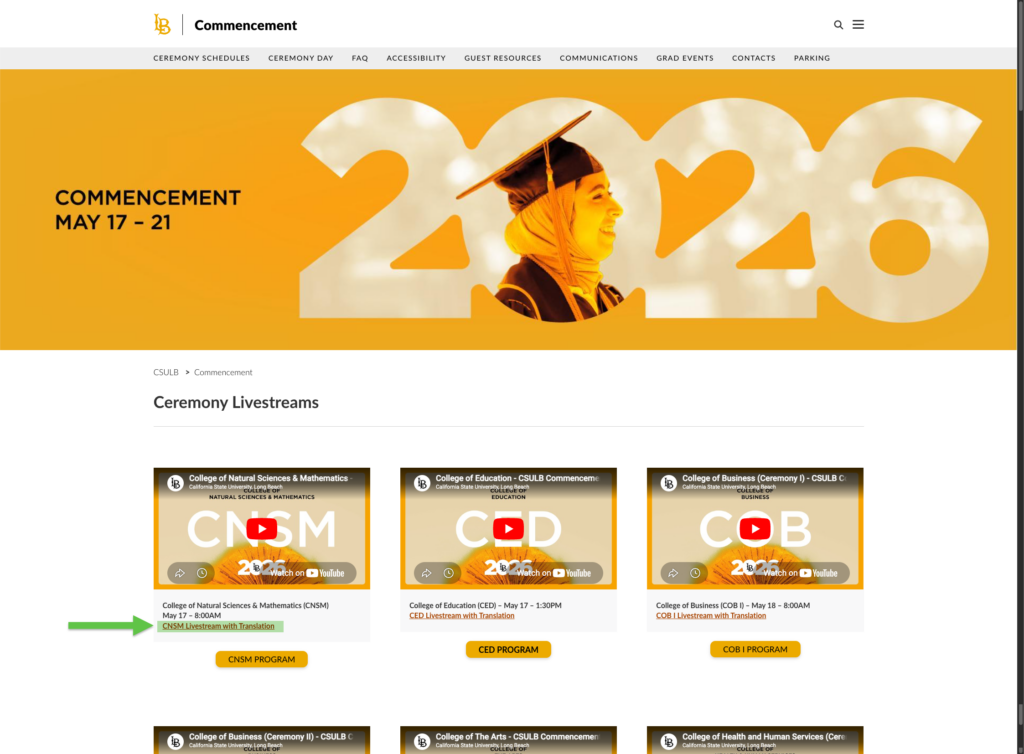
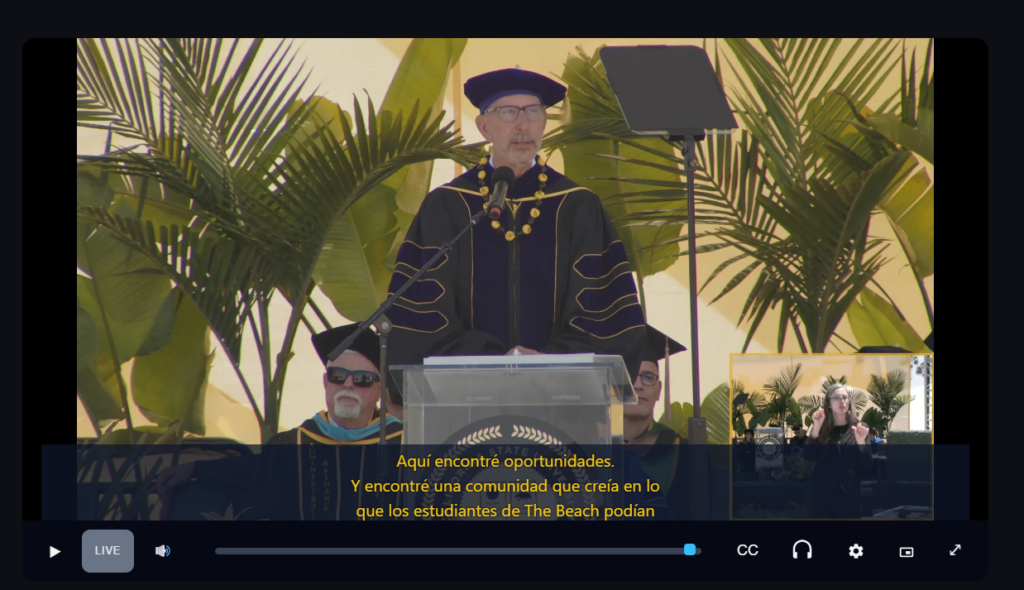
California State University, Long Beach illustrates this shift. After previously relying on venue-provided captioning services that did not meet expectations, returning commencement ceremonies to campus allowed the university to select accessibility solutions that better aligned with its goals. At the same time, the addition of a browser-based streaming player ensured that captions, multilingual subtitles, and voice translations were available to family members watching from anywhere.
Rather than being limited by the capabilities of a venue, institutions are increasingly able to design an accessibility experience that best serves their graduates, families, and guests.
Accessibility Begins Long Before the Ceremony
One of the most noticeable trends this season had nothing to do with captioning technology. It was communication.
The institutions seeing the greatest engagement treated accessibility as part of the overall guest experience, not simply as an accommodation available upon request. Rather than waiting for attendees to discover these services on their own, they introduced them before guests arrived and reinforced their availability throughout the event.
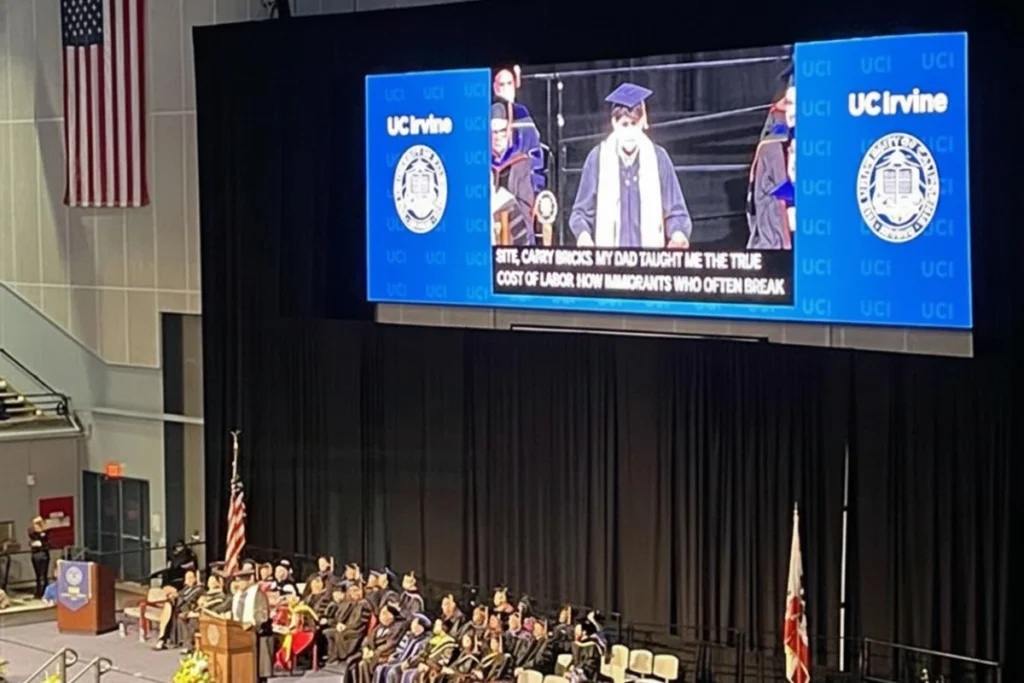
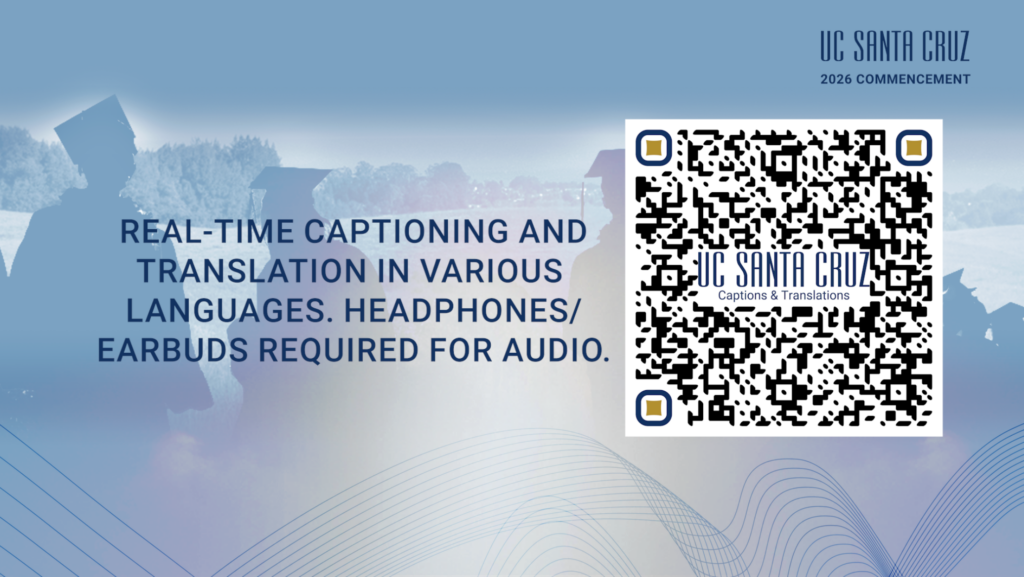
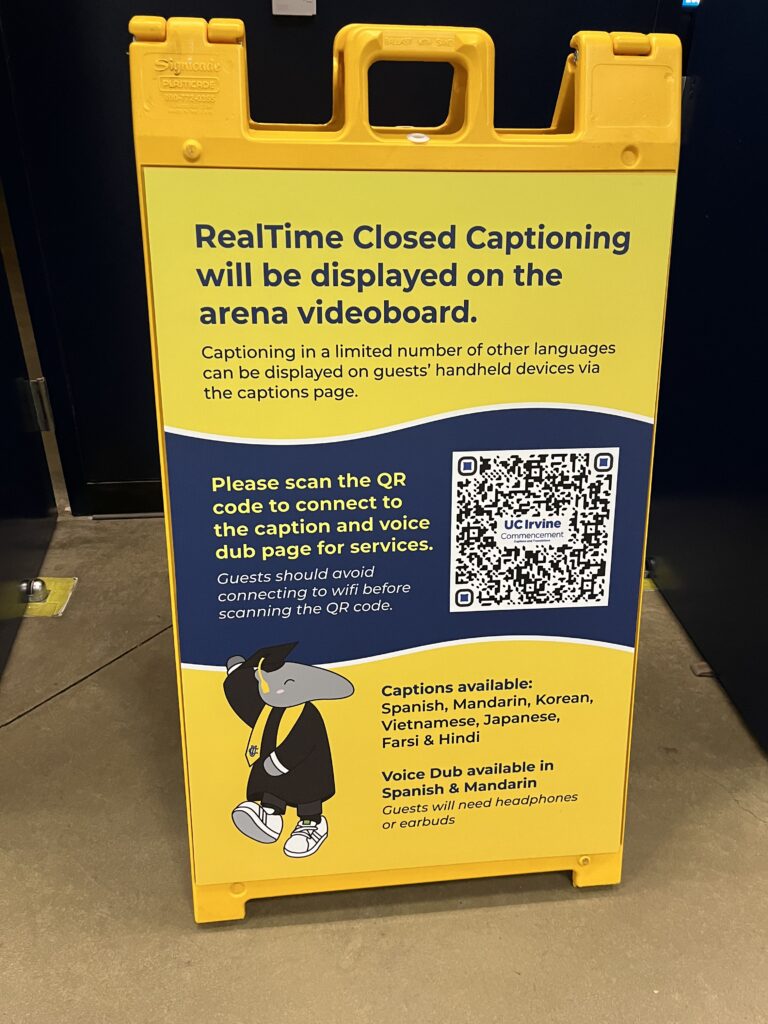
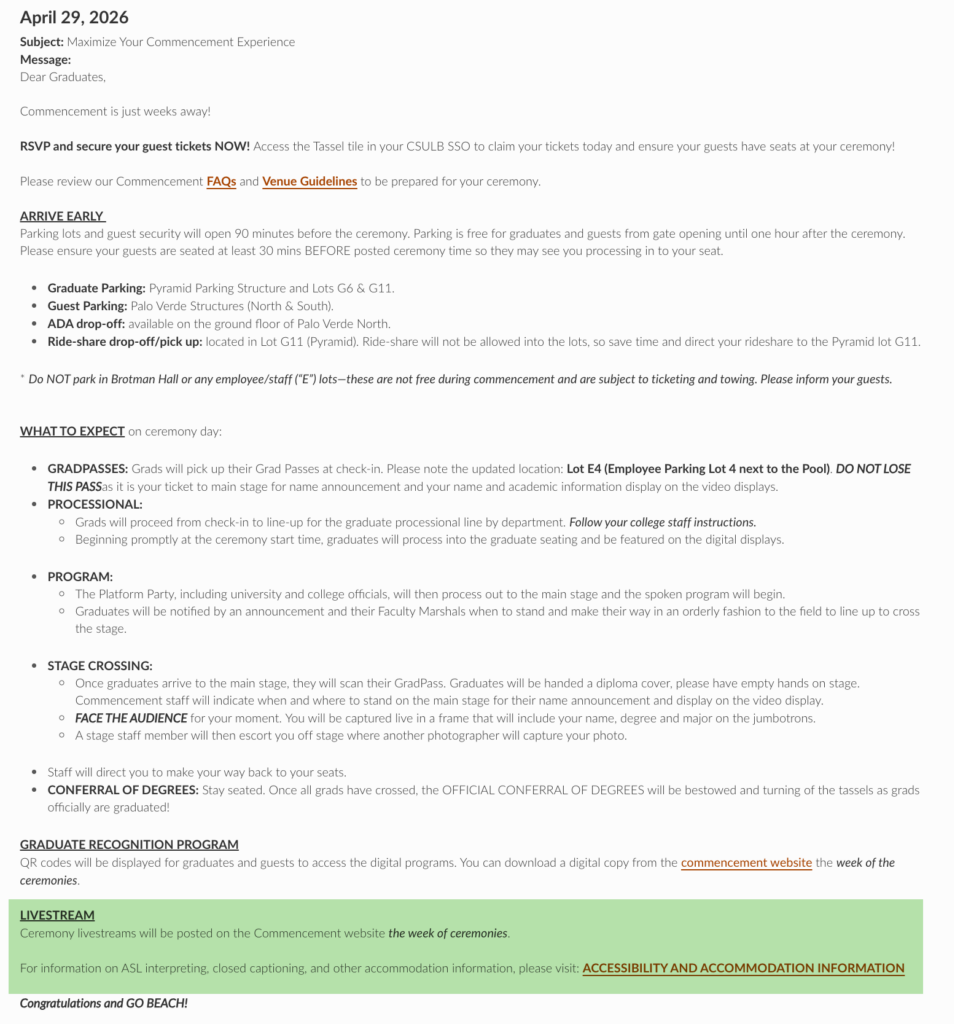
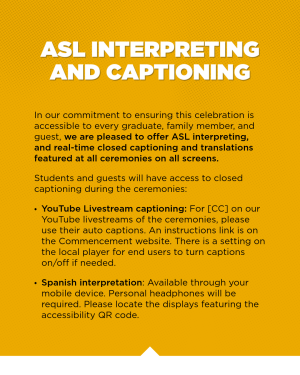
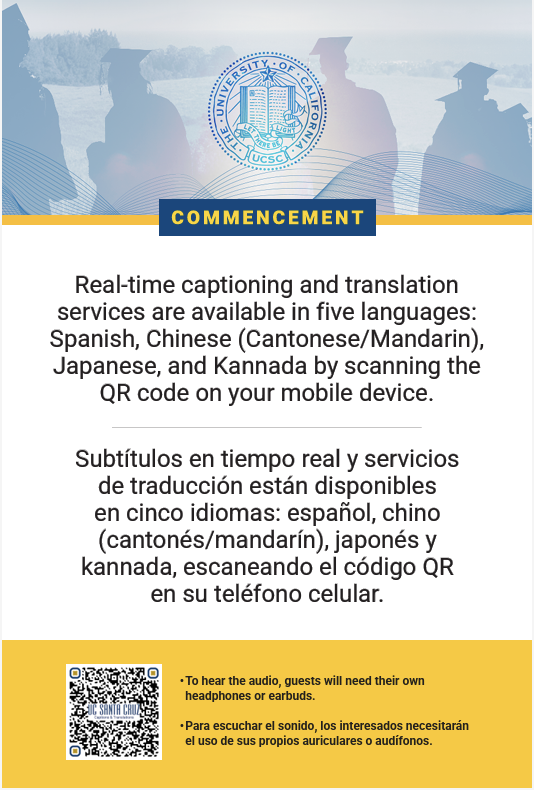
Pre-ceremony on-screen slide from UC Santa CruzA-frame display at UCI's ceremoniesA "know before you go" email sent out by CSULBSocial media post from CSULBFlyers available at the UC Santa Cruz venues
California State University, Long Beach incorporated accessibility information into its "Know Before You Go" communications, helping guests understand what services would be available before they arrived on campus. UC Santa Cruz promoted live captions and multilingual translation through QR codes, presentation slides, printed materials, and on-site signage throughout commencement.
These institutions recognized an important principle: accessibility is only effective when guests know it exists. Clear communication before and during the ceremony helps ensure that captions, translations, and other accessibility services are used by the people they were intended to support.
To help institutions plan future events, Aberdeen has assembled an In-Person Events Promotion Toolkitwith examples of pre-event communications, signage, QR code placement, presentation slides, and other best practices for increasing guest awareness and participation.
Accessibility Beyond the Venue
For many institutions, one of the biggest accessibility advancements this commencement season wasn't a captioning technology. It was how accessibility was delivered.
Traditionally, in-person guests and remote viewers often had different experiences. Accessibility inside the venue depended on the equipment available, while livestream viewers were often limited by the capabilities of the streaming platform itself. Most mainstream platforms support only basic live accessibility features, typically limiting institutions to a single translated language or a single live audio translation during the event. Additional languages are often only available after the livestream has concluded.
Aberdeen's browser-based streaming player removes those limitations. Instead of relying on the accessibility features built into a streaming platform, universities can provide a dedicated viewing experience that combines the live video with synchronized captions, multilingual subtitles, and AI-powered voice translations. This enables multiple languages to be available simultaneously during the live event while delivering a consistent experience for guests attending in person and those watching remotely.
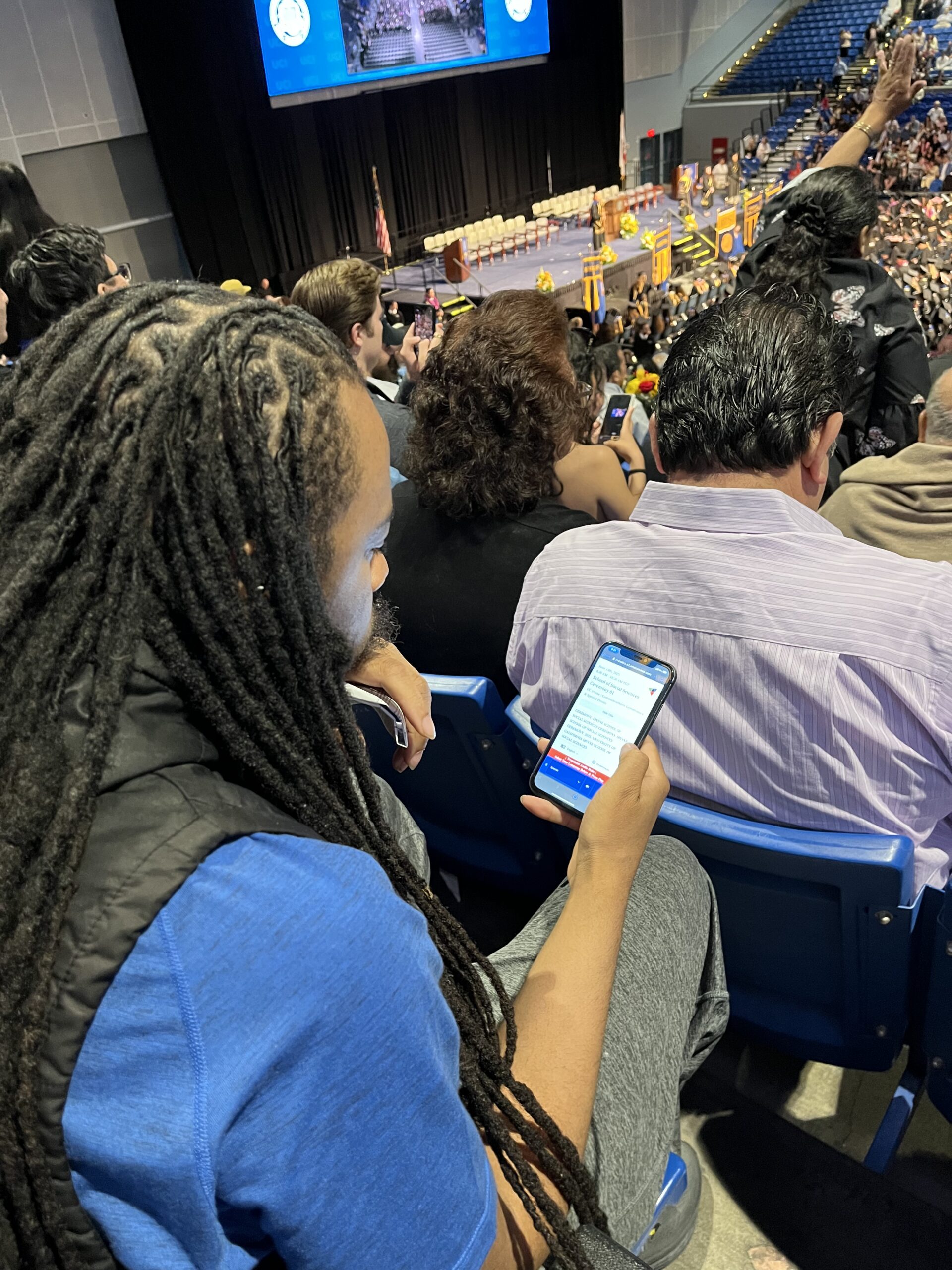
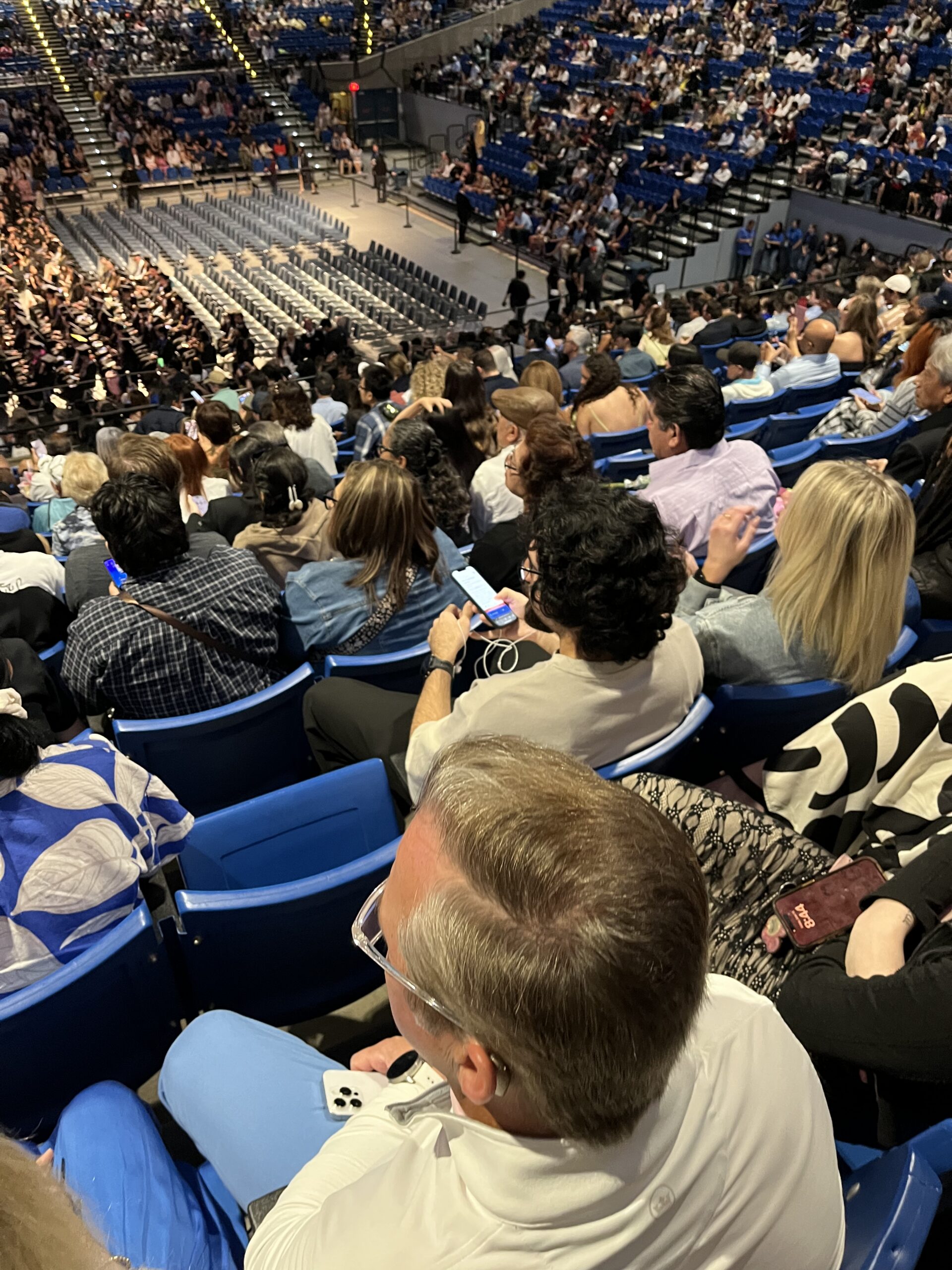
The same experience extended to guests attending in person. Rather than requiring dedicated receivers or venue-provided hardware, attendees could simply scan a QR code and follow along on their own phones using the same captions, translations, and audio available through the livestream.
For California State University, Long Beach, this flexibility was particularly valuable. Returning commencement ceremonies to campus meant the university was no longer limited to the accessibility resources provided by an outside venue. Combined with the streaming player, accessibility became available both inside the ceremony and for family members watching remotely.
Human Expertise and AI Continue to Complement One Another
Every multilingual commencement begins with a high-quality English caption feed.
For the Spring 2026 season, 612 hours of English captions were created by professional human captioners, while 82 hours used Aberdeen's ASR Writer. Those English captions then became the foundation for AI-powered subtitles and voice translations, helping families experience ceremonies in the language they understand best.
English Caption Sources (Spring 2026)
Professional human captioners remained the primary workflow, while ASR expanded as an additional option.
English Caption Sources (Spring 2026)
Professional human captioners remained the primary
workflow, while ASR expanded as an additional option.
English Caption Source
Hours
Professional Human Captioners
612
ASR Writer
82
Note: These figures represent the source of the English captions
only. AI-powered translation was used to generate multilingual
subtitles and audio translations for supported languages
regardless of the English caption source.
Note: These figures represent the source of the English captions only. AI-powered translation was used to generate multilingual subtitles and audio translations for supported languages regardless of the English caption source.
This distinction is important. The chart above represents only the source of the English captions. Once accurate English captions are available, Aberdeen's AI translation technology can generate live subtitles and audio translations in over 100 languages, regardless of whether the English captions originated from a professional captioner or ASR.
Rather than replacing one another, human expertise and AI work together. Professional captioners continue to be the preferred choice for many commencement ceremonies because they can make editorial decisions that improve the guest experience. During graduate name reading, for example, captioners typically omit long sequences of student names and resume captioning when speakers return to remarks or announcements.
ASR, by contrast, continuously transcribes speech and may attempt to caption every name without extensive preparation and custom vocabularies. As ASR technology continues to improve, it is becoming a practical option for more events. In both cases, AI translation extends accessibility well beyond English, allowing more families to fully participate in the celebration.
Building on Shared Success
While every institution's commencement is unique, one trend became increasingly apparent throughout the Spring 2026 season: universities are learning from one another.
Many of the institutions that adopted new accessibility services this year first encountered these approaches through conversations with peer universities, recommendations from trusted colleagues, or demonstrations at higher education conferences. As successful implementations become more visible, accessibility is becoming less about trying something new and more about adopting practices that have already proven successful elsewhere.
This collaborative exchange of ideas continues to accelerate the adoption of accessible commencement experiences across higher education.
Looking Ahead
The Spring 2026 commencement season demonstrated that accessibility is becoming a more intentional part of commencement planning.
Institutions are evaluating accessibility earlier in the planning process, communicating services more proactively, selecting languages based on the needs of their communities, and extending accessible experiences beyond the venue through mobile devices and livestreams. They are also choosing the combination of human expertise and AI technologies that best supports the goals of each ceremony.
The season also reflected a broader shift in how universities view accessibility. Rather than focusing on individual accommodations, institutions are designing commencement experiences that enable more graduates, families, and guests to participate fully, whether they are attending in person or joining remotely.
As technology continues to remove barriers and institutions continue to share successful practices, accessibility is becoming an expected part of commencement planning and an increasingly important part of celebrating student achievement.
Continue the Conversation
Planning Your Next Commencement?
If you're planning a future commencement and would like to explore accessibility options, compare approaches, or learn how other institutions are implementing live captioning, multilingual translation, and accessible livestreams, we'd be happy to share our experience.
Whether you're just beginning to plan or refining an existing program, our team can help you evaluate solutions that best fit your ceremony and your community.
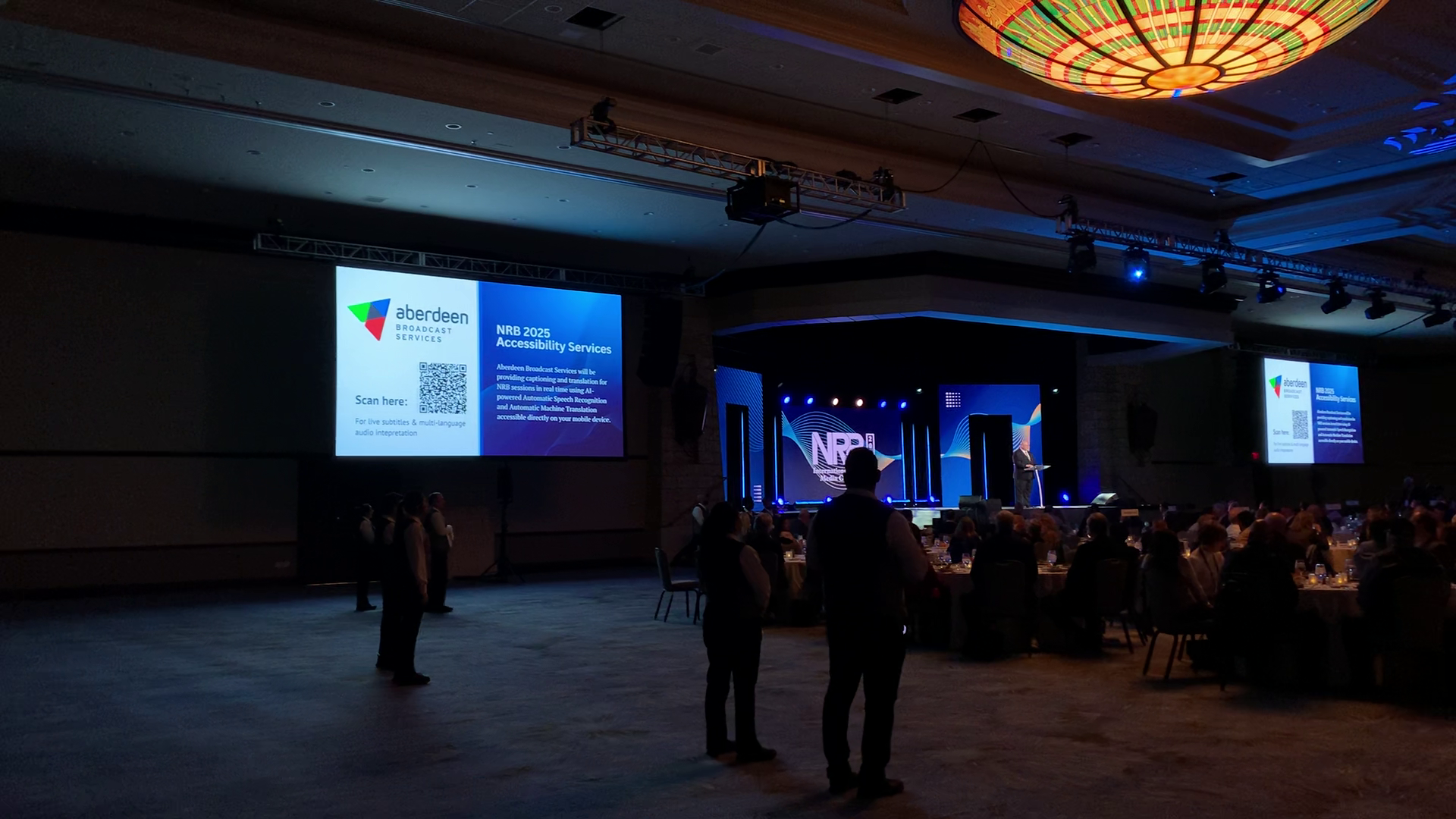
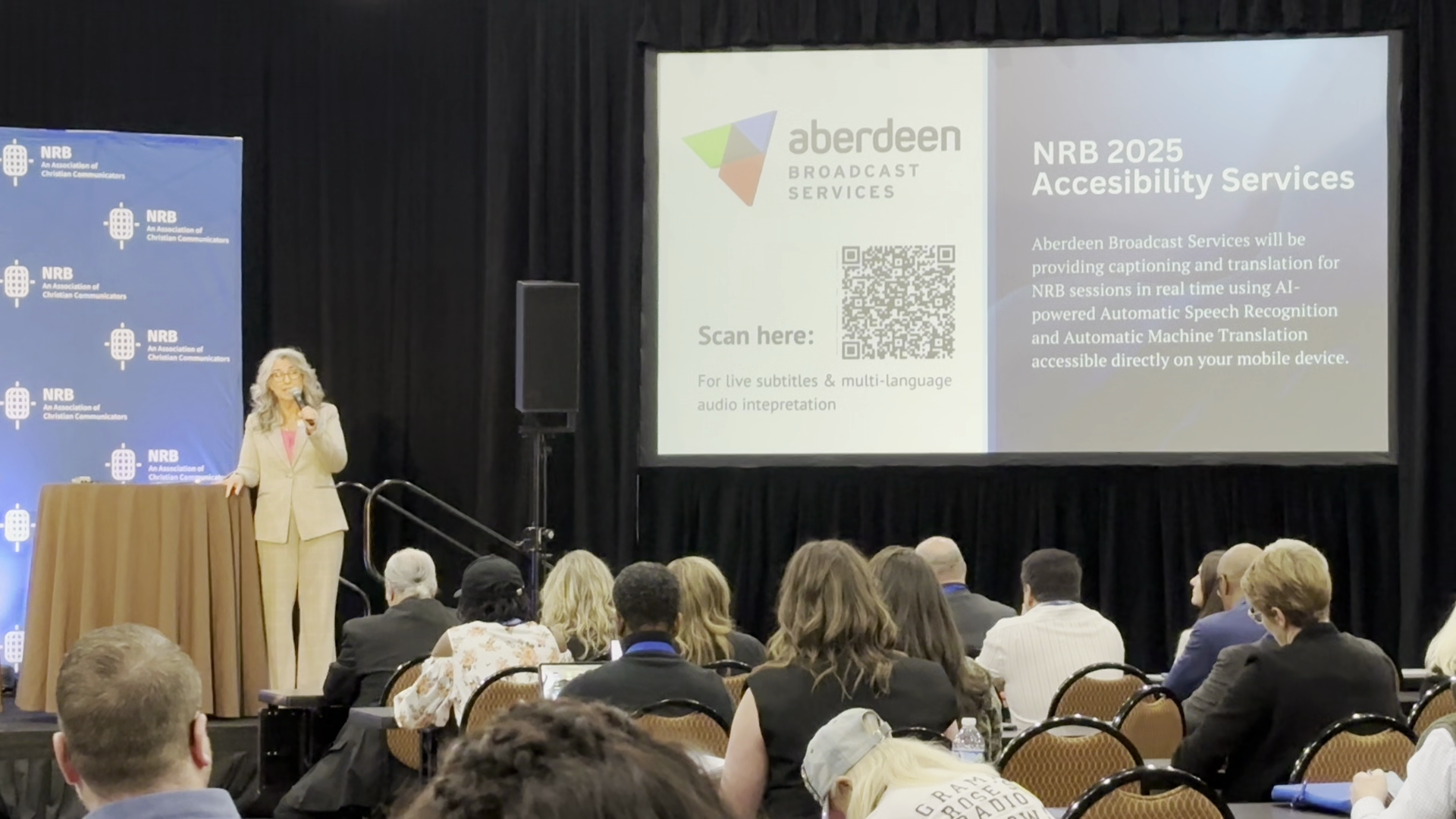
At the four-day International Christian Media Convention in Grapevine, Texas, Aberdeen Broadcast Services revolutionized accessibility by delivering real-time Automated Speech Recognition (ASR) and Automated Machine Translation (AMT) solutions. Through AI-powered captions, subtitles, and voice dubs, we ensured that all sessions, workshops, and events were accessible to a diverse audience, including Deaf and Hard of Hearing (D/HH) attendees, international guests, and non-English speakers.
This case study highlights the technical execution, engagement analytics, and impact of our AI-driven accessibility services, demonstrating how these innovations enhance inclusivity while setting new standards for multilingual communication in the religious broadcasting industry.
Client Overview: NRB (National Religious Broadcasters)
NRB unites content creators, broadcasters, and media professionals in faith-based media. The annual convention serves as a key platform for industry innovation and networking, drawing thousands of attendees from across the globe.
Aberdeen Broadcast Services has been a proud NRB member since 2001, and we’ve exhibited annually in the convention’s Exhibit Hall—supporting Christian media leaders with broadcast-quality captioning, translation, and broadcast transcoding and station delivery solutions year after year.
For more detailed information about NRB's mission, history, and upcoming events, you can visit their official website at https://nrb.org/.
Background & Project Objectives
Aberdeen Broadcast Services collaborated with the NRB (National Religious Broadcasters) team to deploy automated captions and multilingual translations across all event venues.
The initiative aimed to:
Enhance Accessibility – Ensure deaf & hard of hearing (D/HH) and multilingual attendees can fully engage with live content through captions and translated voice dubs.
Expand Reach – Enable non-English speakers and international attendees to participate via real-time, high-accuracy ASR and AMT services.
Seamless Integration – Deploy AI-powered solutions that integrate smoothly with the event’s media and AV infrastructure.
Showcase Innovation – Demonstrate how AI-driven translation transforms live event accessibility.
Implementation Strategy
Aberdeen worked closely with NRB’s event tech and media teams to implement AI-powered captions and voice translations across conference rooms, exhibit halls, and keynote sessions.
Pre-Event Planning
To ensure a smooth deployment, Aberdeen conducted detailed pre-event coordination with NRB’s technical teams. These planning sessions covered AV compatibility, network readiness, and session logistics, laying the groundwork for a seamless on-site setup.
In parallel, Aberdeen’s AI models were fine-tuned specifically for NRB’s audience—incorporating religious broadcasting terminology, varied speaker accents, and unique session formats. This customization helped boost initial accuracy and reduced the need for on-the-fly corrections once the event was live.
On-Site Execution
Delivering real-time captions and multilingual voice dubs across dozens of live events requires more than great technology; it demands strategic integration, on-the-ground expertise, and proactive user engagement. At NRB 2025, Aberdeen’s team worked room by room to implement a reliable, low-latency system that ensured seamless delivery throughout the four-day event.
From technical setup to attendee onboarding, every detail was planned and executed to provide a smooth, accessible experience for all.
Here's how it came together on-site:
Technical Setup & System Integration
Aberdeen deployed a robust, multi-room workflow to ensure the reliable delivery of real-time captions and multilingual voice dubs throughout NRB 2025. Designed for low-latency audio capture and seamless cloud-based processing, the system was supported by a team of on-site technicians assigned to each room.
Technicians monitored session quality, managed live connections, and handled any real-time troubleshooting, ensuring maximum system uptime and translation accuracy across the event.
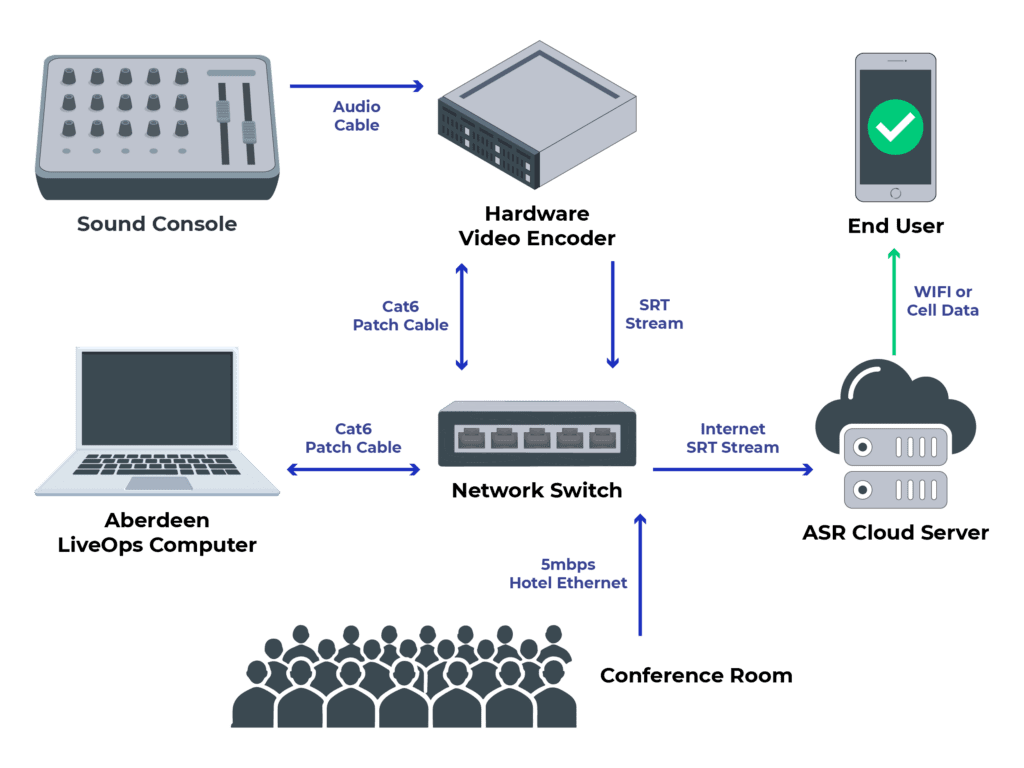
Audio feeds from each venue’s sound console were routed into video encoders and transmitted via dedicated Ethernet connections to Aberdeen’s ASR cloud servers. Simultaneously, technicians used laptops at each event to monitor session loads and dynamically add languages on the fly based on audience needs.
AV & Network Inputs from Each Room
Sound Console (with audio out to connect to Aberdeen’s encoder)
5 Mbps+ Ethernet Connection (dedicated per room)
Aberdeen’s On-Site Equipment
Network Switch
Cat6 Patch Cables (x2): One to connect the encoder to the network and one to connect the technician’s controller laptop
Video Encoder – Captured and streamed audio to ASR servers
Aberdeen Laptop (Controller) – Carried by the technician for on-the-fly control and session monitoring
Backup Audio Cable – Ensured compatibility with varying soundboard configurations
Here's a visual look at the setup:
Event Awareness & User Guidance
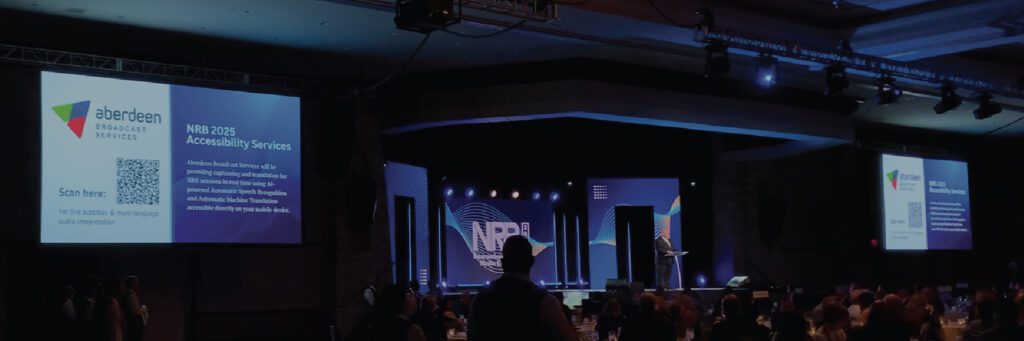
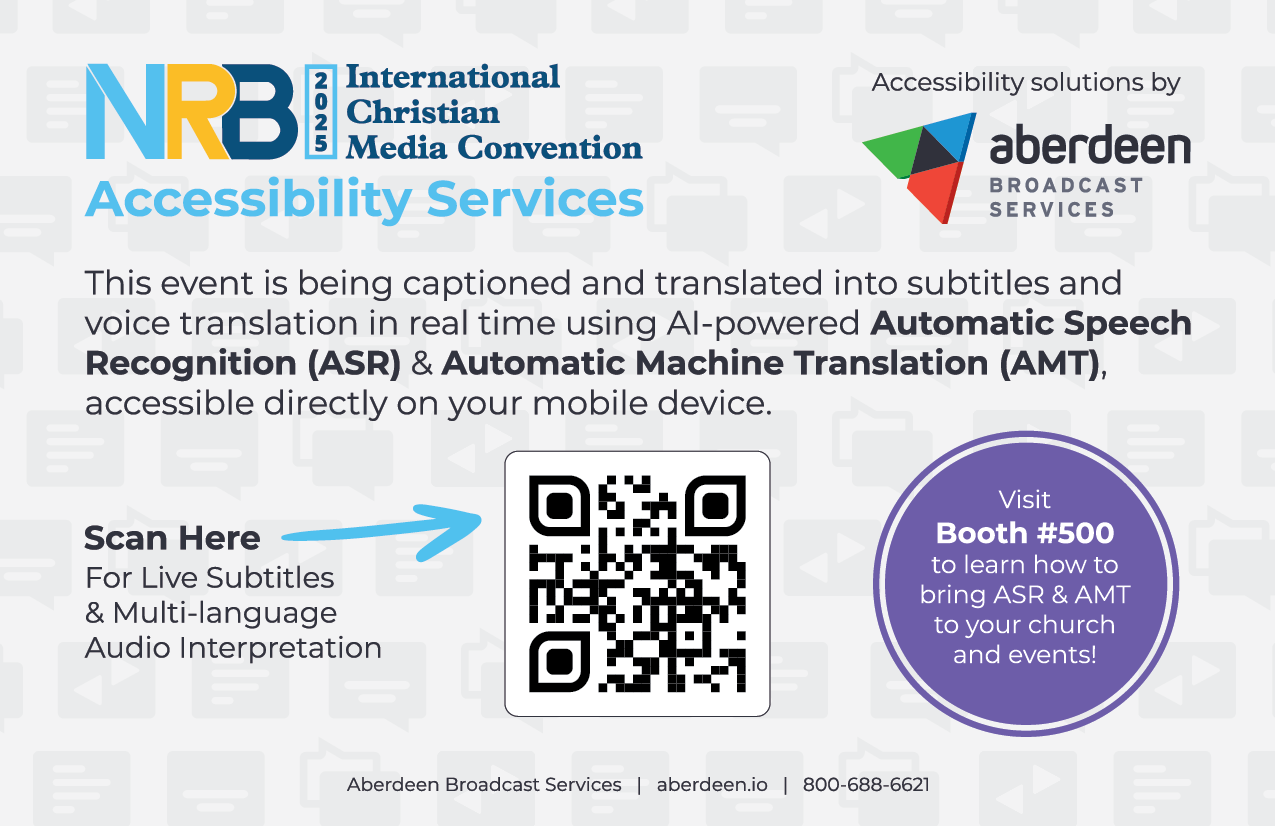
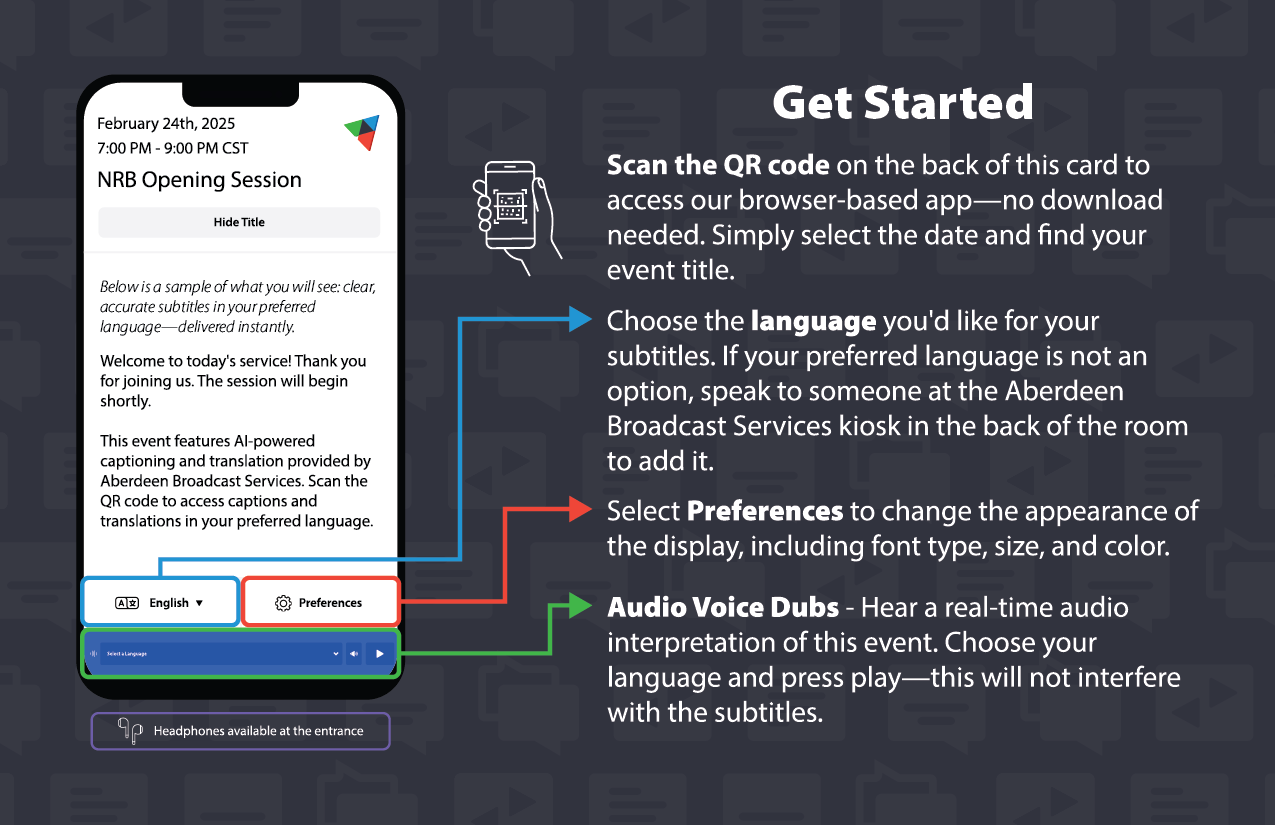
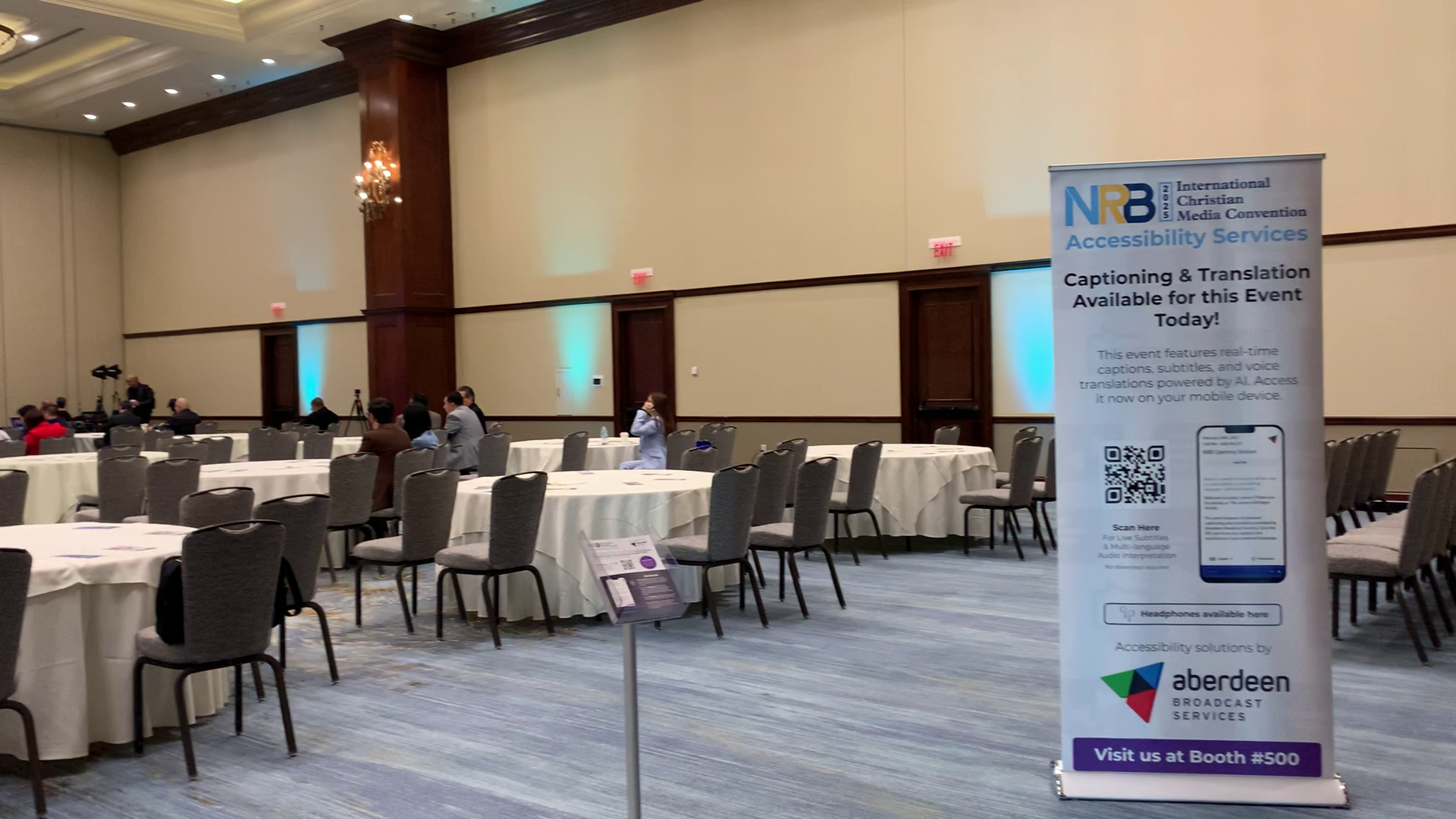
Printed Cards with QR Codes: Distributed to attendees, containing a QR code and simple instructions on how to access the AI-powered captions and voice dubs.Tall Banners at Session Entrances: These are placed at the entrances of all sessions and events, clearly displaying how to use the accessibility services.Pre-Session TV Slides: Before each session, conference TVs displayed an instructional slide with a QR code, ensuring every audience member knew how to access the service before the session started.
Complimentary Earbuds – Upon request, we provided headphones for attendees who wished to listen to the voice dubs.
Engagement Performance (Totals)
The NRB (National Religious Broadcasters) Convention welcomed more than 5,800 Christian media professionals—including 345 international attendees representing 52 countries outside the United States.
The following statistics reflect actual show usage, based on attendees who actively engaged with Aberdeen’s accessibility tools during sessions and events.
It’s important to note that every unique view was automatically recorded as a view of the English captions since English was the default language. Users then had the option to select a translated subtitle or voice dub, meaning the counts for translated languages reflect intentional user selection beyond the initial caption display.
NOTE: The following head counts reflect individual event attendance, not unique people. Many attendees participated in multiple sessions and events, so individuals may be counted more than once.
Metric
Total
% of Attendance
Head Count (Session Attendance)
Total
6,215
% of Attendance
Not applicable
Unique Users Engaged
Total
663
% of Attendance
10.67%
Voice Dub Usage
Total
276
% of Attendance
4.5%
41.63% of engaged users
Subtitle Usage (Non-English)
Total
61
% of Attendance
0.98%
9.2% of engaged users
Over 6,000 seats were filled across four days of sessions, panels, workshops, and keynotes—showcasing the scale and momentum of NRB 2025.
663 attendees actively used Aberdeen’s accessibility tools, representing slightly over 1 in 10 participants who engaged with real-time captions, translated subtitles, or AI-generated voice dubs.
Of those who engaged with the service, nearly 42% chose to listen to translated voice dubs, while just under 10% accessed content through on-screen subtitles—highlighting a clear preference for audio over text-based translation.
Day-By-Day Trends
Day
Head Count
Unique Views
Dubs
Subtitles
Monday
Head Count
1,002
Unique Views
37
Dubs
20
Subtitles
0
Tuesday
Head Count
1,734
Unique Views
272
Dubs
112
Subtitles
2
Wednesday
Head Count
2,220
Unique Views
240
Dubs
90
Subtitles
37
Thursday
Head Count
1,259
Unique Views
114
Dubs
54
Subtitles
22
Room-By-Room Performance
Room
Head Count
Unique Views
Dubs
Subtitles
% Views
Texas Ballroom AB
Head Count
2,067
Unique Views
78
Dubs
31
Subtitles
0
% Views
6.19%
Texas Ballroom C
Head Count
2,535
Unique Views
296
Dubs
104
Subtitles
8
% Views
11.68%
Longhorn Workshop Stage
Head Count
1,431
Unique Views
232
Dubs
115
Subtitles
7
% Views
16.21%
Grapevine Ballroom C
Head Count
182
Unique Views
57
Dubs
26
Subtitles
46
% Views
31.32%
Notable Event Highlights
Tuesday marked the highest engagement day for both attendance and unique views.
Subtitle usage rose significantly midweek, peaking on Wednesday and Thursday.
Longhorn Workshop Stage had the most consistent adoption, with over 16% of attendees engaging daily.
Grapevine Ballroom C hosted the two-day Latino Media Summit, which drew 182 attendees and recorded the highest subtitle usage of the week, with 31.32% engaging with the accessibility service.
Podcasting & Video Workshops (Longhorn Workshop Stage): 1,431 combined headcounts, 232 unique views, and highest per-capita voice dub usage of the week.
Challenges & Mitigation
Challenge
Solution
Hotel Network Configuration
Solution
The hotel’s IT infrastructure blocked standard static IPs and subnet masks. Aberdeen quickly adapted by configuring all encoders to use DHCP, scanning the network to identify active IPs, and manually accessing each WebUI to reconfigure the streaming setup.
User Awareness & Onboarding
Solution
Coming into the event, most attendees didn’t know the service was available or how to access it, so Aberdeen deployed printed QR cards, tall instructional banners, and pre-session screen slides to guide users before each session.
Scaling Across Diverse Room Setups
Solution
Different rooms had varying AV capabilities and audio console types. A technical kit was standardized and included flexible backup equipment, such as extra audio cables and patch cables, to adapt quickly from room to room.
Terminology Accuracy
Solution
Our team built custom dictionaries for each event, including names, acronyms, and phonetic pronunciations tailored to individual sessions, greatly improving real-time accuracy.
Conclusion & Future Strategies
Aberdeen’s AI-powered ASR & AMT deployment at NRB 2025 demonstrated strong engagement and adoption, especially in high-traffic venues. While initial awareness posed a challenge, the usage numbers and feedback show clear potential for continued growth.
Future Improvements
Enhanced Pre-Event Marketing – Increase awareness and user adoption through targeted event promotions.
Survey Language Preferences During Registration – Gather attendee language preferences ahead of time to personalize content delivery and better anticipate demand for specific translations.
Expanded Language Support – Introduce additional languages to serve a broader audience.
This project set a new benchmark for AI-driven accessibility in religious broadcasting and live events. Aberdeen looks forward to refining these solutions and expanding their impact at future industry gatherings.
Ready to Make Your Next Event Accessible to All?
Whether you're planning a conference, live broadcast, or global webcast, Aberdeen’s AI-powered captioning and translation solutions can help you engage a broader, more inclusive audience.
Let’s talk about how we can support your next event.Contact us to learn more.
What a season! We know—it didn’t end the way the Lions had hoped, but wow, what a ride! Each week, fans tuned in to Inside the Pride to relive the action, gain exclusive insights, and experience the energy of game day. And behind the scenes, our team at Aberdeen Broadcast Services worked tirelessly to ensure every thrilling moment was captioned and accessible to all.
The Call to Action
It would all start Wednesday at 5 AM PT. The Detroit Lions uploaded the final cut of Inside the Pride to our portal, and our team would immediately spring into action. The clock was ticking, and we had just four hours to deliver flawless captions.
The Challenge
Captioning a show like Inside the Pride isn’t just about words on a screen. It’s about capturing the emotion, the intensity, and the small moments that make the game come alive. Our team had to:
· Ensure every player, coach, and staff member’s name is spelled correctly.
· Describe the roar of the crowd, the crack of a tackle, and the play calls on the field.
· Position captions strategically so they never block key graphics or important visuals.
No second chances. We had to get it right—the first time, every time.
Inside the Huddle
Our team relied on preparation and expertise to keep up with the fast pace. Football terminology? Memorized. Key phrases and commentator expressions? Locked in. From “screen pass” to “seam route” and “go route,” we knew the language of the game inside and out.
But it wasn’t just about knowing the sport, it was about teamwork. From the account manager coordinating logistics to the caption editor perfecting the captions on every frame, it was a full-team effort, just like the Lions on game day.
A Season to Remember
Though the season ended sooner than we all wanted, we couldn’t be prouder—not just of the Lions, but of the dedication, precision, and passion our team brought each week.
Every touchdown, every huddle, every sideline interview… we were there, making sure every fan, no matter how they experienced the game, could be part of the action. And we can’t wait to do it all again next season!
Aberdeen provides live captioning of a church service at Idlewild Church, allowing members of the congregation who are hard of hearing to be able to understand the message being preached.
Background
Senior Pastor Ken Whitten of Idlewild Church realized that members of his congregation were sitting in silence. Although his message was being interpreted by a sign language interpreter, this service was only helpful to church members who actually knew sign language. There were newly deaf (adult-onset) and hard-of-hearing members in his church that had no way of understanding his sermon.
Solution and Execution
Idlewild Church set up large screen projectors with the live captioning streaming from an Aberdeen live captioner so the deaf and hard-of-hearing members could follow the message live.
Results
The live captioning was a success and for the first time completed seamlessly; every member of the congregation had a clear understanding of the message being preached.
"Thanks Team for making yesterday memorable for so many. It’s just the beginning, but it would have never launched without you and your heart and hard work. You’re a blessing to labor with. I could have also talked about a lady who cried at 9:30 too. They are out there. One lady came to see me at the Pastor’s reception and told me she’s telling all her friends. Get ready. It’s meeting a need.”