For years, a livestream player had one basic job: play the video.
It was simple: open the link, click play, watch the event. That was the whole experience people expected, with nothing more and only one language.
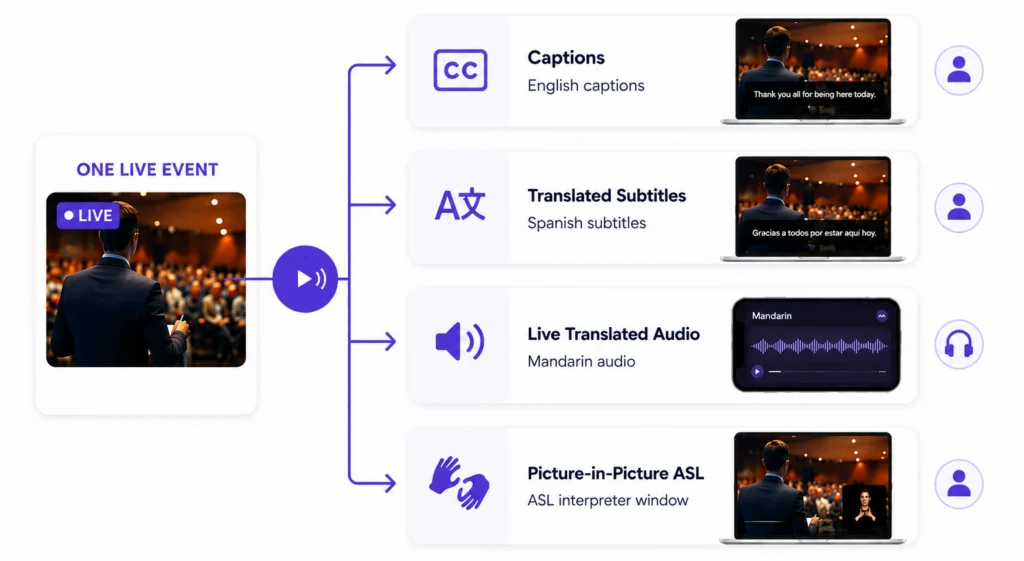
However, when accessibility and multilingual communication are built into the player, the same live event can provide an audience with so much more. During a broadcast, a modern player can:
Same event, same link, but four different ways to experience it, all chosen by the viewer.
So, what makes a streaming player accessible? What should your organization look for when choosing one?
Well, that is what this guide is all about!
Picture your event: a commencement, conference, service, or town hall. This event will reach many different people online. Do you know who is on the other end watching? What are their needs? What would make their experience easier?
Unless a survey went out ahead of time, this can be very hard to determine, but you can expect that at least one viewer will need one or more accessibility services. With an accessible player, each viewer can choose how they take in your content:
The point isn’t to include a single feature. It’s to offer multiple options and allow the viewer to decide. This ensures that no one in the audience is left out.
That is what accessibility looks like when it is built in from the start rather than added as an afterthought.

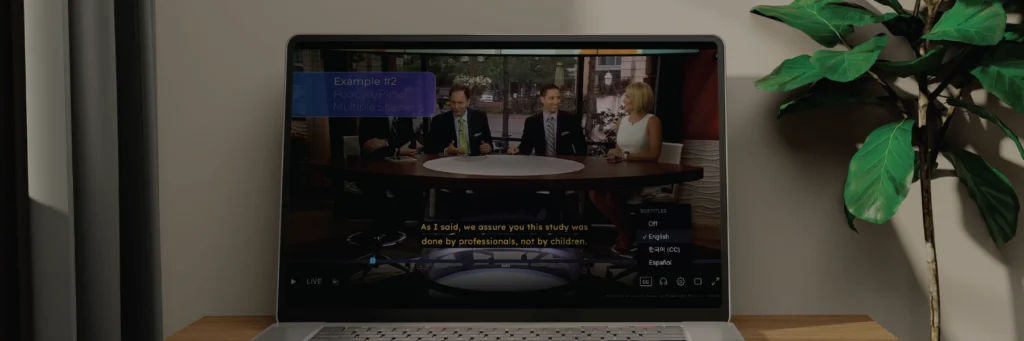
Try it for yourself. Use the controls in the player to switch between captions, subtitle languages, and translated audio. Each viewer can make their own selections while watching the same live event.
It is worth being clear about the current challenge. Many conventional streaming platforms already have accessibility and language options for recorded or on-demand (VOD) video. Viewers can experience recorded video with captions and translated audio tracks on these platforms.
Livestreaming is a different story. During a live event, many of the capabilities offered for VOD are more limited. This is the gap we aimed to bridge with an accessibility-focused player built to bring these options into the live viewing experience.
Here is a look at how a purpose-built player compares to what mainstream platforms offer during a live event:
None of these services matter if the stream itself is not dependable. Viewers need video that plays without constant buffering, captions and translated subtitles that arrive on time, and translated audio that is clear and synchronized with the event.
It is the responsibility of the streaming provider to have a reliable foundation that can continually play out the stream. On top of this foundation is a capable live player built to deliver:
Behind the scenes, the player adjusts to each viewer’s connection in real time and keeps each track locked to the same clock. Keeping video, captions, translations, and multiple audio tracks synchronized is one of the most important parts of delivering a seamless live experience. A good player handles that synchronization so the viewer never has to think about it.
If this all sounds complicated, don’t worry. The complexity of the technology stays behind the pipeline and player. At Aberdeen, we walk clients through the whole process:
Your team can stay focused on the event while we handle the work behind the scenes that makes the stream accessible.
The same livestream can be experienced in different ways. Each viewer selects the accessibility and language options that work best for them.
Here is a practical checklist if you are evaluating options. These questions are worth asking any provider and touch on everything above:
With all the engineering underneath, the viewer should never have to think about it. No one should need a technical background in adaptive bitrate streaming or audio track management to experience a graduation or service. They should simply open the link, choose the language or accessibility option that works for them, and enjoy the event.
That is the real goal: technology sophisticated enough to include everyone and simple enough that no one notices it is there.

For more than a decade, the FCC has continued to refine how responsibility for closed captioning is shared between the video programmers who create content and the video programming distributors (VPDs) that deliver it to viewers. Aberdeen has been following those changes along the way.
In 2014, the FCC established new standards focused on the quality of closed captions. In 2016, the Commission expanded the responsibilities of video programmers and introduced a shared responsibility model between programmers and distributors. Now, ten years later, the FCC is revisiting part of that framework.
On August 26, 2026, the FCC released Report and Order FCC 26-57, eliminating several registration and certification requirements that the Commission determined were unnecessarily duplicative.
The important distinction is that the FCC is simplifying some of the paperwork surrounding closed captioning compliance, not eliminating the underlying obligation to provide compliant closed captions.
The latest changes make more sense in the context of how the FCC's closed captioning rules have evolved. Over the past decade, the Commission has established caption quality standards, defined how responsibility is shared between programmers and distributors, and continued to refine how that compliance is documented.
FCC establishes standards for accuracy, synchronization, completeness, and placement.
Read our 2014 coverage →New quality requirements take effect, including the VPD “best efforts” certification process.
Read our 2015 coverage →FCC formalizes responsibilities for both video programmers and video programming distributors.
Read our 2016 coverage →FCC clarifies the process for addressing caption-quality complaints between VPDs and programmers.
Read our 2018 coverage →FCC eliminates certain duplicative registration and certification requirements while leaving underlying captioning obligations intact.
Latest UpdateThat brings us to 2026. Rather than reversing the captioning standards and shared responsibilities developed over the previous decade, FCC 26-57 revisits some of the administrative requirements built around them.
There is an important bit of history here. In 2016, the FCC adopted a system that would eventually require video programmers to register directly with the Commission and submit annual certifications regarding their compliance with the closed captioning rules. Aberdeen covered those changes at the time in FCC Shared Responsibilities: Caption Quality & Certification.
That direct FCC filing system, however, never became operational as originally envisioned. In FCC 26-57, the Commission notes that video programmers currently do not make those filings because the FCC's website is not yet ready to accept them.
Meanwhile, the certification process that stations and other video programming distributors have actually been working under continued to require VPDs to use "best efforts" to obtain caption quality certifications from their programming suppliers.
FCC 26-57 addresses both pieces of that history.
FCC 26-57 takes another look at the registration and certification structure adopted in 2016 and concludes that, in certain situations, requiring individual programmers and the networks carrying their programming to make separate FCC filings would create unnecessary duplication.
Under the amended rules, video programmers providing programming exclusively to a qualifying nonbroadcast network may not need to separately register and certify with the FCC when the network has filed the appropriate registration and certification covering its linear programming lineup. Similar relief applies to programmers providing content exclusively to qualifying public, educational, and governmental (PEG) access channels.
The distinction is important because this is not a transition from an existing system where every producer has been filing certifications directly with the FCC. Although that direct filing requirement was adopted in 2016, the Commission never implemented the system necessary to accept those filings.
Instead, FCC 26-57 is simplifying that planned framework before it fully takes effect. If the appropriate network or PEG administrator can certify the programming lineup, the FCC no longer sees a need for qualifying individual programmers to duplicate that filing.
FCC 26-57 changes both the certification process broadcasters have been working under and a direct-to-FCC filing system adopted in 2016 that never became fully operational.
VPDs use “best efforts” to obtain caption quality certifications from their programming suppliers.
The FCC adopted direct registration and annual certification requirements for video programmers, but the filing system was never fully implemented.
When the network or PEG administrator meets the FCC's requirements, qualifying individual programmers do not need to duplicate that filing.
If the network or channel administrator does not make the required filing, however, individual programmers can still retain their registration and certification obligations.
PEG programming has been part of this discussion for even longer. In 2015, we covered an FCC roundtable specifically addressing Closed Captioning and PEG Programming, including the complicated relationship between FCC captioning exemptions and other accessibility responsibilities.
FCC 26-57 now provides registration and certification relief for certain PEG programmers. If the administrator of an exempt PEG channel registers with the FCC and certifies the channel's exemption, individual programmers providing content exclusively to that channel will not also have to register and certify the same exemption.
The rule addresses non-exempt PEG channels as well. If the channel administrator certifies that all programming carried on the channel is either compliant with the captioning rules or exempt, individual programmers can similarly be relieved of the duplicative filing requirement.
The distinction here is important: the FCC has not created a blanket closed captioning exemption for PEG programming. The change concerns who must file the registration and certification, not whether otherwise non-exempt programming must be captioned.
This may be the most important part of the new Order. The FCC states directly that the amendments do not alter a video programmer's substantive closed captioning obligations. Programming that was exempt remains exempt, while programming that is not exempt must still be captioned.
The caption quality standards Aberdeen has been writing about since 2014 also remain in place: accuracy, synchronization, completeness, and placement. FCC 26-57 does not undo those requirements.
In fact, the Commission specifically concluded that the changes should not affect caption quality because programmers of non-exempt content are being relieved of certain filing requirements, not the underlying obligation to provide captions that comply with FCC quality standards.
There is another change that may be more immediately recognizable to television stations and other VPDs.
When the FCC's caption quality standards were being implemented in 2015, stations and other distributors were required to use "best efforts" to obtain captioning compliance certifications from the video programmers whose content they carried. We covered that requirement at the time in FCC Pushes Back the Date on New Captioning Quality Standards.
That is the certification process many broadcasters and producers will recognize from their actual workflows: the programmer provides its certification, while the station or other VPD makes the required effort to obtain it.
FCC 26-57 removes that "best efforts" obligation once the amended rules become effective.
What it does not change is the underlying division of captioning responsibility. Video programmers remain responsible for captioning matters within their control, and VPDs remain responsible for matters within theirs.
This is where the new Order fits into the larger history of FCC captioning regulation. FCC 26-57 does not reverse the shared responsibility framework established in 2016.
Video programmers remain responsible for captioning matters within their control, while VPDs remain responsible for matters within theirs. That distinction also remains important when a captioning problem occurs.
We previously covered how those responsibilities work through the FCC's complaint process in FCC Updates the Compliance Ladder for Closed Captioning Complaints.
The 2026 Order is better understood as a simplification of the administrative system built around those responsibilities, rather than a reversal of the responsibilities themselves.
For most producers, the practical requirement to deliver properly captioned programming does not disappear. If programming is subject to the FCC's closed captioning rules, it still must be captioned, and those captions still must comply with the applicable quality standards. FCC 26-57 expressly says that the rule changes do not alter a video programmer's substantive captioning obligations.
What is changing is the administrative structure surrounding those obligations. The FCC is eliminating the VPD "best efforts" requirement to collect programmer certifications and simplifying the direct registration and certification system adopted in 2016 before that system was fully implemented.
Networks and stations may also continue to impose their own captioning requirements through technical specifications, contracts, delivery procedures, or other business arrangements. The FCC specifically notes that nonbroadcast networks often use contractual provisions or other mechanisms to hold their program suppliers accountable for captioning compliance, and FCC 26-57 is not intended to interfere with those arrangements.
In practical terms, a producer may have less FCC certification paperwork surrounding the delivery, but the responsibility to deliver properly captioned programming remains.
That is still the simplest way to summarize FCC 26-57, but the history adds an important layer.
In 2014 and 2015, the FCC established and implemented caption quality standards. In 2016, the Commission formalized shared responsibilities between programmers and distributors and adopted a future system for programmers to register and certify directly with the FCC. That direct filing system never fully became operational.
Now, ten years later, the FCC is simplifying that planned system before it does, while also eliminating the existing "best efforts" requirement that has required VPDs to obtain certifications from their programming suppliers.
Chairman Brendan Carr described the action as eliminating "unnecessarily duplicative requirements" and said the Commission concluded that the changes would have no negative impact on captioning availability or quality.
What the Commission is not doing is backing away from its caption quality standards or removing the requirement to caption non-exempt programming.
For broadcasters and video programmers, the takeaway is straightforward: some of the compliance paperwork is changing. The responsibility to provide quality, compliant closed captions is not.
Not all portions of FCC 26-57 take effect immediately. Certain amendments become effective 30 days after publication in the Federal Register. The new provisions governing registration and certification relief under sections 79.1(i)(4) and 79.1(m)(6), however, are subject to review under the Paperwork Reduction Act and will not become effective until that process is complete and the FCC announces an effective date.
Aberdeen will continue to follow the implementation of these changes and provide updates as additional guidance and effective dates become available.
Accessibility is no longer an afterthought. It's becoming part of the celebration.
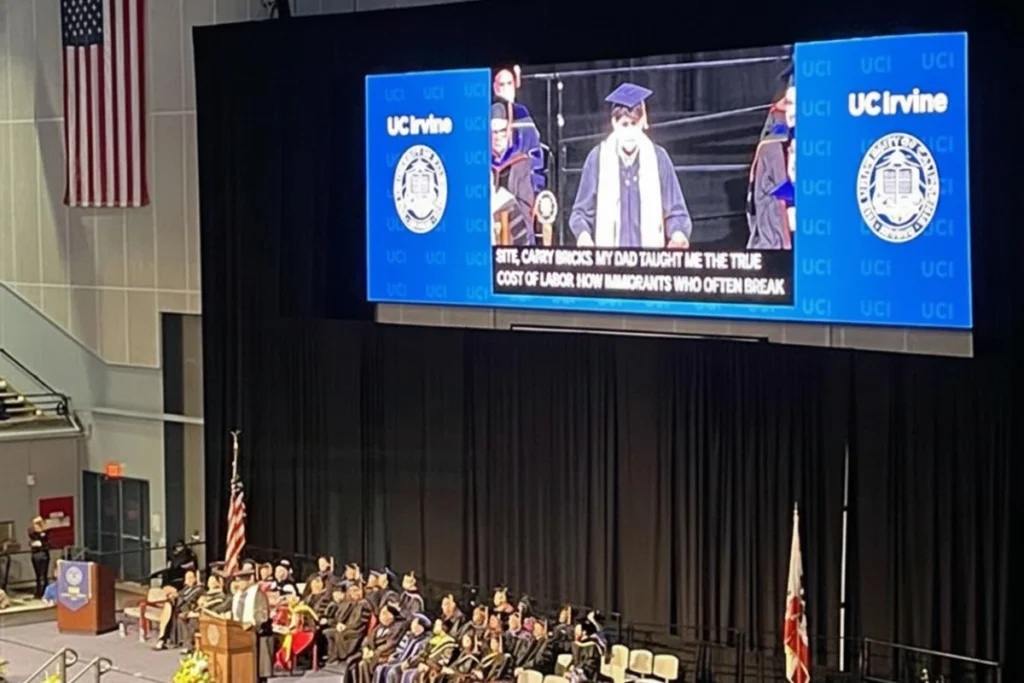
For graduates, commencement marks the culmination of years of hard work. For families, it is one of life's most meaningful milestones. Unlike a lecture or campus event, commencement is a once-in-a-lifetime celebration that cannot simply be repeated, making accessibility especially important for graduates, families, and guests.
As colleges and universities continue to expand accessibility at commencement, one trend has become increasingly clear: institutions are thinking beyond compliance and focusing on creating celebrations that every guest can experience.
During the Spring 2026 commencement season, Aberdeen supported 39 colleges and universities across the United States, providing accessibility services for 279 commencement ceremonies totaling 694 hours of live event support. While every institution approached accessibility differently, several common themes emerged that point toward the future of inclusive commencement experiences.
Accessible commencement is no longer limited to a handful of institutions or a single accommodation. Compared to the previous year, universities expanded both the scale of their ceremonies and the accessibility services supporting them.
Every metric grew at a broadly similar rate from 2025 to 2026 — institutions by half, ceremonies and service hours by roughly three-quarters.
| Metric | 2025 | 2026 | Growth |
|---|---|---|---|
| Institutions | 26 | 39 | +50.0% |
| Ceremonies | 156 | 279 | +78.8% |
| Service hours | 395.5 | 694 | +75.5% |
Between Spring 2025 and Spring 2026:
Growth wasn't concentrated within one segment of higher education. Public universities, private institutions, community colleges, faith-based universities, medical schools, and research institutions all expanded accessible commencement experiences.
Perhaps even more encouraging, 13 institutions partnered with Aberdeen for commencement for the first time, reflecting growing interest across higher education.
Rather than treating accessibility as a specialized service, many institutions are beginning to view it as a standard part of the commencement experience.
Commencement has always celebrated student achievement, but universities increasingly recognize that these ceremonies are equally about the families, friends, and communities who supported graduates along the way.
As a result, accessibility is no longer viewed through a single lens. Some guests benefit from live English captions, while others rely on multilingual subtitles or translated audio to fully experience the ceremony. For family members unable to attend in person, livestream accessibility extends that same experience beyond the venue. Others simply find captions helpful for following along in large venues or noisy environments.
This Spring, participating institutions offered accessibility in 22 languages, reflecting the linguistic diversity of the graduates, families, and communities they serve.
Languages were selected based on the needs of graduates, families, and guests.
Languages were selected based on the needs of graduates, families, and guests.
| Language | Hours | Clients | Share of English hours |
|---|---|---|---|
| Spanish | 324.5 | 21 | 53.0% |
| Chinese, Simplified | 237.25 | 8 | 38.8% |
| Hindi | 171.5 | 5 | 28.0% |
| Korean | 166 | 5 | 27.1% |
| Japanese | 161.5 | 4 | 26.4% |
| Chinese, Traditional | 146.5 | 3 | 23.9% |
| Arabic | 144.5 | 3 | 23.6% |
| French | 124.25 | 2 | 20.3% |
| Portuguese | 121.25 | 2 | 19.8% |
| Hebrew | 118.25 | 1 | 19.3% |
| Tagalog | 118.25 | 1 | 19.3% |
| Vietnamese | 66.75 | 5 | 10.9% |
| Farsi/Persian | 27.5 | 2 | 4.5% |
| German | 15.5 | 1 | 2.5% |
| Myanmar/Burmese | 15.5 | 1 | 2.5% |
| Kannada | 12.75 | 1 | 2.1% |
| Tigrinya | 10 | 1 | 1.6% |
| French Creole | 5 | 1 | 0.8% |
| Twi/Ghanaian | 3 | 1 | 0.5% |
| Hmong | 3 | 1 | 0.5% |
While Spanish remained the most frequently requested language, institutions also provided Chinese, Hindi, Korean, Japanese, Arabic, Portuguese, Tagalog, Vietnamese, Hebrew, and many others based on the needs of their graduates and families.
Rather than offering multilingual access simply because the technology exists, universities increasingly selected languages intentionally, recognizing the communities they serve.
Not long ago, the accessibility options available for commencement were often dictated by the venue. If a facility lacked captioning infrastructure, interpretation equipment, or streaming capabilities, institutions had limited flexibility in the services they could offer.
Advances in cloud-based delivery, browser-based captions, AI-powered translation, and mobile access are changing that. Today, universities have far greater control over how accessibility is delivered, both inside the venue and to guests joining remotely.
California State University, Long Beach illustrates this shift. After previously relying on venue-provided captioning services that did not meet expectations, returning commencement ceremonies to campus allowed the university to select accessibility solutions that better aligned with its goals. At the same time, the addition of a browser-based streaming player ensured that captions, multilingual subtitles, and voice translations were available to family members watching from anywhere.
Rather than being limited by the capabilities of a venue, institutions are increasingly able to design an accessibility experience that best serves their graduates, families, and guests.
One of the most noticeable trends this season had nothing to do with captioning technology. It was communication.
The institutions seeing the greatest engagement treated accessibility as part of the overall guest experience, not simply as an accommodation available upon request. Rather than waiting for attendees to discover these services on their own, they introduced them before guests arrived and reinforced their availability throughout the event.
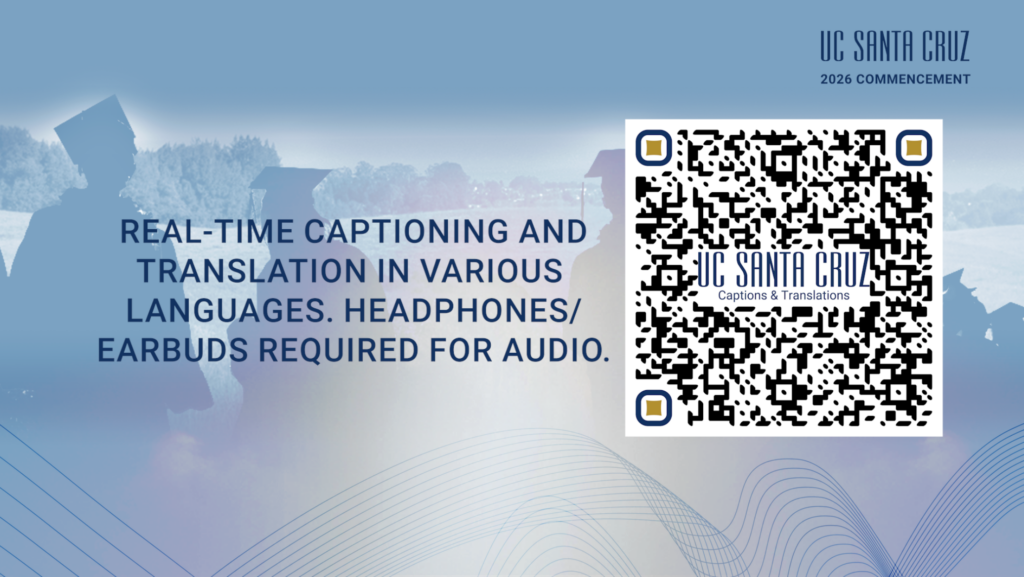
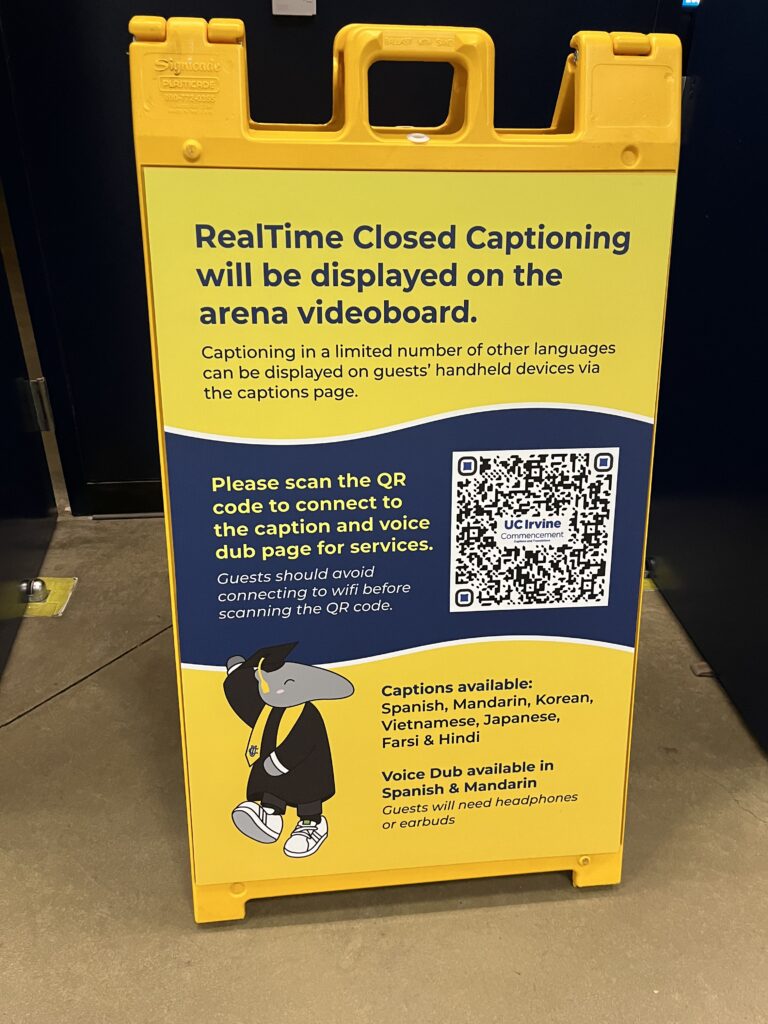
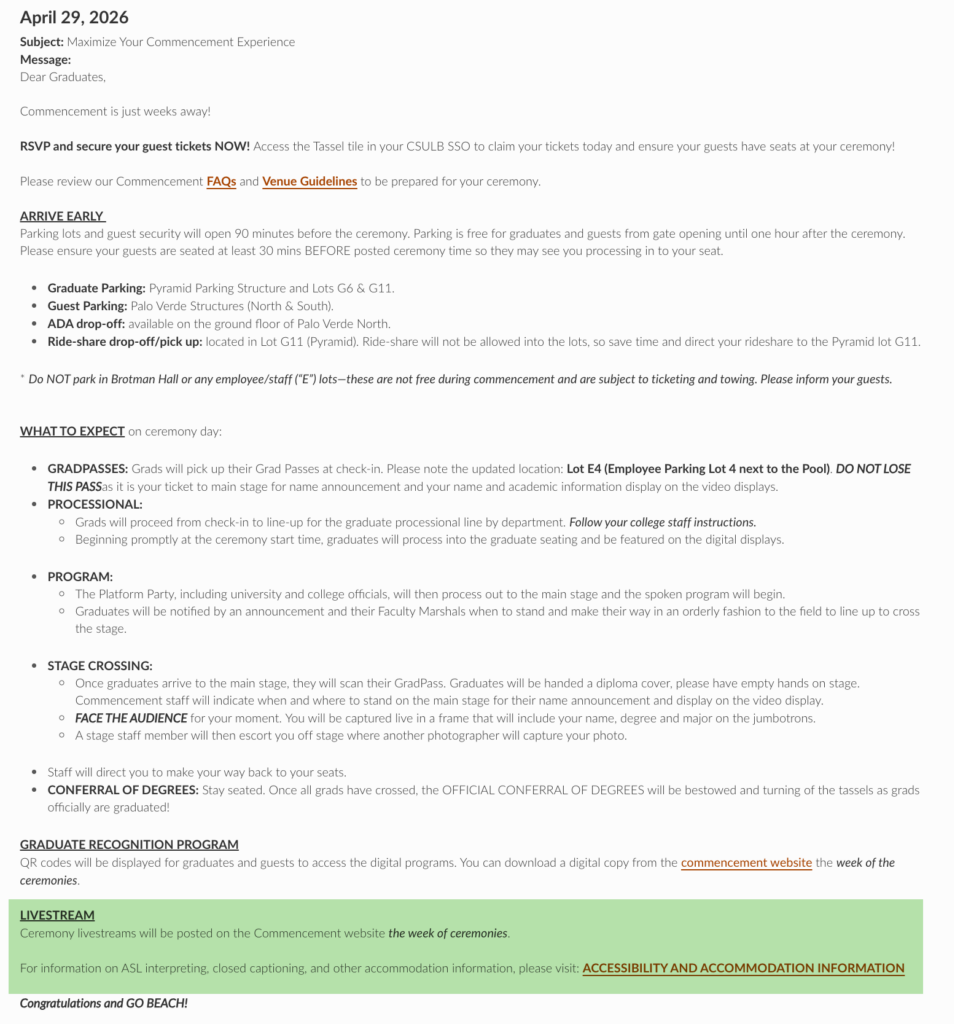
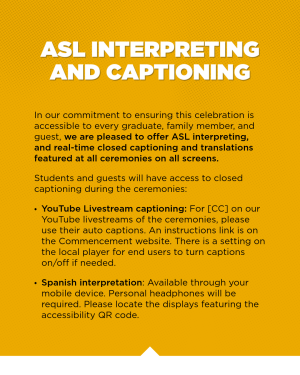
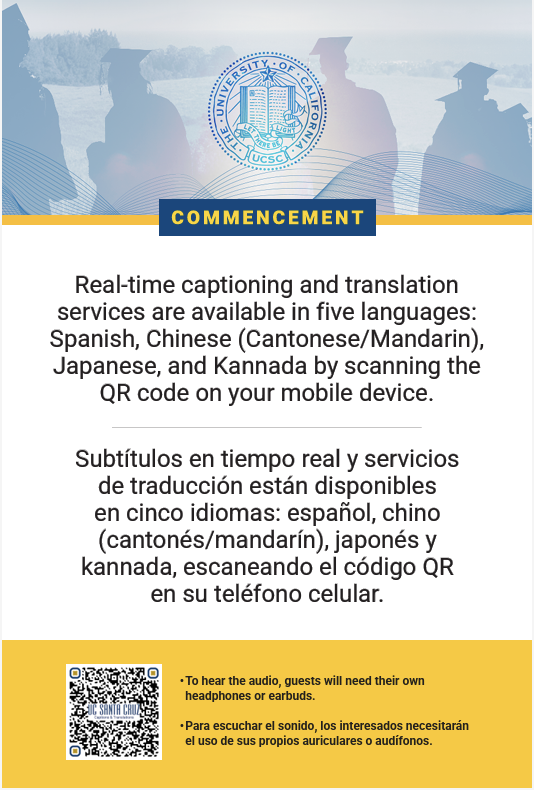
California State University, Long Beach incorporated accessibility information into its "Know Before You Go" communications, helping guests understand what services would be available before they arrived on campus. UC Santa Cruz promoted live captions and multilingual translation through QR codes, presentation slides, printed materials, and on-site signage throughout commencement.
These institutions recognized an important principle: accessibility is only effective when guests know it exists. Clear communication before and during the ceremony helps ensure that captions, translations, and other accessibility services are used by the people they were intended to support.
To help institutions plan future events, Aberdeen has assembled an In-Person Events Promotion Toolkit with examples of pre-event communications, signage, QR code placement, presentation slides, and other best practices for increasing guest awareness and participation.
For many institutions, one of the biggest accessibility advancements this commencement season wasn't a captioning technology. It was how accessibility was delivered.
Traditionally, in-person guests and remote viewers often had different experiences. Accessibility inside the venue depended on the equipment available, while livestream viewers were often limited by the capabilities of the streaming platform itself. Most mainstream platforms support only basic live accessibility features, typically limiting institutions to a single translated language or a single live audio translation during the event. Additional languages are often only available after the livestream has concluded.
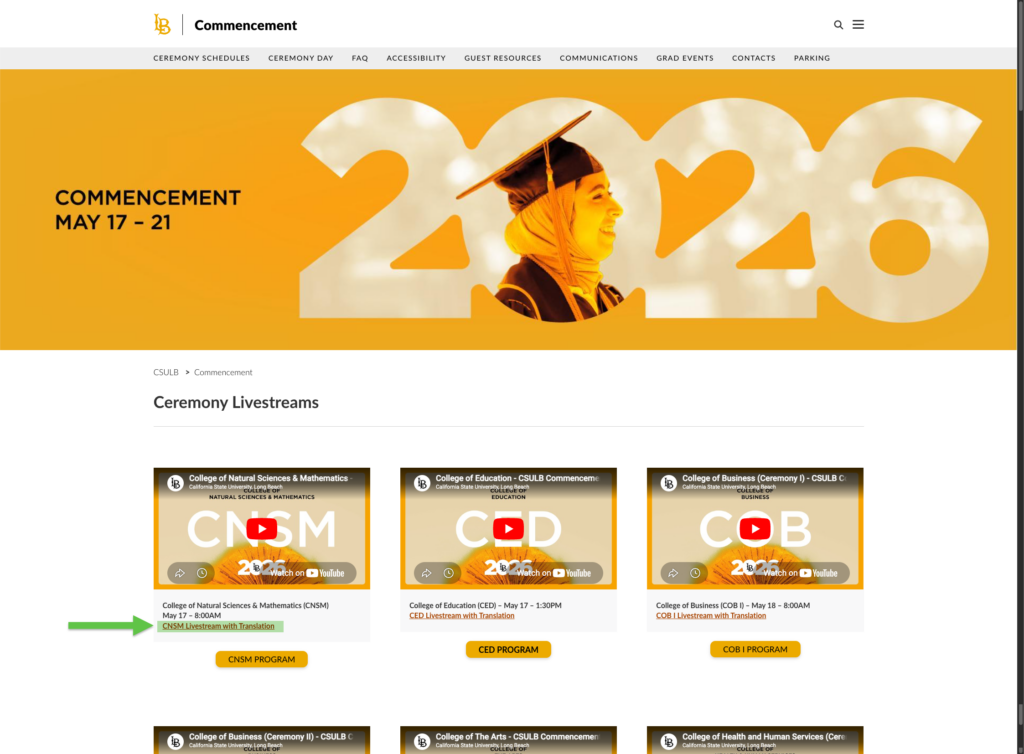
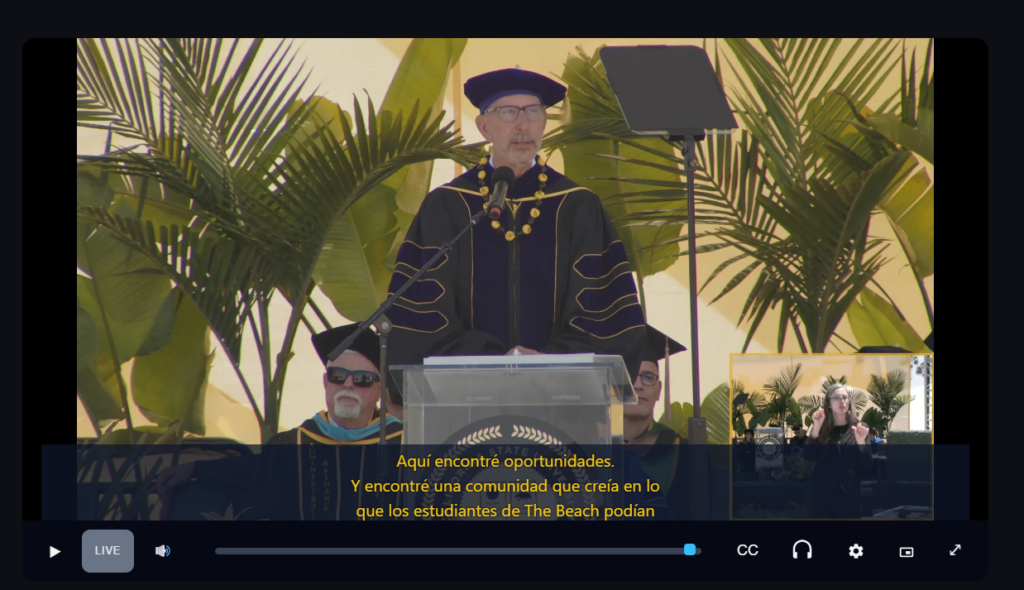

Aberdeen's browser-based streaming player removes those limitations. Instead of relying on the accessibility features built into a streaming platform, universities can provide a dedicated viewing experience that combines the live video with synchronized captions, multilingual subtitles, and AI-powered voice translations. This enables multiple languages to be available simultaneously during the live event while delivering a consistent experience for guests attending in person and those watching remotely.
The same experience extended to guests attending in person. Rather than requiring dedicated receivers or venue-provided hardware, attendees could simply scan a QR code and follow along on their own phones using the same captions, translations, and audio available through the livestream.
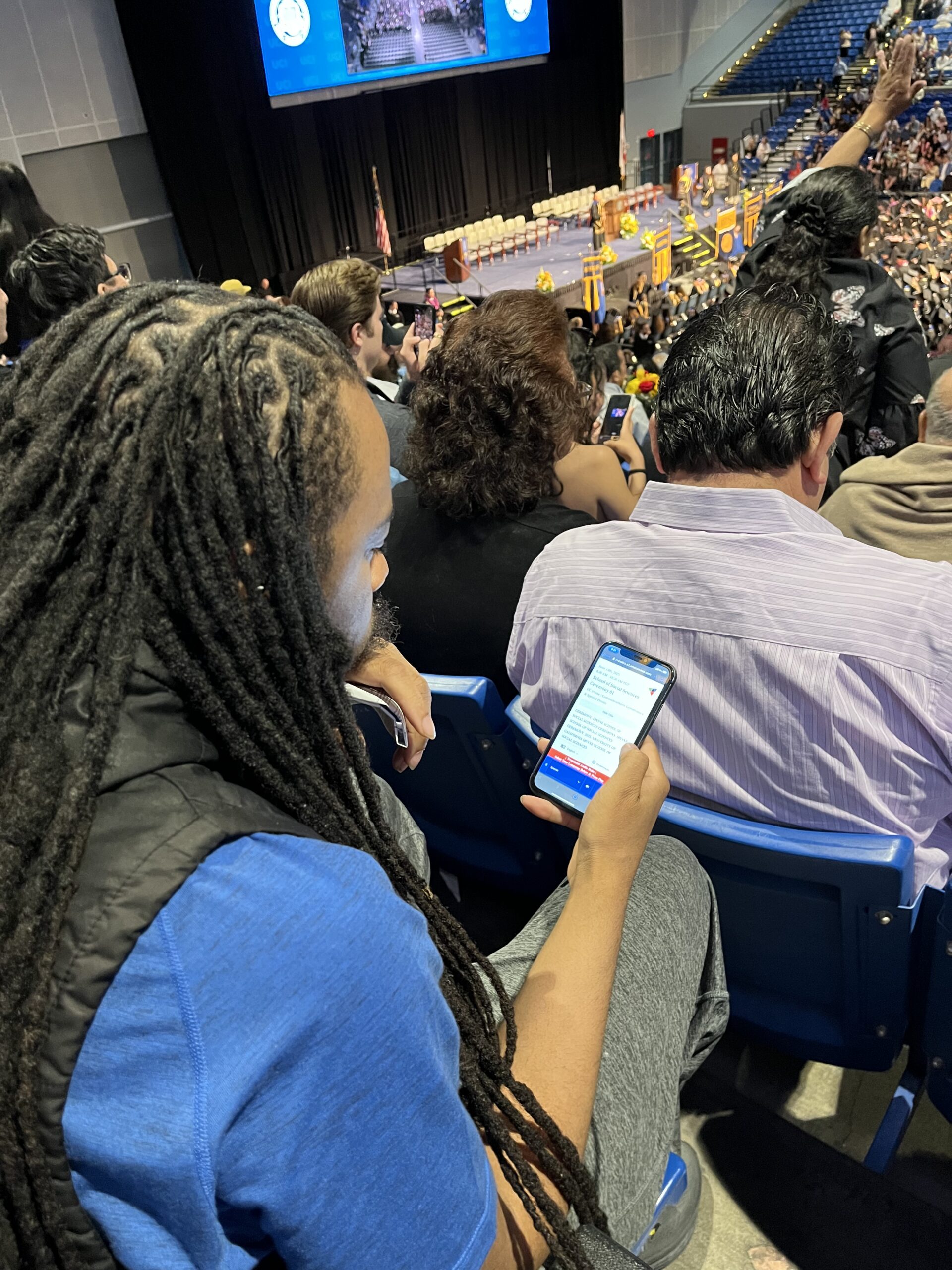
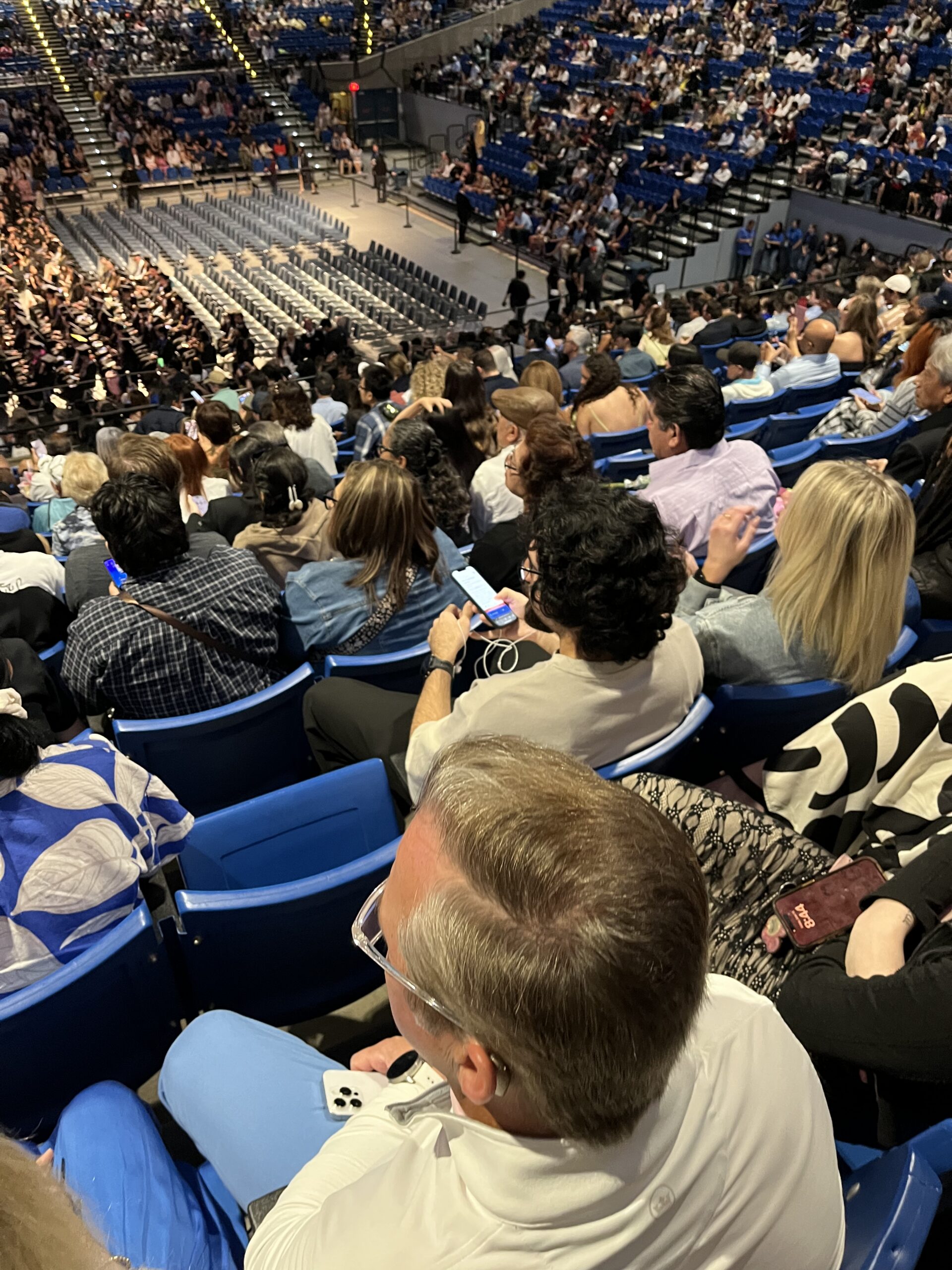
For California State University, Long Beach, this flexibility was particularly valuable. Returning commencement ceremonies to campus meant the university was no longer limited to the accessibility resources provided by an outside venue. Combined with the streaming player, accessibility became available both inside the ceremony and for family members watching remotely.
Every multilingual commencement begins with a high-quality English caption feed.
For the Spring 2026 season, 612 hours of English captions were created by professional human captioners, while 82 hours used Aberdeen's ASR Writer. Those English captions then became the foundation for AI-powered subtitles and voice translations, helping families experience ceremonies in the language they understand best.
Professional human captioners remained the primary workflow, while ASR expanded as an additional option.
Professional human captioners remained the primary workflow, while ASR expanded as an additional option.
| English Caption Source | Hours |
|---|---|
| Professional Human Captioners | 612 |
| ASR Writer | 82 |
Note: These figures represent the source of the English captions only. AI-powered translation was used to generate multilingual subtitles and audio translations for supported languages regardless of the English caption source.
Note: These figures represent the source of the English captions only. AI-powered translation was used to generate multilingual subtitles and audio translations for supported languages regardless of the English caption source.
This distinction is important. The chart above represents only the source of the English captions. Once accurate English captions are available, Aberdeen's AI translation technology can generate live subtitles and audio translations in over 100 languages, regardless of whether the English captions originated from a professional captioner or ASR.
Rather than replacing one another, human expertise and AI work together. Professional captioners continue to be the preferred choice for many commencement ceremonies because they can make editorial decisions that improve the guest experience. During graduate name reading, for example, captioners typically omit long sequences of student names and resume captioning when speakers return to remarks or announcements.
ASR, by contrast, continuously transcribes speech and may attempt to caption every name without extensive preparation and custom vocabularies. As ASR technology continues to improve, it is becoming a practical option for more events. In both cases, AI translation extends accessibility well beyond English, allowing more families to fully participate in the celebration.
While every institution's commencement is unique, one trend became increasingly apparent throughout the Spring 2026 season: universities are learning from one another.
Many of the institutions that adopted new accessibility services this year first encountered these approaches through conversations with peer universities, recommendations from trusted colleagues, or demonstrations at higher education conferences. As successful implementations become more visible, accessibility is becoming less about trying something new and more about adopting practices that have already proven successful elsewhere.
This collaborative exchange of ideas continues to accelerate the adoption of accessible commencement experiences across higher education.
The Spring 2026 commencement season demonstrated that accessibility is becoming a more intentional part of commencement planning.
Institutions are evaluating accessibility earlier in the planning process, communicating services more proactively, selecting languages based on the needs of their communities, and extending accessible experiences beyond the venue through mobile devices and livestreams. They are also choosing the combination of human expertise and AI technologies that best supports the goals of each ceremony.
The season also reflected a broader shift in how universities view accessibility. Rather than focusing on individual accommodations, institutions are designing commencement experiences that enable more graduates, families, and guests to participate fully, whether they are attending in person or joining remotely.
As technology continues to remove barriers and institutions continue to share successful practices, accessibility is becoming an expected part of commencement planning and an increasingly important part of celebrating student achievement.
For many organizations, the April 24, 2026, deadline around ADA Title II has raised an important question: Is this a new requirement, or something that’s been in place all along?
The answer is straightforward: Accessibility under ADA Title II is not new. What’s new is clarity.
In 2024, the Department of Justice issued a final rule that formally defines how ADA Title II applies to websites, mobile apps, and digital content. For the first time, public entities now have a clear technical standard and a firm deadline.
This post breaks down:
Under the Americans with Disabilities Act (ADA) Title II, state and local governments have long been required to provide equal access to their programs, services, and activities, along with effective communication for individuals with disabilities.
In practice, this has always applied to core public functions like meetings, educational programs, and government services. As digital communication became central to how these services are delivered, enforcement made it increasingly clear that the same expectations extended to websites, online video, and other digital materials.
Accessibility in digital environments wasn’t new; it was a continuation of an existing requirement.
The DOJ’s 2024 update does not change the core obligation. It defines it.
For the first time, public entities now have:
While the requirement itself was well established, how to meet it was not.
There was no officially defined technical standard, no universal deadline, and no consistent enforcement model. As a result, organizations relied on interpretation, guidance, and precedent to determine what “accessible” meant in practice.
Much of that guidance came through enforcement and legal action. The Department of Justice and the Office for Civil Rights investigated complaints and entered into resolution agreements, while high-profile cases helped shape expectations. The University of California, Berkeley case required the removal or remediation of inaccessible online video content, and lawsuits involving Harvard and MIT reinforced expectations around captioning and digital access.
These cases made one thing clear: Accessibility was required, but organizations didn’t have a consistent, measurable way to implement it.
One of the most immediate impacts of the rule is clarity around captions.
Under WCAG 2.1 Level AA:
This aligns with how accessibility has already been enforced, but now it is explicitly defined and expected. Just as important, the standard is not simply whether captions exist, it’s whether they are effective.
WCAG does not define a specific accuracy percentage. Instead, it requires that captions present the full meaning of the content, including spoken dialogue and relevant non-speech elements, in a way that is properly synchronized and easy to follow. This is reinforced by ADA Title II’s broader requirement for effective communication: Captions must allow a viewer to fully understand the message—not just approximate it.
In practice, that means:
With that in mind, it’s important to understand how different captioning approaches align with these expectations. There are two primary approaches used today: automated captioning powered by AI (ASR) and human captioning performed by trained writers.
In practice, the right choice comes down to context. ASR can be effective in controlled environments with clear audio and lower risk, offering a scalable and cost-efficient solution. Human captioning is better suited for high-stakes, complex, or public-facing content where accuracy, speaker identification, and reliability are critical.
The goal isn’t choosing a method—it’s ensuring the message is fully understood.
The rule includes a limited exception for content created before April 24, 2026, but it’s narrower than many expect.
Older content can remain as-is only if it is truly archival. That means it is not actively used, not updated, and not part of any current program, service, or activity.
Where this gets important is how “use” is defined. If older content is still being used in any meaningful way, it must be made accessible—even if it was created years ago.
Content may qualify for the exception if it is:
The practical way to think about it: If your audience is expected to use it, it must be accessible. The exception isn’t based on age; it’s based on relevance and use.
The rule does not require translation. There is no percentage threshold that triggers multilingual content, no requirement to offer multiple languages, and no rule that content in one language must be mirrored in another.
What the rule does require is consistency: Any language you provide must be accessible.
If an organization offers content in Spanish, that version must be accessible in Spanish. If content is delivered in English, it must be accessible in English.
For example, a Spanish video would need Spanish captions, and an English livestream would need real-time English captions.
Language access itself is governed by other regulations. ADA Title II focuses specifically on accessibility for people with disabilities, ensuring that whatever content is provided can be fully understood.
The rule applies to public entities under ADA Title II, including state and local governments, public universities, school systems, and municipal agencies.
The timeline is based on population size:
Applies to public entities serving 50,000+ people, such as:
Applies to entities serving under 50,000 people, including:
The requirement is the same for both groups—only the timeline differs.
Churches are not considered public entities under ADA Title II and are generally exempt from ADA Title III as well. This means they are not legally required to meet WCAG standards.
However, many churches are still adopting accessibility tools like captions and translation—not because they are required to, but because they recognize the value. Accessibility improves understanding, supports multilingual communities, and helps remove barriers for first-time visitors.
Accessibility in this context isn’t about compliance. It’s about connection.
ADA Title II has required accessibility for decades. The 2024 rule does not introduce a new obligation—it provides a clear, consistent framework for meeting one that already existed.
For public entities, that means:
Accessibility has always been about ensuring people can fully receive the message. Now, there is a clear path for how to deliver it.
Closed captions have long been one of the most important accessibility tools in modern media. They transform spoken words, music, and sound cues into text, allowing Deaf and hard-of-hearing audiences to fully engage with film, television, and live programming.
Yet despite decades of progress in video technology, caption presentation itself has changed very little. The familiar format of white text at the bottom of the screen remains the standard across most platforms. While effective, this approach often strips away elements that hearing viewers naturally perceive, such as tone, pacing, emphasis, and speaker identity.
That is why we were intrigued when we came across Caption with Intention.
Caption with Intention is not simply a visual redesign. It is a captioning design system built on a simple yet powerful premise: captions should convey not only what is said but also how it is said.
The project explores ways to represent aspects of speech that traditional captions rarely capture:
These ideas may sound subtle, but they address a real gap in how captioned content is experienced.
One of the most compelling aspects of Caption with Intention is its development process. The system was shaped through collaboration with members of the Deaf and hard-of-hearing community. That involvement grounds the work in lived experience rather than purely aesthetic experimentation.
Accessibility innovations are most meaningful when they are informed by the audiences they are intended to serve. This project reflects that principle.
Caption with Intention is currently a design framework rather than a fully automated captioning engine. Its concepts still require thoughtful implementation. Even so, the direction is notable.
As AI, real-time rendering, and player technologies continue to evolve, it is easy to imagine a future where expressive captioning systems like this can be applied at scale. Not as decorative features, but as standard components of accessible storytelling.
At Aberdeen, we spend a great deal of time thinking about how captions function in practical, regulatory, and production contexts. Accuracy, timing, compliance, and reliability always come first.
Projects like Caption with Intention invite a different but equally important question:
What if captions could better reflect the emotional and narrative texture of a scene?
The idea does not replace the fundamentals. It expands the conversation.
We are not involved in the project, nor are we presenting this as an endorsement or partnership. We simply find the thinking behind it compelling. It represents the kind of experimentation that can influence how accessibility evolves over time.
We will be watching its progress with interest and testing its ideas when the technology and workflows feel ready.
Because the future of captions is not only about access. It is also about experience.
Matt Cook joins Kenny Jahng on the Church Tech Today Podcast
We’re excited to share that our President, Matt Cook, was recently featured on the Church Tech Today Podcast hosted by Kenny Jahng — one of the leading voices in digital ministry and AI innovation for churches. The conversation dove into how Aberdeen’s real-time AI captioning and translation tools are making worship services more accessible, inclusive, and effective for everyone in the pews.
Read the article on ChurchTechToday.com: Church Tech Today Podcast Feature with Matt Cook
The conversation wasn’t just about cool tech — it was about mission. AI is opening the door for churches to reach people who’ve been sitting quietly in their pews, unable to fully engage — whether due to hearing loss, language barriers, or generational differences in media consumption.
As Kenny noted, "Most churches are barely scratching the surface of what's possible." But with the right tools, accessibility can be seamless, affordable, and incredibly impactful.
Matt shared how Aberdeen has taken technology once reserved for large, media-savvy churches — and made it accessible for congregations of all sizes. Even 100-member churches are now using AI captioning and translation to serve ESL communities and individuals with hearing loss.
“We’ve had churches start this just to help one deaf member, and suddenly realize there are more people quietly struggling to engage — and they begin reaching new audiences they never expected.”
— Matt Cook, Aberdeen
More than 70% of Gen Z and over 50% of Millennials now watch content with captions on. It’s not an accessibility issue — it’s an engagement issue.
Captions help with focus, retention, and accessibility for everyone — not just those with hearing impairments.
“Captions help us absorb more. They’ve become part of how the next generation engages with content, including sermons.”
— Kenny Jahng
Churches don’t need expensive gear or complex workflows. Aberdeen’s AI captioning and translation system works right from the audio feed churches already have. Viewers can scan a QR code and get real-time captions or listen to a voice dub in their preferred language — right on their phone.
“Setup takes just minutes. Most churches already have everything they need.”
— Matt Cook
Beyond just captions, Aberdeen offers AI voice dubbing — allowing attendees to hear the sermon in real time in their own language, with natural inflection and clarity. This opens the door to multi-generational families, immigrant communities, and global reach without needing separate services.
Kenny brought up an important shift in thinking: Captioning and translation aren't just for “accommodation” — they’re tools for growth and connection.
Whether it’s helping Gen Z absorb more of the message, allowing a Spanish-speaking grandmother to understand her grandson’s baptism, or making someone with hearing loss feel seen and included — accessibility is kingdom work.
As Matt shared on the podcast, Aberdeen offers churches a free trial month and will even demonstrate the technology using the church’s own sermon video.
Curious how it would work for your services? We’re now offering personalized live demos using your actual content so you can see how real-time captions and multilingual translations would look during your own worship services.
Schedule your one-on-one demo now using our calendar link below.
In a recent StreamingChurch.tv webinar, Aberdeen Broadcast Services President Matt Cook joined Phil Thompson to discuss the powerful role artificial intelligence is playing in making church services more accessible—both in-person and online.
As churches strive to reach broader and more diverse communities, the need for multilingual captioning and translation has never been greater. During the conversation, Matt shared how Aberdeen has spent years refining AI tools behind the scenes before confidently bringing them forward for real-time use.
“We’ve been using AI in post-production captioning for years—combining it with human editors to ensure top-tier quality,” Matt explained. “But we didn’t want to offer it live until we were confident it would meet the high standards our clients expect.”
What once required dedicated human captioners or translators can now be achieved instantly through AI—with support for over 60 languages in both subtitles and audio dubbing.
Whether you’re broadcasting to viewers across the globe or welcoming a multilingual congregation in your sanctuary, Aberdeen’s real-time solution is built to scale with you. During the live demo, attendees saw firsthand how captions and translations could be instantly toggled across multiple devices—no app, log-in, or special equipment required.
One of the biggest takeaways from the webinar was that you don’t have to be a tech expert to bring this level of accessibility to your church. Aberdeen’s cloud-based tools work with any encoder and can be used in both live streams and in-person worship services.
“It’s as simple as scanning a QR code or clicking a link. Your viewers can then choose their preferred language and follow along in real-time,” said Matt.
If you missed the live event or want to revisit what was shared, you can now watch the full replay on demand here:
You’ll see:
Curious how it would work for your services? We’re now offering personalized live demos using your actual content so you can see how real-time captions and multilingual translations would look during your own worship services.
Spots are limited and filling up quickly. Schedule your one-on-one demo now using our calendar link below.
Churches today have an unprecedented opportunity to reach global audiences, welcome newcomers, and serve members of all abilities and backgrounds. With trusted AI-powered tools from Aberdeen, you can break language barriers and make sure no one misses the message.
Learn more about ASR-powered accessibility tools for churches here.
What a July and August it has been for the Aberdeen team. It was a whirlwind tour of airports, convention centers, and some truly inspiring conversations as we connected with the higher education community at three incredible events: the Online Teaching Conference (OTC), the CSU+UC Event Professionals Network (EPN) conference, and the AHEAD conference.
While each conference had a specific focus, we found a powerful common thread at every stop. We were visiting one unified community of passionate people all working toward the same goal of making education more inclusive. Our team came home exhausted but overwhelmingly inspired. This is a thank you to the community that welcomed us and a collection of stories we hope you find valuable.
Our journey started in sunny Long Beach at the Online Teaching Conference. The energy was electric, with the theme of "AI, Innovation, and Equity" buzzing in every conversation. What struck our team was the shift in the dialogue around AI. The narrative has moved beyond fear and is now rooted in possibility. The conversations we had were full of this optimism, reminding us that technology at its best is a tool for connection.
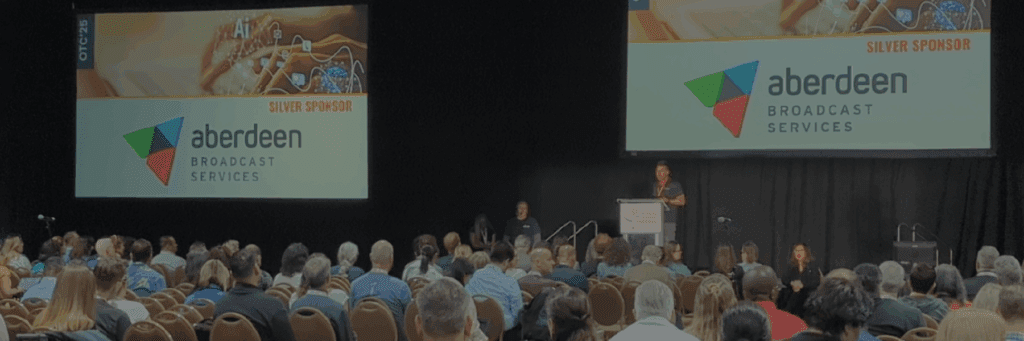
Our Higher Education Accessibility Specialist, Tony Baltayan, also had the privilege of presenting at OTC, where he shared Aberdeen’s latest advancements in captioning and translation. It was an energizing moment to highlight how far the technology has come and how it’s helping campuses right now.
Next, our team headed to the gorgeous UC Berkeley campus for the CSU+UC Event Professionals Network conference. This event brought together the talented individuals who create every campus experience, from departmental meetings to massive commencements. The conversations were centered on logistics, engagement, and creating seamless events. It was a fantastic opportunity to discuss how accessibility can be woven into the planning process from the very beginning, making it a natural part of every event rather than a last-minute addition.
Being on the UC Berkeley campus for the conference was a wonderful excuse to arrive early and meet with our partners in person. We had the opportunity to sit down and interview some of the key people behind their accessibility initiatives. We were blown away by their collaborative model, which we started calling the "Heart, Head, and Hands" of accessibility. It’s a powerful approach linking passionate student advocacy, strategic ADA compliance, and flawless technical execution. Their story is a testament to what’s possible when a university commits to access at every level. We can't wait to share our full interviews with their team, so keep an eye out for those videos coming soon!
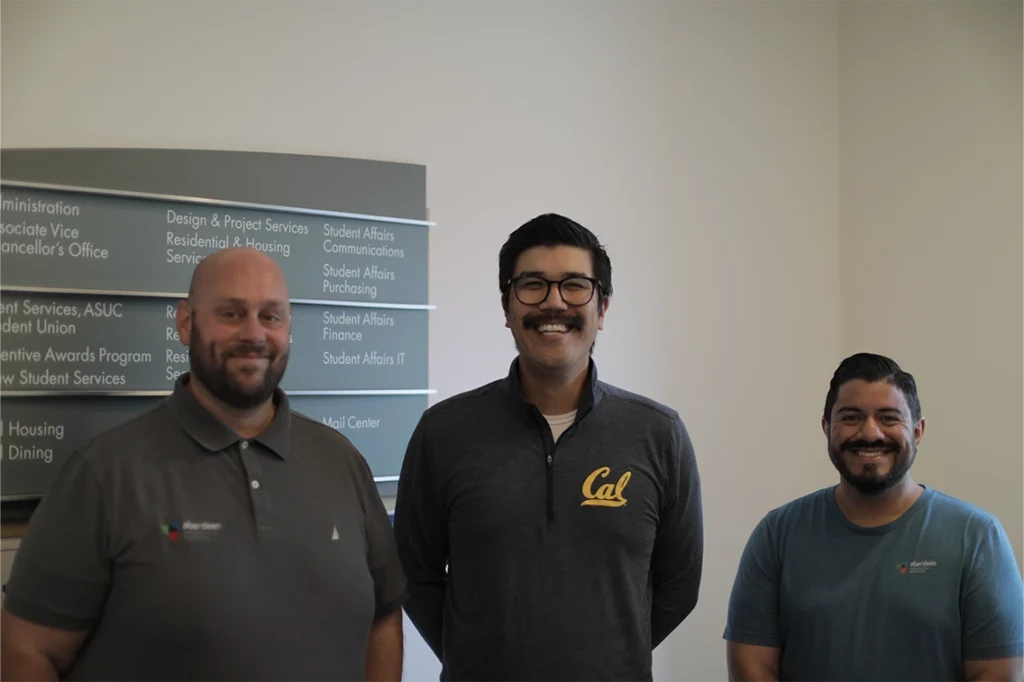
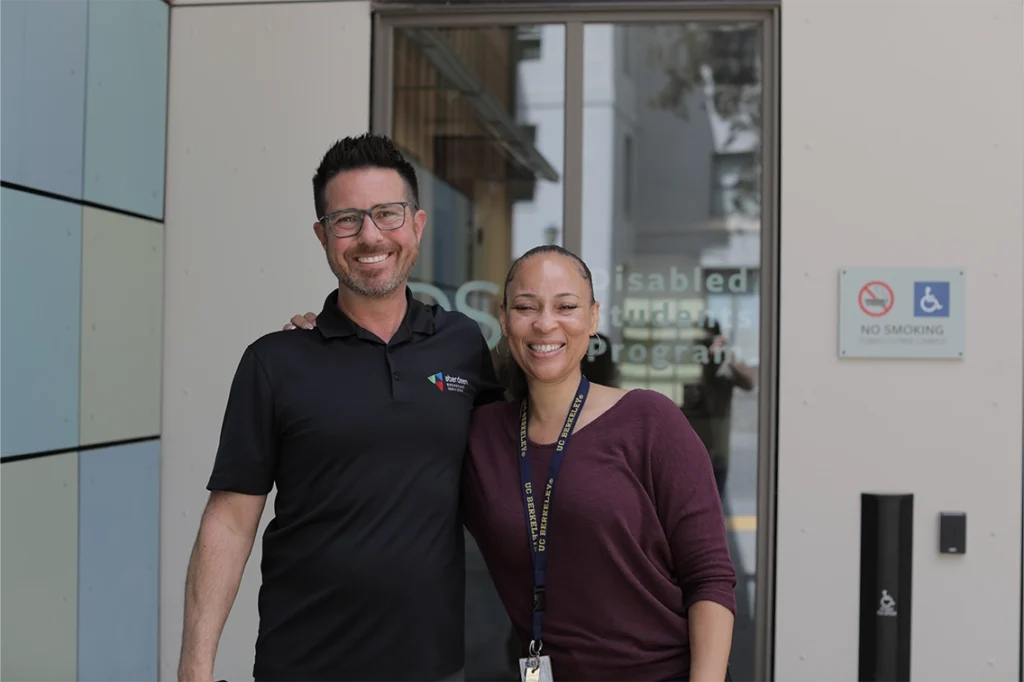
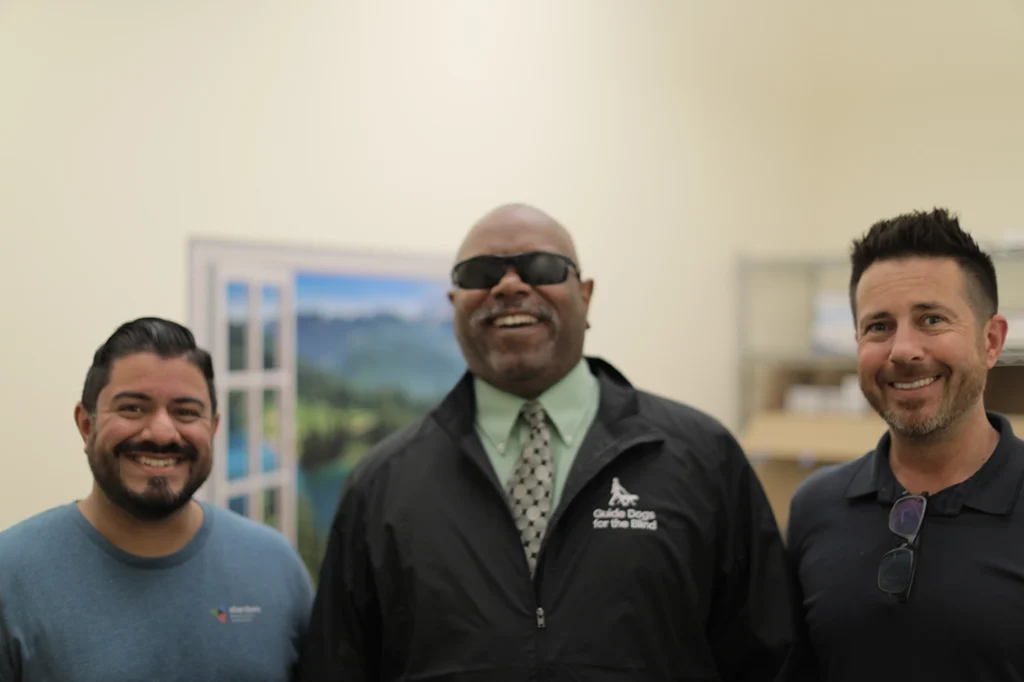
For our final stop in Denver for the 48th annual AHEAD conference, our team was ready to listen and learn. As the global epicenter for professionals in higher education and disability, this was our chance to connect as students of the industry. We were humbled by the dedication in every room. An "aha" moment for us came during a session about the immense pressure on small DRC offices. It was a stark reminder of how critical reliable partners and efficient systems are when a student's education is on the line.
Tony was honored to present at AHEAD as well, highlighting Aberdeen’s cutting-edge captioning and translation solutions. Presenting at AHEAD highlighted the shared commitment of professionals working to advance access in higher education.
Looking back on our journey, the one theme that rings true is community. We met instructional designers, event coordinators, and DRC directors who are all united by a shared passion for opening doors.
On behalf of the entire Aberdeen team, we want to extend a huge thank you to the organizers and to every single person who shared a story with us. You’ve energized us, you’ve inspired us, and we can’t wait to continue the conversation and build the future of access together.
Want to see how our latest accessibility technology can support your campus? Read More.
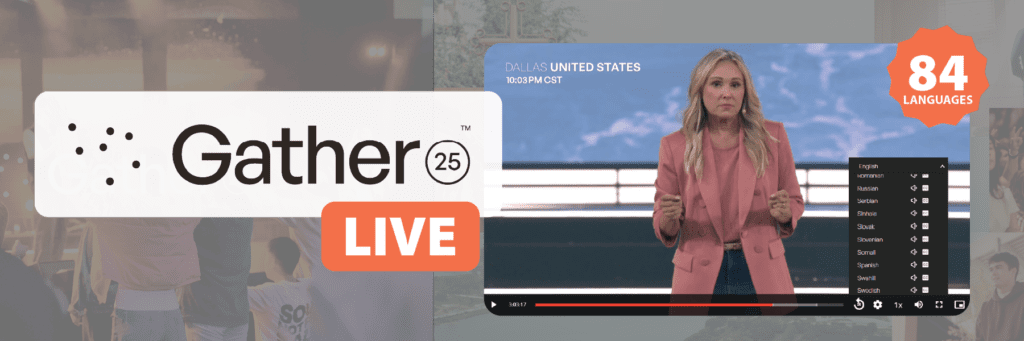
Gather25, hosted by IF:Gathering, was a groundbreaking 25-hour global broadcast connecting audiences across every continent. With over 1.25 million online viewers and participation from more than 21,000 Gather Groups worldwide, the event aimed to inspire and unite the global church community.
Aberdeen Broadcast Services has partnered with IF:Gathering since 2020, providing both live captioning for streaming events and post-produced captioning for archived content. Gather25 marked an ambitious new chapter in that partnership—the first time Aberdeen was brought on to help scale the event’s global reach through real-time translation.
As far as we know, this was a first-of-its-kind undertaking: a multilingual livestream of this magnitude, requiring impeccable coordination across dozens of languages and platforms. Aberdeen was one of several trusted vendors, working alongside the technology and broadcast partners hired for the event to make it all possible.
Supporting a continuous, multilingual broadcast of this scale introduced several technical challenges:
Before the event went live, a workflow that could support uninterrupted, real-time captioning and translation across dozens of simultaneous streams needed to be built. This required deep coordination with multiple teams to align audio sources, language feeds, and delivery endpoints. Our goal was to ensure every segment of the broadcast could be accurately captioned and translated with minimal manual intervention once the event began.
A key technology partner behind this workflow was SyncWords, whose platform Aberdeen leverages to manage real-time captioning and translation delivery. SyncWords played a vital behind-the-scenes role in not only powering the infrastructure we used to deploy captions across dozens of streams but also collaborating directly with engineers at Sardius and Elemental Media to implement specialized audio-isolation coding for the event. This coordination ensured that every audio feed we received was optimized for clean, accurate transcription and translation at scale.
To guarantee performance, Aberdeen conducted over 50 hours of pre-event testing, stress-testing multi-language streams, and simulating 25-hour sessions to ensure system endurance. A key priority was ensuring that VTT caption files would function as continuously updated feeds, rather than static uploads. This real-time updating was essential for Sardius’ platform to support both live captions and rolling DVR features, while also allowing seamless access to captions during on-demand playback after the event.
In a typical video workflow, captions are created after recording, uploaded separately, and synced to on-demand content. For Gather25’s livestream, captions had to be generated and delivered in real time, alongside the video stream.
The system worked like this:
.ts files) and stored in an S3 bucket, alongside a .m3u8 manifest file managing playback.This architecture required precise timing, structured file delivery, and full alignment with Sardius’ streaming infrastructure.
An HLS stream (HTTP Live Streaming) delivers video content over the internet in small, manageable chunks. The video is split into short segments (usually 2–10 seconds long) and saved as .ts (transport stream) files. A playlist file (called a .m3u8) tells the video player what order to play those chunks in. As a viewer watches, their device downloads and plays the segments one at a time, allowing smooth playback, even with slow or fluctuating internet.
Aberdeen’s team engineered a sophisticated workflow to process 20 incoming HLS feeds. Working closely with Element Media Group, which managed master control and delivered stripped audio to Sardius, Aberdeen received feeds prepped for accessibility:
EN for English, ES for Spanish), with structured naming conventions to ensure accurate mapping during the live event and in the post-event archive.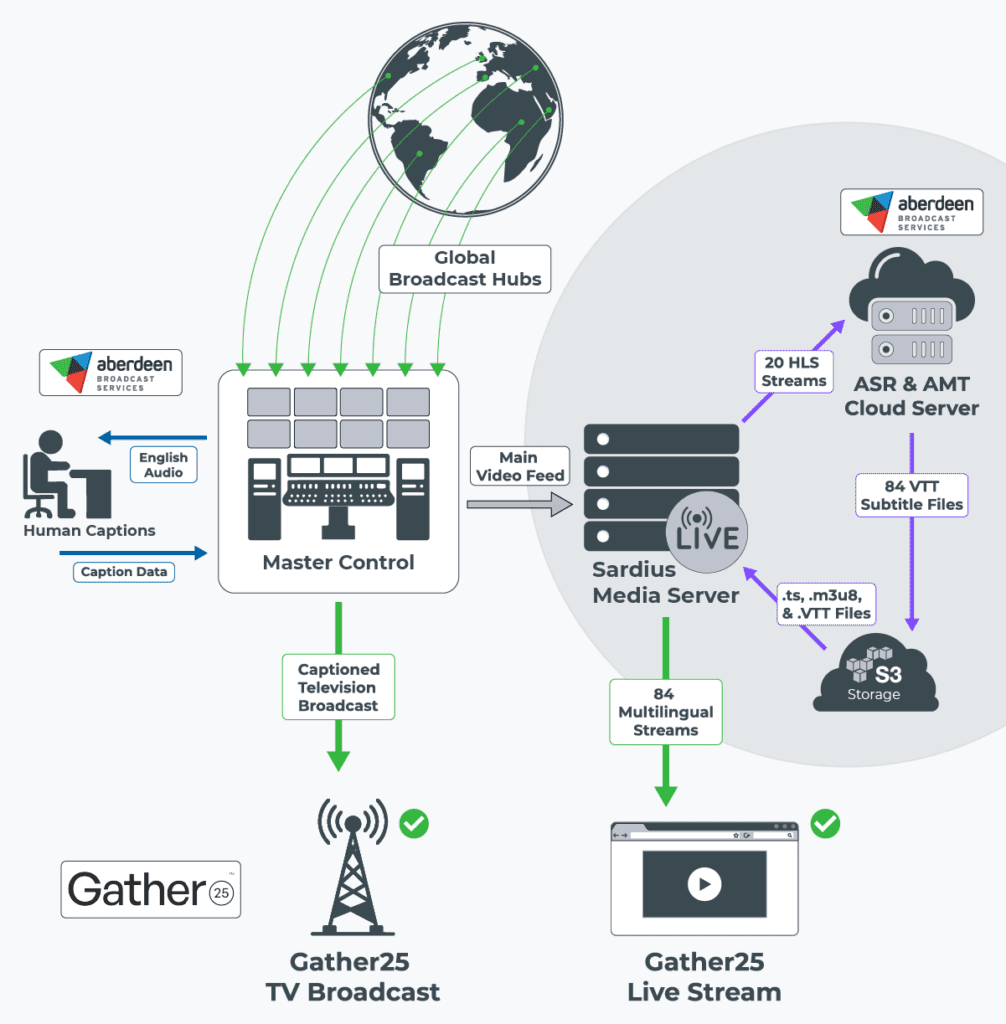
Gather25’s accessibility efforts produced measurable results:
By combining AI-driven automation, human captioning expertise, and a deep integration with broadcast systems, Aberdeen Broadcast Services delivered scalable, high-quality accessibility at a truly global level.
Gather25’s mission to unite believers around the world was made stronger through its commitment to accessibility. With real-time captioning and translation across 84 language streams, Aberdeen Broadcast Services helped make this global event inclusive, impactful, and available to all.
For organizations planning large-scale, multilingual broadcasts, Aberdeen’s tested and proven solutions offer the reliability and scalability needed to reach a worldwide audience.
Let’s talk about how we can support your next event. Contact us to learn more.
Distance education is rapidly expanding within California Community Colleges (CCC) as more students are choosing to take online courses to fit their busy schedules. Ensuring equal access demands accessible course content, notably captioning and transcription, to comply with legal requirements and support student success. The Distance Education Captioning and Transcription (DECT) Grant provides vital funding to all 116 CCCs, specifically addressing these critical accessibility needs in the growing online learning environment.
Aberdeen Broadcast Services is a state-approved DECT Grant vendor, allowing California Community Colleges to contract with us directly. This is the most streamlined process for colleges, as it signifies that we are already vetted and have a strong understanding of the grant requirements, simplifying both service delivery and billing.
Please visit the CCC DECT Grant website for official grant information and a list of approved vendors.
The DECT Grant funds services that transcribe spoken content to ensure the accessibility of aural information. The scope of funding primarily includes:
Funding is available for accessibility services across various eligible course types and content:
(Note: Specific rules apply to which videos qualify; consult the official grant website for full details. Community services/continuing education material is not covered.)
Requests for captioning services are typically made by college staff, often faculty who need their course materials captioned, or individuals in departments such as the Disabled Students Program or Accessibility Services.
Partnering with a pre-approved vendor can simplify the process of identifying needs and estimating costs. Simply fill out this request form, and we’ll help you get started!
Leveraging the DECT grant is crucial for California Community Colleges because it directly contributes to key institutional goals:
The DECT grant is a valuable resource designed to help California Community Colleges make their distance education offerings fully accessible and inclusive. Leveraging this funding is essential for supporting all students and advancing digital learning.
We encourage your college to take full advantage of this opportunity. Let’s work together to make sure your students have the access they deserve!