For more than a decade, the FCC has continued to refine how responsibility for closed captioning is shared between the video programmers who create content and the video programming distributors (VPDs) that deliver it to viewers. Aberdeen has been following those changes along the way.
In 2014, the FCC established new standards focused on the quality of closed captions. In 2016, the Commission expanded the responsibilities of video programmers and introduced a shared responsibility model between programmers and distributors. Now, ten years later, the FCC is revisiting part of that framework.
On August 26, 2026, the FCC released Report and Order FCC 26-57, eliminating several registration and certification requirements that the Commission determined were unnecessarily duplicative.
The important distinction is that the FCC is simplifying some of the paperwork surrounding closed captioning compliance, not eliminating the underlying obligation to provide compliant closed captions.
What Changed
Less Duplicative Compliance Paperwork
Certain video programmers may no longer need to register separately with the FCC.
Certain video programmers may no longer need to submit separate captioning certifications.
Qualifying PEG channel administrators can certify on behalf of programming carried on the channel.
Qualifying nonbroadcast networks can certify compliance or exemption for their linear programming lineup.
VPDs will no longer be required to use “best efforts” to obtain caption quality certifications from programmers.
What Didn't Change
The Underlying Captioning Obligations
Non-exempt programming still must be captioned.
FCC caption quality standards remain in place.
Caption accuracy requirements remain in place.
Synchronization, completeness, and placement requirements remain in place.
Video programmers and distributors remain responsible for captioning matters within their control.
The short version:
The FCC reduced compliance paperwork, not captioning requirements.
How We Got Here
The latest changes make more sense in the context of how the FCC's closed captioning rules have evolved. Over the past decade, the Commission has established caption quality standards, defined how responsibility is shared between programmers and distributors, and continued to refine how that compliance is documented.
2014
Caption Quality Standards
FCC establishes standards for accuracy, synchronization,
completeness, and placement.
FCC eliminates certain duplicative registration and certification
requirements while leaving underlying captioning obligations intact.
Latest Update
That brings us to 2026. Rather than reversing the captioning standards and shared responsibilities developed over the previous decade, FCC 26-57 revisits some of the administrative requirements built around them.
There is an important bit of history here. In 2016, the FCC adopted a system that would eventually require video programmers to register directly with the Commission and submit annual certifications regarding their compliance with the closed captioning rules. Aberdeen covered those changes at the time in FCC Shared Responsibilities: Caption Quality & Certification.
That direct FCC filing system, however, never became operational as originally envisioned. In FCC 26-57, the Commission notes that video programmers currently do not make those filings because the FCC's website is not yet ready to accept them.
Meanwhile, the certification process that stations and other video programming distributors have actually been working under continued to require VPDs to use "best efforts" to obtain caption quality certifications from their programming suppliers.
FCC 26-57 addresses both pieces of that history.
What Is the FCC Changing?
FCC 26-57 takes another look at the registration and certification structure adopted in 2016 and concludes that, in certain situations, requiring individual programmers and the networks carrying their programming to make separate FCC filings would create unnecessary duplication.
Under the amended rules, video programmers providing programming exclusively to a qualifying nonbroadcast network may not need to separately register and certify with the FCC when the network has filed the appropriate registration and certification covering its linear programming lineup. Similar relief applies to programmers providing content exclusively to qualifying public, educational, and governmental (PEG) access channels.
The distinction is important because this is not a transition from an existing system where every producer has been filing certifications directly with the FCC. Although that direct filing requirement was adopted in 2016, the Commission never implemented the system necessary to accept those filings.
Instead, FCC 26-57 is simplifying that planned framework before it fully takes effect. If the appropriate network or PEG administrator can certify the programming lineup, the FCC no longer sees a need for qualifying individual programmers to duplicate that filing.
How We Got Here
From Programmer Certifications to a Simplified FCC Process
FCC 26-57 changes both the certification process broadcasters
have been working under and a direct-to-FCC filing system adopted
in 2016 that never became fully operational.
Existing Process
Programmer Certification
VP
Video Programmer
Provides certification
→
Captioning Certification
Documents compliance
→
TV
Station / VPD
Obtains certification
VPDs use “best efforts” to obtain caption quality certifications
from their programming suppliers.
↓
2016 Rules Adopted
Direct FCC Filing Planned
VP
Video Programmer
Would file directly
→
FCC
Registration + Annual Certification
The FCC adopted direct registration and annual certification
requirements for video programmers, but the filing system was
never fully implemented.
↓
FCC 26-57
Certification Simplified
Producer AProducer BProducer C
→
TV
Qualifying Network
Certifies its linear lineup
→
FCC
Qualifying filing
When the network or PEG administrator meets the FCC's requirements,
qualifying individual programmers do not need to duplicate that filing.
Also changing:
VPDs will no longer be required to use “best efforts” to obtain
caption quality certifications from video programmers.
Not changing:
Non-exempt programming still must be captioned and meet applicable
FCC caption quality standards.
If the network or channel administrator does not make the required filing, however, individual programmers can still retain their registration and certification obligations.
What About PEG Programming?
PEG programming has been part of this discussion for even longer. In 2015, we covered an FCC roundtable specifically addressing Closed Captioning and PEG Programming, including the complicated relationship between FCC captioning exemptions and other accessibility responsibilities.
FCC 26-57 now provides registration and certification relief for certain PEG programmers. If the administrator of an exempt PEG channel registers with the FCC and certifies the channel's exemption, individual programmers providing content exclusively to that channel will not also have to register and certify the same exemption.
The rule addresses non-exempt PEG channels as well. If the channel administrator certifies that all programming carried on the channel is either compliant with the captioning rules or exempt, individual programmers can similarly be relieved of the duplicative filing requirement.
The distinction here is important: the FCC has not created a blanket closed captioning exemption for PEG programming. The change concerns who must file the registration and certification, not whether otherwise non-exempt programming must be captioned.
What Is Not Changing?
This may be the most important part of the new Order. The FCC states directly that the amendments do not alter a video programmer's substantive closed captioning obligations. Programming that was exempt remains exempt, while programming that is not exempt must still be captioned.
The caption quality standards Aberdeen has been writing about since 2014 also remain in place: accuracy, synchronization, completeness, and placement. FCC 26-57 does not undo those requirements.
In fact, the Commission specifically concluded that the changes should not affect caption quality because programmers of non-exempt content are being relieved of certain filing requirements, not the underlying obligation to provide captions that comply with FCC quality standards.
The "Best Efforts" Requirement Is Also Going Away
There is another change that may be more immediately recognizable to television stations and other VPDs.
When the FCC's caption quality standards were being implemented in 2015, stations and other distributors were required to use "best efforts" to obtain captioning compliance certifications from the video programmers whose content they carried. We covered that requirement at the time in FCC Pushes Back the Date on New Captioning Quality Standards.
That is the certification process many broadcasters and producers will recognize from their actual workflows: the programmer provides its certification, while the station or other VPD makes the required effort to obtain it.
FCC 26-57 removes that "best efforts" obligation once the amended rules become effective.
For Stations & VPDs
The practical change:
VPDs will no longer be required to use “best efforts” to obtain
caption quality certifications from their video programmers.
What it does not change is the underlying division of captioning responsibility. Video programmers remain responsible for captioning matters within their control, and VPDs remain responsible for matters within theirs.
Shared Responsibility Is Still Shared Responsibility
This is where the new Order fits into the larger history of FCC captioning regulation. FCC 26-57 does not reverse the shared responsibility framework established in 2016.
Video programmers remain responsible for captioning matters within their control, while VPDs remain responsible for matters within theirs. That distinction also remains important when a captioning problem occurs.
The 2026 Order is better understood as a simplification of the administrative system built around those responsibilities, rather than a reversal of the responsibilities themselves.
What Does This Mean for Video Producers?
For most producers, the practical requirement to deliver properly captioned programming does not disappear. If programming is subject to the FCC's closed captioning rules, it still must be captioned, and those captions still must comply with the applicable quality standards. FCC 26-57 expressly says that the rule changes do not alter a video programmer's substantive captioning obligations.
What is changing is the administrative structure surrounding those obligations. The FCC is eliminating the VPD "best efforts" requirement to collect programmer certifications and simplifying the direct registration and certification system adopted in 2016 before that system was fully implemented.
Networks and stations may also continue to impose their own captioning requirements through technical specifications, contracts, delivery procedures, or other business arrangements. The FCC specifically notes that nonbroadcast networks often use contractual provisions or other mechanisms to hold their program suppliers accountable for captioning compliance, and FCC 26-57 is not intended to interfere with those arrangements.
In practical terms, a producer may have less FCC certification paperwork surrounding the delivery, but the responsibility to deliver properly captioned programming remains.
Less Paperwork, Not Less Accessibility
That is still the simplest way to summarize FCC 26-57, but the history adds an important layer.
In 2014 and 2015, the FCC established and implemented caption quality standards. In 2016, the Commission formalized shared responsibilities between programmers and distributors and adopted a future system for programmers to register and certify directly with the FCC. That direct filing system never fully became operational.
Now, ten years later, the FCC is simplifying that planned system before it does, while also eliminating the existing "best efforts" requirement that has required VPDs to obtain certifications from their programming suppliers.
Chairman Brendan Carr described the action as eliminating "unnecessarily duplicative requirements" and said the Commission concluded that the changes would have no negative impact on captioning availability or quality.
What the Commission is not doing is backing away from its caption quality standards or removing the requirement to caption non-exempt programming.
For broadcasters and video programmers, the takeaway is straightforward: some of the compliance paperwork is changing. The responsibility to provide quality, compliant closed captions is not.
When Do the Changes Take Effect?
Not all portions of FCC 26-57 take effect immediately. Certain amendments become effective 30 days after publication in the Federal Register. The new provisions governing registration and certification relief under sections 79.1(i)(4) and 79.1(m)(6), however, are subject to review under the Paperwork Reduction Act and will not become effective until that process is complete and the FCC announces an effective date.
Aberdeen will continue to follow the implementation of these changes and provide updates as additional guidance and effective dates become available.
From the Aberdeen Archives
Related Reading
Aberdeen has been following changes to the FCC's closed captioning
rules for more than a decade. Explore our previous coverage for
additional background on how today's requirements developed.
Loud commercials are back in the spotlight—and not in a good way. After a sharp rise in viewer complaints, especially in 2024, the FCC is revisiting the rules it put in place more than a decade ago to keep ad volume in check.
Originally implemented in 2011, the Commercial Advertisement Loudness Mitigation (CALM) Act requires that TV ads maintain consistent volume levels with the programming they accompany. But with thousands of new complaints hitting the FCC’s inbox, the Commission is proposing updates—and asking both consumers and industry players for input.
Key Changes Under Consideration
Stronger Enforcement and Compliance Checks
If a pattern of loud ad complaints is identified, broadcasters and MVPDs (multichannel video programming distributors) could face stricter oversight. This includes mandatory 24-hour spot checks for affected channels. Stations may be able to qualify for “safe harbor” status by using certified audio equipment—but that won’t be enough if loud ads keep slipping through.
Cracking Down on Audio Tricks
Some advertisers are reportedly front-loading commercials with loud intros, then quickly lowering the volume to stay within “average loudness” limits. The FCC is considering shifting to maximum loudness standards to close this loophole and better protect the viewer experience.
Streaming Isn’t Off the Hook
While the CALM Act currently applies to traditional broadcast, cable, and satellite providers, the FCC is now asking whether streaming platforms like Hulu, YouTube, and Roku should also be held to similar loudness standards.
Better Tools for Consumer Complaints
The FCC wants to make it easier for viewers to report loud commercials—especially when they notice patterns by time of day, channel, or provider.
The goal: identify repeat offenders faster and hold platforms accountable.
Small Broadcasters in Mind
The Commission recognizes that small stations and content distributors may not have the same resources as national players. They’re inviting feedback on how to update the rules without creating an undue burden for smaller entities.
What You Can Do Now
While no new rules have been adopted yet, this is a clear signal that change is coming—and likely sooner than later. Here's how broadcasters and content producers can prepare:
Audit your loudness tools and workflows. Make sure you’re using compliant equipment and monitoring systems.
Stay in sync with third-party ad providers. If you're airing content you didn’t create, make sure they’re playing by the same rules.
Log and respond to viewer complaints. Being proactive here could help avoid FCC scrutiny down the line.
Watch for updates on streaming regulations. If you’re in the OTT or hybrid space, this could affect you next.
At Aberdeen, we’ll be monitoring this closely as it develops. Whether it’s new FCC enforcement or emerging standards around streaming, we’ll help you stay ahead of the curve. And when the time comes, we’re here to support your team with loudness compliance, audio quality control, and everything in between.
Have questions in the meantime? We’re just a message away. Contact us.
On July 18, 2024, the FCC released Report and Order (FCC 24-79) which implements a “readily accessible” requirement for closed captioning display settings on various video devices, allowing users to customize font size, type, color, position, opacity, and background to enhance readability and viewing preferences. This Order addresses the difficulties many users, particularly those who are deaf or hard of hearing, face due to complex navigation, inconsistent device interfaces, limited customization options, and inadequate support. This initiative responds to widespread complaints about the accessibility challenges of closed captioning.
There will be four elements to consider in deciding whether or not these display settings are "readily accessible”, which manufacturers of covered apparatus and multichannel video programming distributors (MVPDs) will need to comply with in this Order. These four elements include: proximity, ensuring settings are easy to navigate to; discoverability, making them straightforward to find; previewability, allowing users to see changes in real-time; and consistency/persistence, maintaining user settings across devices and sessions.
FCC Commissioner Anna Gomez stated, "Ensuring that those who are deaf and hard of hearing can locate and adjust closed caption settings is essential to their being able to meaningfully access and enjoy video programming. While this is a milestone to be proud of, as technology continues to advance, it is crucial that manufacturers prioritize the inclusion of accessibility features into product development from the beginning. Accessibility by design."
The discussions and rulings on these matters emphasize the FCC's commitment to improving accessibility in communications technologies, ensuring that closed captioning features are more user-friendly and customizable. Hopefully, these changes will be implemented sooner rather than later, so more people can enjoy the benefits of closed captions.
The Federal Communications Commission’s (FCC) Public Safety and Homeland Security Bureau (PSHSB) issued a Public Notice to remind Emergency Alert System (EAS) participants of their obligation to ensure that EAS alerts are accessible to persons with disabilities.
The Federal Emergency Management Agency (FEMA), in coordination with the FCC, will conduct a nationwide Emergency Alert System (EAS) and Wireless Emergency Alert (WEA) test on October 4, 2023.
The Public Notice also reminded EAS Participants that they must file ETRS Form Two after the nationwide EAS test no later than October 5, 2023, and they must file ETRS Form Three on or before Nov. 20, 2023. For TV stations, to be visually accessible, EAS texts must be displayed as follows (as it relates to closed captioning):
“At the top of the television screen or where it will not interfere with other visual messages (e.g., closed captioning),” and “without overlapping lines or extending beyond the viewable display (except for video crawls that intentionally scroll on and off the screen)…”
This is in addition to another FCC Public Notice which states:
“Individuals who are Deaf or Hard of Hearing. Emergency information provided in the audio portion of programming also must be accessible to persons who are deaf or hard of hearing through closed captioning or other methods of visual presentation, including open captioning, crawls or scrolls that appear on the screen. Visual presentation of emergency information may not block any closed captioning, and closed captioning may not block any emergency information provided by crawls, scrolls, or other visual means.”
As EAS alerts are expected to be more common in the future, this is something that we in the captioning industry will be prepared for and do our part to make it better for viewers.
On June 8, 2023, the Federal Communications Commission (FCC) released a Report and Order, Notice of Proposed Rulemaking, aiming to further ensure accessibility for all individuals in video conferencing services. The action establishes that under Section 716 of the Twenty-First Century Communications and Video Accessibility Act of 2010 (CVAA), video conferencing platforms commonly used for work, school, healthcare, and other purposes, fall under the definition of "interoperable video conferencing service."
Under Section 716 of the CVAA, Advanced Communications Services (ACS) and equipment manufacturers are required to make their services and equipment accessible to individuals with disabilities, unless achieving accessibility is not feasible. ACS includes interoperable video conferencing services such as Zoom, Microsoft Teams, Google Meet, and BlueJeans. The FCC previously left the interpretation of "interoperable" open, but in this latest report, it adopted the statutory definition without modification, encompassing services that provide real-time video communication to enable users to share information.
In the Notice of Proposed Rulemaking, the FCC seeks public comments on performance objectives for interoperable video conferencing services, including requirements for accurate and synchronous captions, text-to-speech functionality, and effective video connections for sign language interpreters.
The FCC's actions on this item are an important step toward ensuring that people with disabilities have equal access to video conferencing services. The Report & Order will help to make video conferencing more accessible and promote greater inclusion and participation of people with disabilities.
On October 11, 2022, the Federal Communications Commission (FCC) released the latest CVAA biennial report to Congress, evaluating the current industry compliance as it pertains to Sections 255, 716, and 718 of the Communications Act of 1934. The biennial report is required by the 21st Century Communications and Video Accessibility Act (CVAA), which amended the Communications Act of 1934 to include updated requirements for ensuring the accessibility of "modern" telecommunications to people with disabilities.
FCC rules under Section 255 of the Communications Act require telecommunications equipment manufacturers and service providers to make their products and services accessible to people with disabilities. If such access is not readily achievable, manufacturers and service providers must make their devices and services compatible with third-party applications, peripheral devices, software, hardware, or consumer premises equipment commonly used by people with disabilities.
Accessibility Barriers
Despite major design improvements over the past two years, the report reveals that accessibility gaps still persist and that industry commenters are most concerned about equal access on video conferencing platforms. The COVID-19 pandemic has highlighted the importance of accessible video conferencing services for people with disabilities.
Zoom, BlueJeans, FaceTime, and Microsoft Teams have introduced a variety of accessibility feature enhancements, including screenreader support, customizable chat features, multi-pinning features, and “spotlighting” so that all participants know who is speaking. However, commentators have expressed concern over screen share and chat feature compatibility with screenreaders along with the platforms’ synchronous automatic captioning features.
Although many video conferencing platforms now offer meeting organizers synchronous automatic captioning to accommodate deaf and hard-of-hearing participants, the Deaf and Hard of Hearing Consumer Advocacy (DHH CAO) pointed out that automated captioning sometimes produces incomplete or delayed transcriptions and even if slight delays of live captions cannot be avoided, these captioning delays may cause “cognitive overload.” Comprehension can be further hindered if a person who is deaf or hard of hearing cannot see the faces of speaking participants, for “people with hearing loss rely more on nonverbal information than their peers, and if a person misses a visual cue, they may fall behind in the conversation.”
Automated vs. Human-generated Captions
At present, the automated captioning features on these conference platforms have an error rate of 5-10%. That’s 5-10 errors per 100 words spoken and when the average conversation rate of an English speaker is 150 words per minute, you’re looking at the possibility of over a dozen errors a minute.
Earlier this year, our team put Adobe’s artificial intelligence (AI) powered speech-to-text engine to the test. We tasked our most experienced Caption Editor with using Adobe’s auto-generated transcript to create & edit the captions to meet the quality standards of the FCC and the deaf and hard of hearing community on two types of video clips: a single-speaker program and one with multiple speakers.
In the July ‘21 release of Premiere Pro, Adobe introduced its artificial intelligence (AI) powered speech-to-text engine to help creators make their content more accessible to their audiences. Their extensive toolset allows their users to edit, stylize, and export captions in all supported formats straight out of the sequence timeline of a Premiere Pro project. A 3-step process of auto-transcribing, generating, and stylizing captions all within the platform already familiar to its users delivers a seamless experience from beginning to end. But how accurate is the final product?
This blog article was published in March 2022, and since then, ASR (Automatic Speech Recognition) technology has advanced significantly. While AI-powered ASR still does not outperform human writers — which we firmly consider the gold standard — these advancements have been so substantial and continue to improve. This progress gives us the confidence to use ASR as a budget-friendly alternative for specific applications.
Today, at their best, AI captions have an error rate of 5-10% - much improved over the 80% accuracy we saw just a few years ago. High accuracy is crucial for the deaf and hard-of-hearing audience as each error adds to the possibility of confusing the message. To protect all audiences that rely on captioning to understand television programming, the Federal Communications Commission (FCC) set a detailed list of quality standards that all captions must meet to be acceptable for broadcast back in 2015. Preceding those standards, the Described and Captioned Media Program (DCMP) published its Captioning Key manual over 20 years ago and has since been a valuable reference for captioning of both entertainment and educational media targeted to audiences of all age groups. Simply having captions present on your content isn’t enough, it needs to be accurate and best replicate the experience for all audiences.
Adobe’s speech-to-text engine has been one of the most impressive that our team has seen to date, so we decided to take a deeper look at it and run some tests. We tasked our most experienced Caption Editor with using Adobe’s auto-generated transcript to create & edit the captions to meet the quality standards of the FCC and the deaf and hard of hearing community on two types of video clips: a single-speaker program and one with multiple speakers. Our editor used our Pop-on Plus+ caption product for these examples, which are our middle-tier quality captions that fulfill all quality standard requirements but are not always 100% free of errors.
Did using Adobe’s speech-to-text save time, or did it create more work in the editing process than needed? Here’s how it went…
In-depth comparison documents that evaluate the captions cell-by-cell are available for download here:
In this example, we used the perfect scenario for AI: clear audio, a single speaker at an optimal words-per-minute (WPM) speaking rate, and no sound effects or music.
The captions contained the following issues that would need to be corrected by the Caption Editor:
No speaker ID.
Strange leading spaces before the second caption line - Caption Editor can delete easily in their software.
A total of 10 cells out of 95 were formatted the way our Caption Editor did it and would have required no further attention at all.
Several first words were not capitalized.
Some sentences had end-sentence punctuation in the middle of a sentence.
Many words were wrong.
Most cells formatted poorly, resulting in cells with 2-3 words, or cells that were difficult to read.
Many of these cells can be optimized and lines combined for ease of reading.
Several cells with a duration of less than 1 second.
Here’s the clip with Adobe’s speech-to-text captions overlayed on the top half of the video, and ours on the bottom half.
Multiple Speaker Clip
For the next clip, we went with a more realistic example of television programming where there are multiple speakers, an area where AI is known to struggle and has difficulties identifying the speakers. This clip also features someone with a pronounced accent, commentators speaking over one another, and proper names of athletes – all of which our editors take the time to research and understand.
The same errors detailed in the single-speaker example are present throughout, among the other difficulties we expected it to have. In fact, there were so many errors that our editor was unable to use the transcript from Adobe and started from the beginning using our own workflow.
Here’s a sample of the first 9 cells of captions with what Adobe transcribes in the first column, notes from our Caption Editor, and how it should look.
Adobe’s Automated SRT Caption File
Issue
Formatted by Aberdeen
something you are never seen in your life, correct?
No speaker ID.
(Pedro Martinez) It's something you have never seen in your life,
“Correct” is spoken by new speaker.
(Matt Vasgersian) Correct!
So it's.
Missing text.
So it's--so it's MVP of the year!
So we're all watching something different. OK
(Pedro) We're all watching something different.
He gets the MVP.
Okay, he gets the MVP.
I'd be better off.
Completely misunderstood music lyrics.
♪ Happy birthday to you ♪
Oh, you, you guys.
(Matt) You guys.
Let me up here to dove into the opening night against the Hall of Fame.
Merged multiple sentences together.
Just left me up here to die.
You left me up here to die against the hall of famer.
Take a look at the clip. Again, with Adobe's speech-to-text on the top and Aberdeen on the bottom.
In-depth comparison documents that evaluate the captions cell-by-cell are available for download here:
Overall, the quality of the auto-generated captions exceeded expectations, and we found them to be in the top tier of speech-recognition engines available. The timing and punctuation were particularly impressive. However, when doing a true comparison to the captioning work that we would consider acceptable, AI does not meet Aberdeen’s broadcast quality standard.
Aberdeen's post-production Caption Editors are detail-oriented and grammar-savvy and always strive to portray every element of the program with 100% accuracy so that the viewer misses nothing. For our most experienced Caption Editor, it took a 5:1 ratio in time for them to edit and correct the single-speaker clip; meaning, for every minute of video, it took 5 minutes to clean up the transcript and captions. Assuming your team is educated in the proper timing of caption cells, line breaks, and grammar, a 30-minute program may take over 2.5 hours to bring up to standards with a usable transcript. In the second example, the transcript was unusable and would have taken more time to clean up than it did to transcribe from scratch. Double that timeline now.
Consider all of the above when using this service. Do you have the time and resources to train your staff to know how to edit auto-generated captions and get them up to the appropriate standards? How challenging may your content be for the AI? Whenever and however you make the choice, make sure you deliver the best possible experience to your entire audience.
In the history of our planet, littering is a relatively new problem. It was around the 1950s when manufacturers began producing a higher volume of litter-creating material, such as disposable products and packaging made with plastic. Much like the boom of manufacturers creating more disposable packaging, new video content is being pushed out to streaming platforms in incredible volumes every day.
Along with all this new video content, there are noticeable similarities between littering and a prevalent problem in our industry: inaccessible media – specifically poor captioning quality. Instead of it being food wrappers, water bottles, plastic bags, or cigarette butts, it’s misspellings, lack of punctuation, missing words, or the wrong reading rate (words-per-minute on the screen) that affects readability.
The motives behind littering and choosing poor-quality captioning are similar and it generally boils down to one of the following reasons: laziness or carelessness, lenient law enforcement, and/or presence of litter already in the area. Both are very selfish acts, allowing one person to take the easy route by just discarding their trash wherever they please, or in the case of captioning, choosing the quickest & cheapest option available to fulfill a request without any regard to the quality. When it comes to organizations enforcing the guidelines and standards, if their efforts are relaxed, it will encourage a lot of people to not follow them. And the presence of other content creators getting away with inaccessible media will, no doubt, encourage others to take the same route.
In The Big Hack’s survey of over 3,000 disabled viewers, four in five disabled people experience accessibility issues with video-on-demand services. “66% of users feel either frustrated, let down, excluded or upset by inaccessible entertainment.” In fact, “20% of disabled people have canceled a streaming service subscription because of accessibility issues.” It’s clear: inaccessible media is polluting video content libraries.
Viewers that do not utilize closed captions may not always think about how poor-quality captions affect the users that do, just like the consequences of littering on the community and animals that all share the Earth’s ecosystem are often overlooked. Education and awareness are important tools in reducing the problem. If we allow it to become commonplace, much like litter, bad captioning will wash away into the “ocean” of online video content and become permanent pollution our video “eco-system.”
So, what can we do about it before it’s too late? Much like with littering, we can start with community cleanups. Let the content creators know that you value captioning and would enjoy their content more if captions were present and accurately represent the program to all viewers. Find their websites and social media pages and contact them – make them aware. And if it’s on broadcast television, let the FCC know.
Clean communities have a better chance of attracting new business, residents, and tourists – the same will go for the online video community. Quality captioning is your choice and, for the sake of the video community, please evaluate the quality of work done by the captioning vendors that you’re considering and don’t always just go for the cheapest and quickest option. Help keep the video community clean.
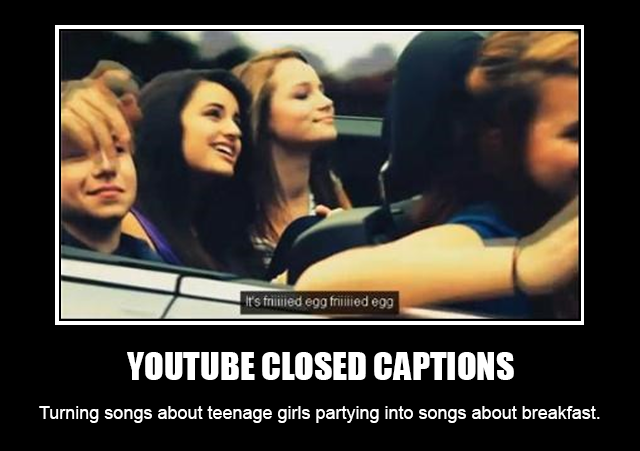
There’s a growing trend on social media and sites like Reddit and Quora to showcase captioning errors from television and numerous online platforms. As accessibility laws tighten and the quality standards for captioning on broadcasts become more rigorous, how do these bloggers have so much fuel for their posts on captioning errors? It is a simple question with many complicated answers.
Live television programming is captioned in real-time either by machines or humans working with a stenotype machine (like those used in courtrooms) and thus tends to lag slightly behind and, inevitably, will include some paraphrasing and errors. While the Federal Communication Commission requires American television stations' post-production captions to meet certain standards, the Internet is still vastly unregulated. Video-sharing websites like YouTube have struggled to provide accessible captions. Despite YouTube's recent efforts to improve accessibility, their captions continue to disappoint viewers, especially those of the deaf and hard-of-hearing community.
In a 2014 The Atlantic article called "The Sorry State of Closed Captioning," Tammy H. Nam explains why machines cannot create the same experience humans can. She posits, "Machine translation is responsible for much of today’s closed-captioning and subtitling of broadcast and online streaming video. It can’t register sarcasm, context, or word emphasis." By using machines instead of human writers and editors, sites like YouTube are not providing the same viewing experience to the deaf and hard of hearing as they are to their other patrons. Humans can understand which homophone to use based on context. There is an enormous difference between the words soar and sore, air and heir, suite and sweet. Humans can also determine when noise is important to the plot of a story and thereby include it in the captions so that a non-hearing viewer won't miss critical details. In the same Atlantic article, deaf actress Marlee Matlin says, "I rely on closed captioning to tell me the entire story…I constantly spot mistakes in the closed captions. Words are missing or something just doesn’t make sense." Accessible closed captions should follow along exactly with the spoken dialogue and important sounds so that viewers are immersed in the story. Having to decipher poor captions takes the viewer out of the flow of the story and creates a frustrating experience.
YouTube created its own auto caption software for its creators to use in 2010. The software is known for its incomprehensible captions. Deaf YouTuber and activist Rikki Poynter made a video in 2015 highlighting the various ways in which YouTube's automatic captions are inaccessible. She wrote a 2018 blog post explaining her experience with the software, "Most of the words were incorrect. There was no grammar. (For the record, I’m no expert when it comes to grammar, but the lack of punctuation and capitalization sure was something.) Everything was essentially one long run-on sentence. Captions would stack up on each other and move at a slow pace." For years, Rikki and other deaf and hard-of-hearing YouTube users had to watch videos with barely any of the audio accurately conveyed. Although her blog post highlights the ways in which YouTube's automatic captions have improved since 2015, she writes, "With all of that said, do I think that we should choose to use only automatic captions? No, I don’t suggest that. I will always suggest manually written or edited captions because they will be the most accurate. Automatic captions are not 100% accessible and that is what captions should be." The keyword is accessible. When captions do not accurately reflect spoken words in videos, television shows, and movies, the stories and information are inaccessible to the deaf and hard of hearing. Missing words, incorrect words, poor timing, captions covering subtitles, or other important graphics all take the viewer out of the experience or leave out critical information to fully understand and engage with the content. Until web resources like YouTube take their deaf and hard-of-hearing viewer's complaints seriously, they will continue to alienate them.
So, what can we do about poor web-closed captioning? Fortunately, the Internet is also an amazing tool that allows consumers and users to have a voice in the way they experience web content. Deaf and hard-of-hearing activists like Marlee Matlin, Rikki Poynter, and Sam Wildman have been using their online platforms to improve web-closed captions. Follow in their footsteps and use the voice that the web gives you. Make a YouTube video like Rikki Poynter or write a blog post like Sam Wildman's post, "An Open Letter to Netflix Re: Subtitles."
The Internet is a powerful platform in which large companies like Google can hear directly from their consumers. If you would like to see the quality of closed captions on the web improve, use your voice. Otherwise, you'll continue to see memes like this one...
Last month, the FCC amended a few sections of Title 47 CFR 79.1: the rule pertaining to closed captioning of televised video programming. The amendments, specifically to 79.1(g)(1) through (9) and (i)(1) through (2), along with the removal of (j)(4), are a follow-up to the proposed reallocation of responsibilities of the Video Programmers and Video Program Distributors first established back in early 2016. The updates to the rule reflect the final decisions on how a compliance ladder will operate when handling consumer complaints related to closed captioning quality concerns.
The ruling focuses on two different scenarios based on how the consumer may approach making a complaint. The FCC recommends filing all complaints within 60 days of the problem either directly with the FCC, or with the Video Program Distributor (VPD) responsible for delivering the program to the consumer. Depending on how the complaint is filed, the review and steps taken to correct the issue should follow the steps below.Read